NASA’s Astronomy Picture of the Day turns the Eagle Nebula’s “Pillars of Creation” into an audio experience, using sonification of Hubble and Chandra data.
A new installment of NASA’s Astronomy Picture of the Day invites the public to experience one of the sky’s most iconic star-forming regions in an unexpected way: through sound.
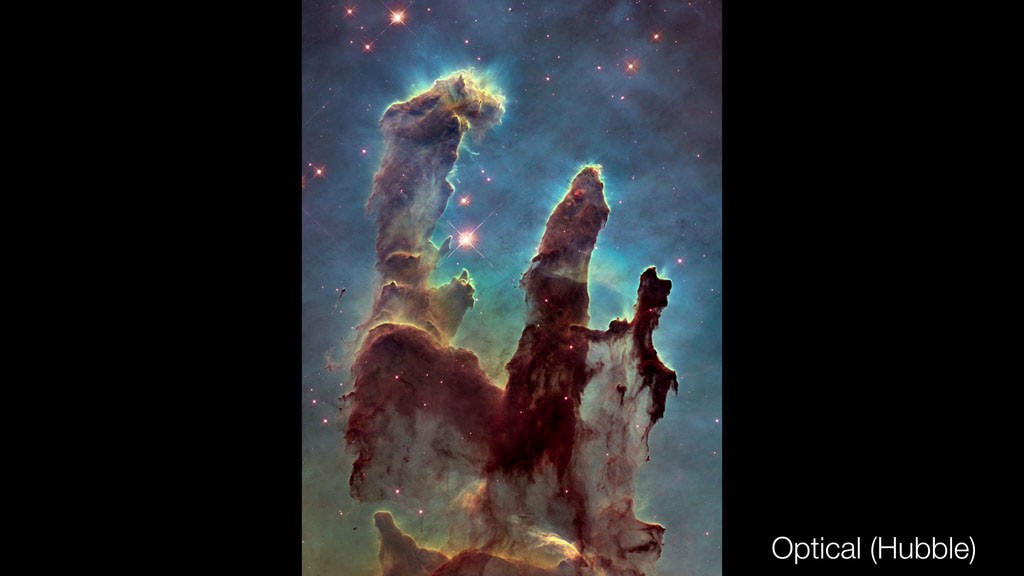
The subject is the Eagle Nebula, also cataloged as M16, a luminous cloud complex renowned for the “Pillars of Creation” — towering, dark structures that appear as silhouettes against the nebula’s bright interior. These columns, each stretching for light-years, are made of cold gas and dust and sit about 6,500 light-years from Earth in the direction of the constellation Serpens, the Serpent.
For decades, the Eagle Nebula has been a visual showpiece, revealing clusters of young stars embedded within the surrounding material. But the APOD feature asks a different question: what if the same scene could be “heard”? The accompanying video translates the image data into audio using a technique known as sonification. As an on-screen scanning line sweeps from left to right across the nebula, different elements of the scene are mapped to sound. In this rendition, vertical position in the image controls musical pitch, allowing stars and dusty structures to register as distinct tones as the scan passes over them.
The underlying imagery comes from a composite view that merges observations at different wavelengths. Visible-light detail from the Hubble Space Telescope is paired with X-ray data from the Chandra X-ray Observatory, together highlighting both the cool, obscuring dust lanes and the energetic environments around hot, massive stars. The result is a layered portrait of a region where star formation is actively reshaping its surroundings.
Those surroundings are far from tranquil. The pillars themselves have been carved by intense ultraviolet radiation and strong stellar winds blowing from a nearby cluster of massive stars in M16. That same erosion, astronomers emphasize, means the famous columns are not permanent fixtures: the forces that sculpt them are also steadily tearing them apart. In cosmic terms, the pillars are living on borrowed time.
Even as the structures face eventual destruction, the nebula provides an instructive window into the conditions that can accompany the birth of stars. APOD notes that the turbulent, radiation-filled setting inside M16 — captured in the combined Hubble-and-Chandra perspective — may resemble the kind of environment in which our own Sun formed billions of years ago.
By turning a celebrated astronomical image into an audible journey, the feature adds a new layer of engagement to a familiar target, encouraging audiences to explore how scientific data can be translated across senses without changing the underlying observations.
Why it matters
Multiwavelength images like this one reveal both cold star-forming material and high-energy activity that would be invisible in a single band, sharpening scientists’ understanding of how massive stars shape their birthplaces. Sonification broadens access to astronomy data and offers new ways to detect patterns, benefiting educators, researchers, and audiences who may not rely primarily on visual information. As these pillars continue to be studied, astronomers will keep tracking how radiation and winds from young stars influence what kinds of stars can form next.