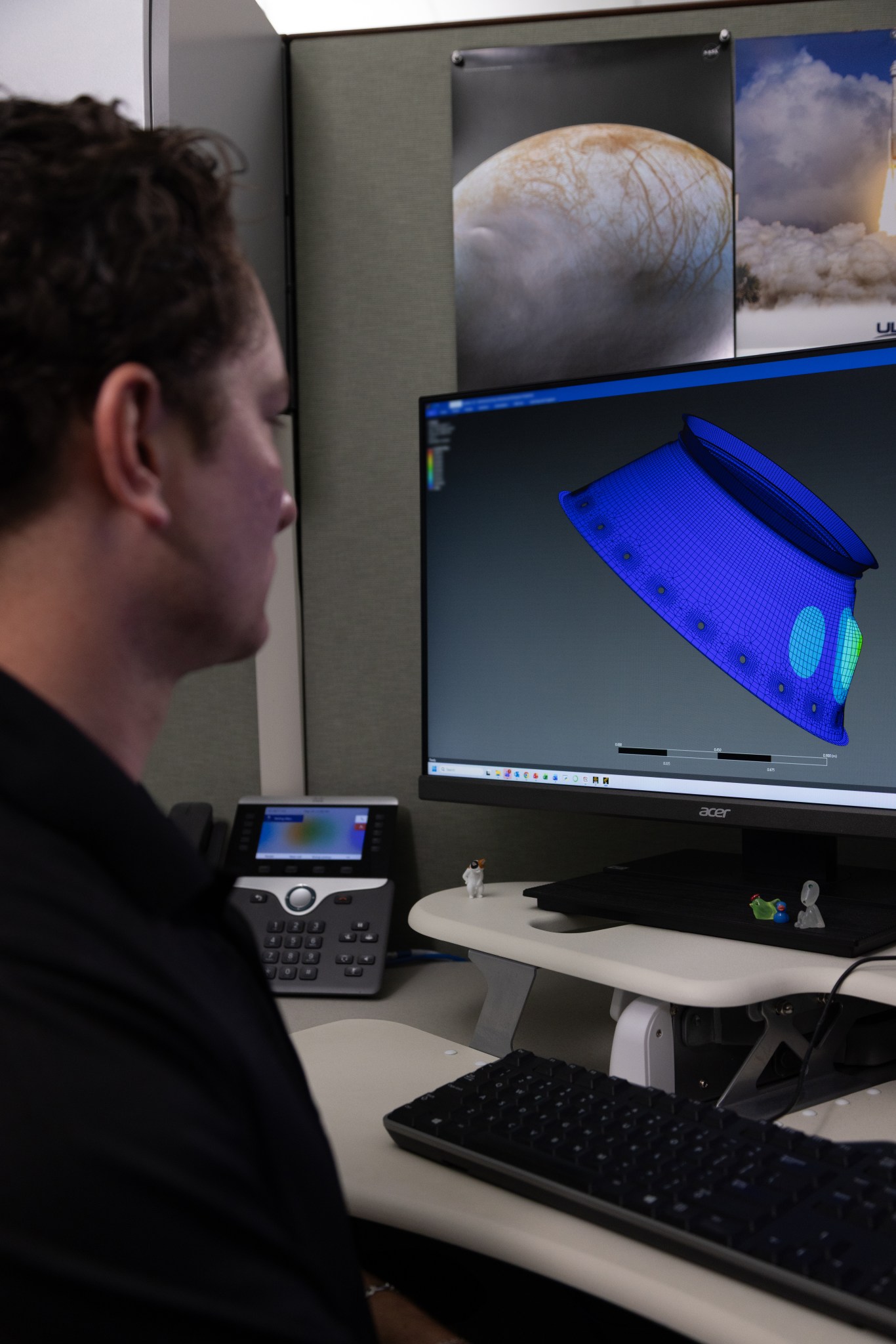
NASA engineers at Kennedy Space Center have standardized a finite element modeling workflow to better predict rocket shock and vibration, helping flag risks earlier.
Rockets endure violent physical forces on their way to space. As engines roar and the vehicle accelerates through the atmosphere, the structure can bend, rattle, and transmit intense vibration and shock—exactly the kinds of conditions that can damage sensitive scientific instruments or shorten the life of flight hardware. Long before a launch, NASA engineers work to forecast those stresses and confirm that both rockets and spacecraft will tolerate them.
At NASA’s Kennedy Space Center in Florida, engineers in the Dynamic Environments Group within the agency’s Launch Services Program Office have revamped how they perform those predictions. By adapting a commercially available digital engineering tool and formalizing a repeatable workflow, the team has built a standardized approach to finite element modeling aimed at strengthening shock and vibration analysis for launch and ascent.
“This computer-based method helps predict how rockets and spacecraft behave under extreme conditions before hardware is built and helps identify weak spots and potential failure risks early so the team can address the findings,” said Brian Beaver, chief of the Flight Analysis Division in the Launch Services Program Office at Kennedy.
Finite element analysis (FEA) is a simulation method that represents a complex structure as many smaller pieces, allowing computers to estimate how the full system will respond to specified loads. For launch vehicles and payloads, that can mean modeling how random vibration levels and shock events propagate through structures and into mounted components. The benefit is timing: problems found in analysis can be corrected on the ground, whereas issues discovered after liftoff generally cannot be repaired.
The new workflow is intended to make that capability easier to use consistently. Historically, dynamic environments engineers have often estimated shock and vibration conditions using rules of thumb or by scaling data from earlier missions. Those practices have been effective, but they depend heavily on engineering judgment and simplified assumptions. And because many engineers use FEA tools only occasionally for dynamic environments work, they can lose time re-learning specialized modeling steps each time a new analysis is needed.
The Kennedy team’s approach replaces older tools with a standardized template that guides users through key steps for evaluating vibration profiles and shock conditions. According to the engineers, this improves both speed and thoroughness, while reducing the amount of manual modeling previously required.
The group recently put the method to work during certification activities for a commercial launch provider’s rocket chosen for a NASA mission. The company supplied vibration test data, but did not include shock testing. The Dynamic Environments Group determined shock testing was necessary and used its new template to run “what-if” comparisons, visualize the rocket’s structural response, and tackle questions that previously would have required more labor-intensive modeling. The effort also helped the team confirm the provider’s flight-environment testing results and yielded additional insight into shock loads during transport.
“We are using a tool that’s existed for decades, but it’s not normally used by the dynamic environments disciplines,” said Alex Hardt, an aerospace engineer with the Launch Services Program Office at Kennedy. “But we’re changing that. We’re using it in a relatively new area of dynamics.”
Hardt emphasized that even when rockets and spacecraft are built to handle these conditions, vibration and shock can still contribute to wear—or in worst cases, failures—particularly during launch and ascent. “We define how severe the random vibration levels and shock levels are, and then we verify that all the parts going on future rockets have been tested to those levels, maximizing their longevity,” he said.
Why it matters
NASA increasingly relies on commercial launch providers, raising the stakes for consistent, rigorous verification of the physical environments payloads will face. A standardized finite element modeling workflow can help engineers spot vulnerabilities earlier, validate test programs more efficiently, and reduce risk to costly spacecraft and instruments. The next test will be how broadly the approach can be applied across different vehicles and missions, especially when key data—such as shock measurements—are missing or incomplete.