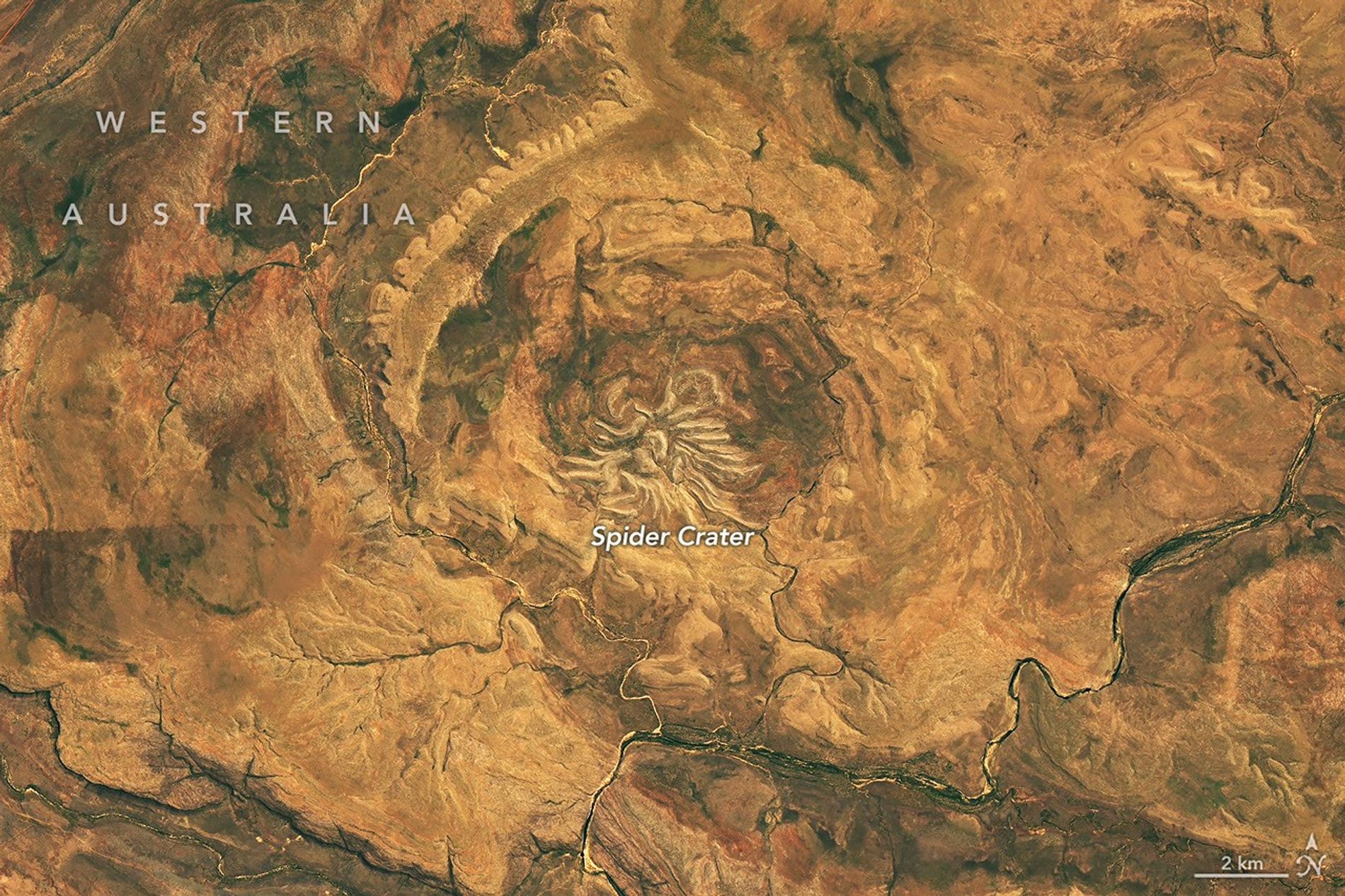
Satellite imagery spotlights Western Australia’s Spider Crater, where erosion has sculpted an ancient impact site into a striking arachnid-like pattern.
From orbit, a strange oval in Western Australia looks less like a familiar crater and more like something with limbs. The feature—known as Spider Crater—sits in the remote Kimberley region, where hundreds of millions of years of weathering have reshaped the scars of an ancient meteorite strike into an unsettling, arachnid-like pattern.
NASA’s Landsat 9 satellite captured a clear view of the structure on September 20, 2026, using its Operational Land Imager (OLI). In the image, the broader impact structure forms an oval roughly 13 kilometers by 11 kilometers (about 8 miles by 7 miles). At its center lies the “spider” itself: a lighter-toned, radial feature about 4 kilometers (2.5 miles) across that gives the crater its name.
Geologists think that central pattern is what remains of a central uplift—a raised dome created when rock rebounds upward immediately after an impact. In complex impact craters, the collision compresses the ground violently and then, in a kind of elastic response, the crater floor rises in the middle. Over immense spans of time, erosion can carve the uplifted rocks into ridges and spokes, leaving behind geometry that hints at the crater’s internal architecture long after the original rim has softened.
At Spider Crater, the pale “legs” are resistant sandstone ridges. Those ridges have outlasted surrounding layers that wore away, effectively tracing the framework of the uplift while other parts of the impact zone were stripped down by wind and water.
That interpretation did not come easily. After the feature was first identified, researchers debated its origin for decades, with some suggesting volcanic processes could explain the structure. The case shifted as geologists conducted detailed fieldwork and found shatter cones—distinctive, fan-shaped fracture patterns formed only under extreme pressures generated by powerful shock waves. At Spider Crater, those shatter cones are widespread in the central dome, providing a diagnostic signature of an impact event rather than volcanism.
Scientists have since taken the investigation into the lab. Analyses of shocked quartz and zircon crystals collected from the crater’s sandstone have offered additional confirmation of impact-related deformation. Those minerals can preserve evidence of the shock conditions and may help researchers infer aspects of the collision, including the angle at which the meteorite struck.
Pinning down exactly when the impact happened remains difficult. Based on regional geology, researchers estimate the event occurred sometime between about 900 million and 600 million years ago, placing it in the late Precambrian—an era far older than the first land animals, when Earth’s surface and atmosphere were undergoing major transitions.
The Landsat 9 view, assembled from U.S. Geological Survey data and published by NASA’s Earth Observatory, adds a striking new perspective to a long-standing geological mystery: an ancient crater whose “legs” are not biology, but the stubborn remnants of stone.
Why it matters
Spider Crater is a vivid reminder that Earth’s surface still carries readable evidence of deep-time catastrophes, even after hundreds of millions of years of erosion. Confirming and analyzing impact structures helps scientists refine how often large collisions occur and how they reshape crustal rocks. Future mineral analyses and field mapping could narrow the impact’s timing and better constrain the meteorite’s trajectory—key pieces in reconstructing Earth’s early history.