NASA’s Juno spacecraft has begun charting the hidden heat of Jupiter’s volcanic moon Io using an instrument designed to “see” below the surface.
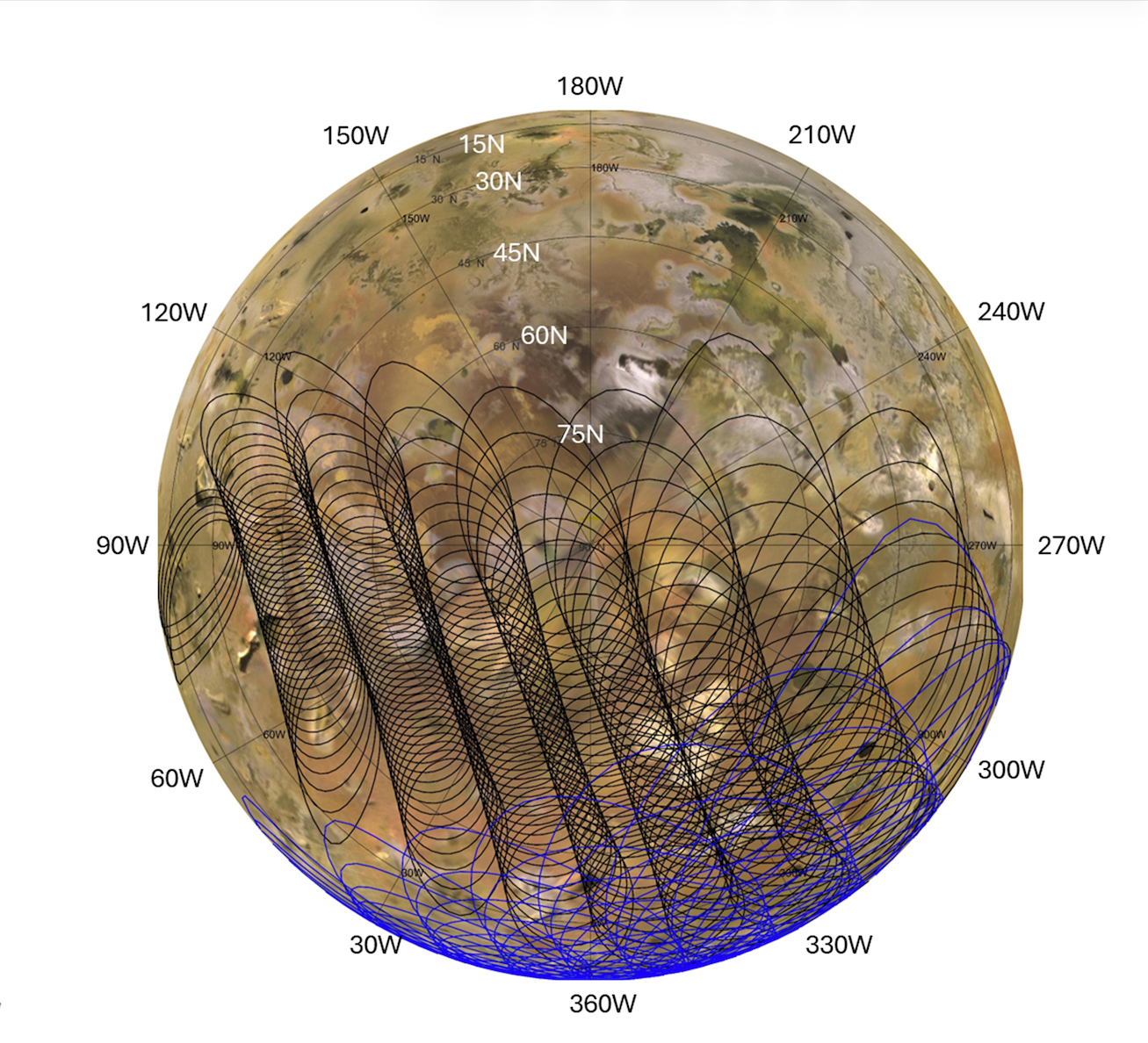
NASA’s Juno spacecraft has begun charting the hidden heat of Jupiter’s volcanic moon Io using an instrument designed to “see” below the surface. A newly released graphic shows where Juno’s Microwave Radiometer (MWR) collected data during two close encounters that brought the probe within about 930 miles (1,500 kilometers) of the moon.
The image traces the radiometer’s sampling paths as Juno swept past Io during back-to-back flybys tied to the mission’s 57th and 58th close approaches to Jupiter, known as Perijoves. During Perijove 57 on Dec. 30, 2023, Juno’s observations were weighted toward Io’s northern hemisphere. The MWR footprints from that pass are marked in black, forming a series of overlapping swaths across the terrain.
A second pass followed on Feb. 3, 2024, during Perijove 58. Those measurements, shown in blue, concentrated more strongly on the moon’s mid-latitudes and its equatorial belt. Together, the two encounters sampled the hemisphere of Io that is perpetually turned toward Jupiter—the same face locked in place by tidal forces as the moon orbits the giant planet.
The distinctive, crisscrossing pattern is produced by Juno’s rotation. The spacecraft spins at about two revolutions per minute, and as it flew past Io, the MWR’s field of view traced broad arcs across the surface. The resulting overlaps help improve coverage and allow scientists to compare measurements along intersecting tracks.
Juno is managed by NASA’s Jet Propulsion Laboratory (JPL)—a division of Caltech in Pasadena, California—for the mission’s principal investigator, Scott Bolton of the Southwest Research Institute in San Antonio. The spacecraft is part of NASA’s New Frontiers Program, overseen by the Marshall Space Flight Center in Huntsville, Alabama, for NASA’s Science Mission Directorate in Washington. JPL built the Microwave Radiometer, while Lockheed Martin Space in Denver built the Juno spacecraft and is responsible for operating it.
More information on the mission is available at nasa.gov/juno and missionjuno.swri.edu.