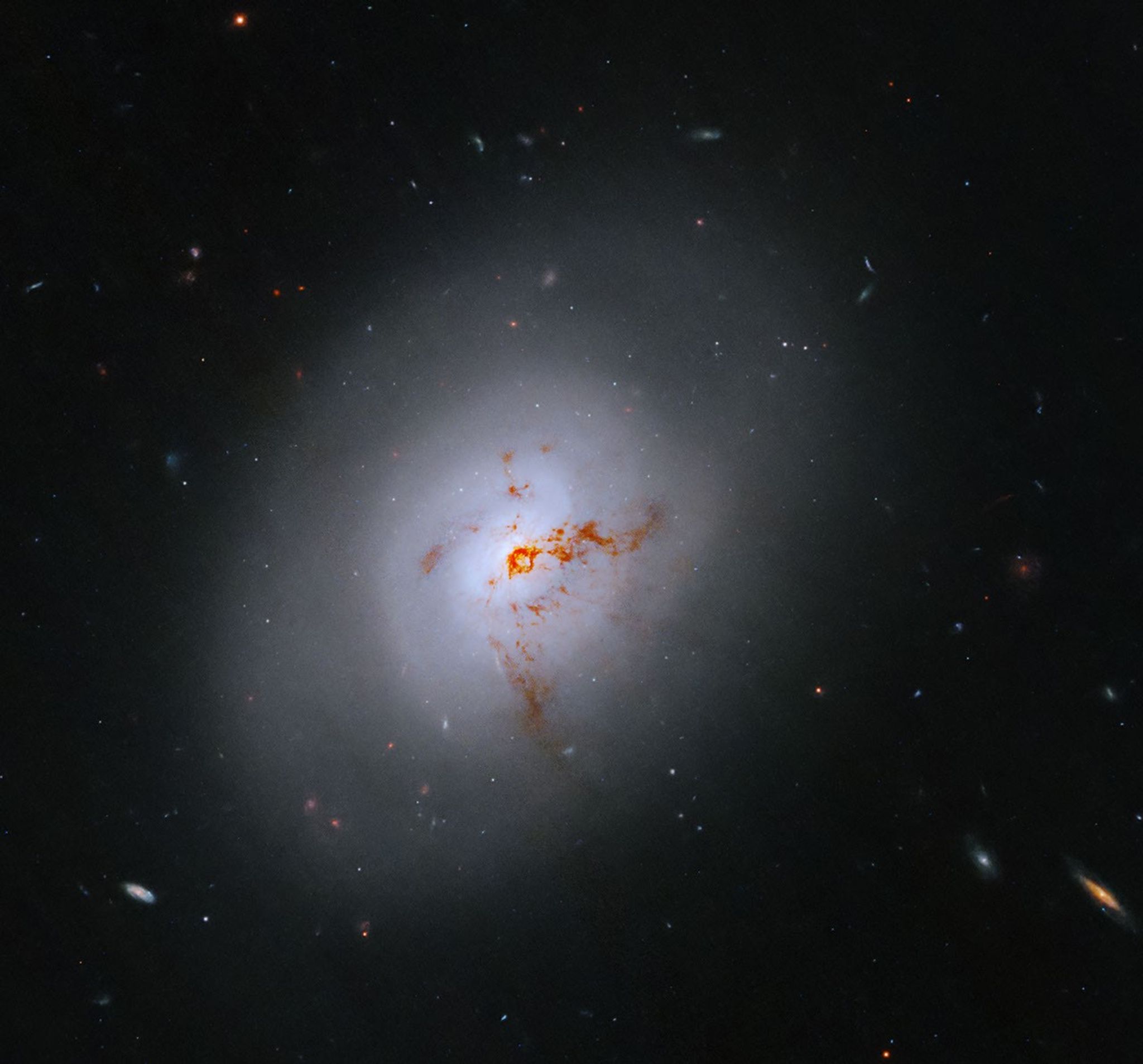
A new image from NASA’s Hubble Space Telescope spotlights a puzzling galaxy that appears to be caught between familiar cosmic identities.
A new image from NASA’s Hubble Space Telescope spotlights a puzzling galaxy that appears to be caught between familiar cosmic identities. At first glance, the system shows a brilliant central region and a disk that seems to suggest a spiral-like layout. But a closer look reveals a key absence: there are no clear spiral arms tracing their usual sweeping patterns across the galaxy’s face.
The object, known as NGC 1266, sits roughly 100 million light-years from Earth in the constellation Eridanus, sometimes called the Celestial River. Hubble’s view captures the galaxy as a partly veiled scene. Dark, reddish-brown patches and threadlike dust lanes cut across the disk, masking portions of its structure and adding to the impression that the galaxy’s appearance is in flux. Beyond the dust, the galaxy’s outer regions are comparatively faint and diffuse, allowing the light of far more distant galaxies to shine through. Those background systems—glowing in red, blue, and orange—pepper the surrounding blackness and provide a vivid sense of depth.
Astronomers classify NGC 1266 as a lenticular galaxy, a category often described as transitional. Lenticulars are thought to represent an evolutionary link between two of the most common galaxy types: spirals and ellipticals. They combine traits of both. Like spirals, they typically feature a flattened disk and a prominent central bulge. Yet, unlike spirals, they lack the distinct arm structures where gas clouds and new stars commonly collect. And in another echo of elliptical galaxies, lenticulars tend to show little to no ongoing star formation.
This mix of characteristics is why systems like NGC 1266 draw scientific attention. Lenticular galaxies offer astronomers a way to probe how galaxies can change over time—how a star-forming spiral might lose or exhaust the raw material needed to build new stars and settle into a quieter, more “red and dead” phase associated with ellipticals. Hubble’s sharp imaging helps researchers scrutinize features such as dust filaments and the distribution of light in the bulge and disk, clues that can point to past interactions, internal processes, or other events that may have reshaped the galaxy.
The image was produced from observations by the Hubble Space Telescope, with credit to NASA, ESA, and K. Alatalo (Space Telescope Science Institute), and image processing by G. Kober (NASA/Catholic University of America).