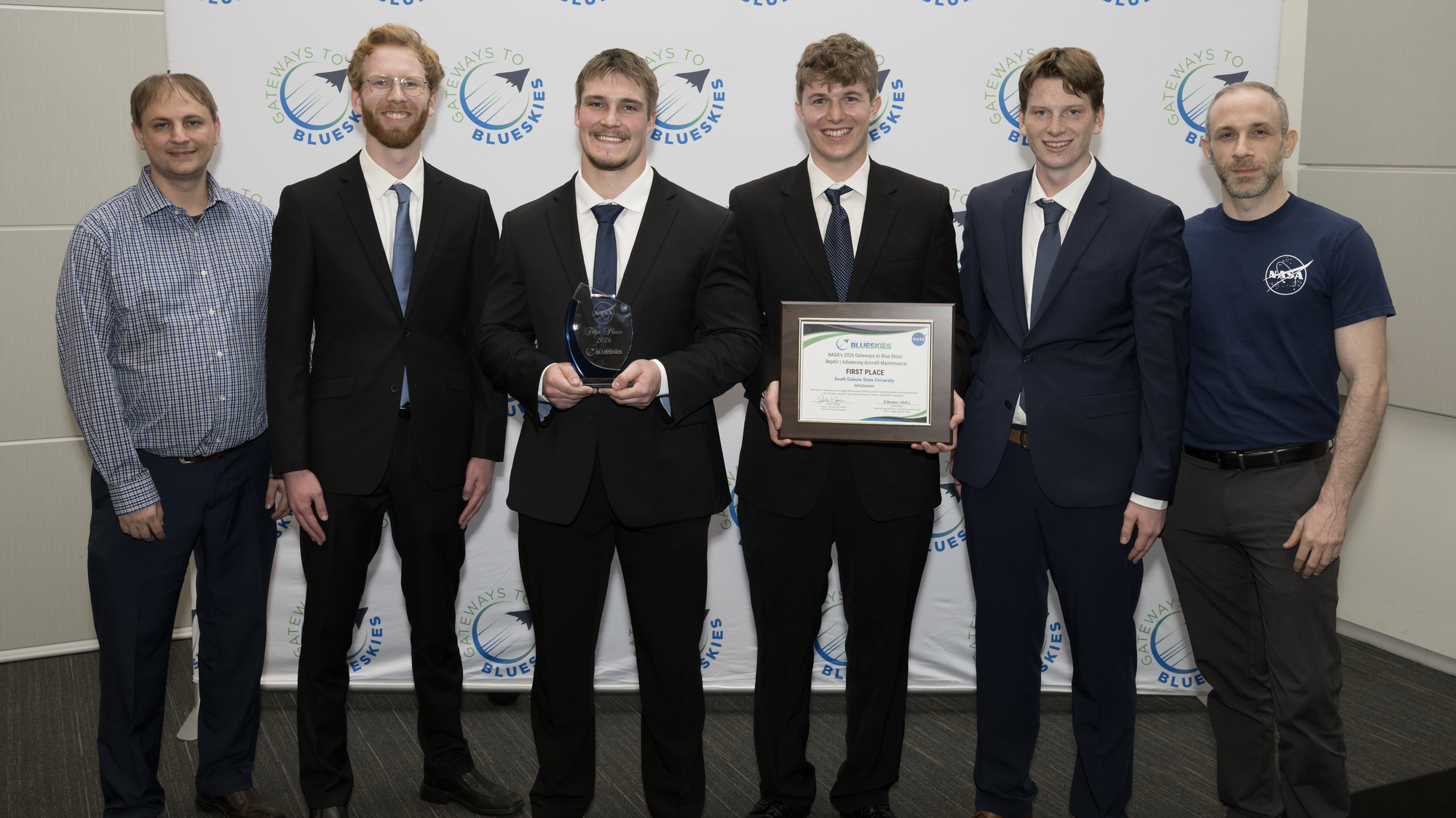
South Dakota State University has won top honors at NASA’s fifth annual Gateways to Blue Skies Competition, a university challenge focused this year on a pressing issue for U.S.
South Dakota State University has won top honors at NASA’s fifth annual Gateways to Blue Skies Competition, a university challenge focused this year on a pressing issue for U.S. aviation: keeping commercial aircraft maintained, repaired, and ready to fly.
The 2026 contest theme—RepAir: Advancing Aircraft Maintenance—asked postsecondary student teams to look ahead to 2035 and propose new tools, systems, and workplace practices that could improve how airlines and maintenance organizations handle routine servicing and repair operations. The competition is supported by NASA’s University Innovation Project within the agency’s Aeronautics Research Mission Directorate, aligning with NASA goals to spur early-stage aeronautics research ideas and help develop the next generation aviation workforce.
“This year’s finalists proposed novel ideas to equip companies and their workers with innovative technologies to help keep our nation’s planes airworthy,” said Steven Holz, associate project manager for NASA’s University Innovation Project and chair of the Gateways to Blue Skies judging panel. He noted that the concepts arrive at a moment when flight safety receives heightened attention and when staffing shortages across aviation maintenance create both obstacles and openings for change. Holz added that judges from industry and technical fields were encouraged by the potential for the student proposals—and offered guidance intended to help teams move closer to solutions that could be used in real operational settings.
The winning South Dakota State project, called WINGMAN, centered on augmented reality safety glasses designed specifically for aircraft mechanics. The system envisions hands-free support during line inspections and other daily maintenance tasks, with features such as voice-controlled access to manuals, automatic documentation, and photo recognition to assist with identifying components and recording work performed. In the team’s concept, the glasses act as a mechanic’s “wingman,” making it easier to retrieve information and complete required reporting while keeping both hands available for the job.
WINGMAN was presented at the 2026 Gateways to Blue Skies Forum, held May 18–19 at NASA’s Langley Research Center in Hampton, Virginia, alongside eight other finalist teams. A panel of subject matter experts evaluated the projects, including judges from NASA, the Federal Aviation Administration, and the aviation industry. Industry representation included Southwest Airlines and American Airlines.
Beyond the competition itself, the forum was designed as a career development opportunity. Students met and networked with NASA personnel and industry professionals, toured the Langley facility, and learned more about aviation career paths. NASA also made the event accessible to a wider audience by livestreaming the forum, with the student presentations recorded.
As part of the award, members of the first-place team will be eligible for internships during the 2026–27 academic year at one of NASA’s four aeronautics research centers: Langley in Virginia; Glenn Research Center in Cleveland; Ames Research Center in California’s Silicon Valley; and Armstrong Flight Research Center in Edwards, California.
“It was super exciting to participate in Gateways to Blue Skies, especially with the really interesting concepts this year,” said Owen Diede, the WINGMAN team lead, who credited faculty advisor Dr. Todd Letcher and design review committee members Dr. Ruyi Lian and Dr. Cody Christensen for their guidance.
NASA framed the competition against a broader industry backdrop: commercial aviation is a major pillar of the U.S. economy, yet airlines and maintenance organizations are contending with a shortage of qualified technicians while also being expected to keep aircraft operating longer. Gateways to Blue Skies is part of NASA’s Transformative Aeronautics Concepts Program, and the challenge is administered by the NASA Tournament Lab—within the agency’s Prizes, Challenges, and Crowdsourcing Program—through the National Institute of Aerospace.