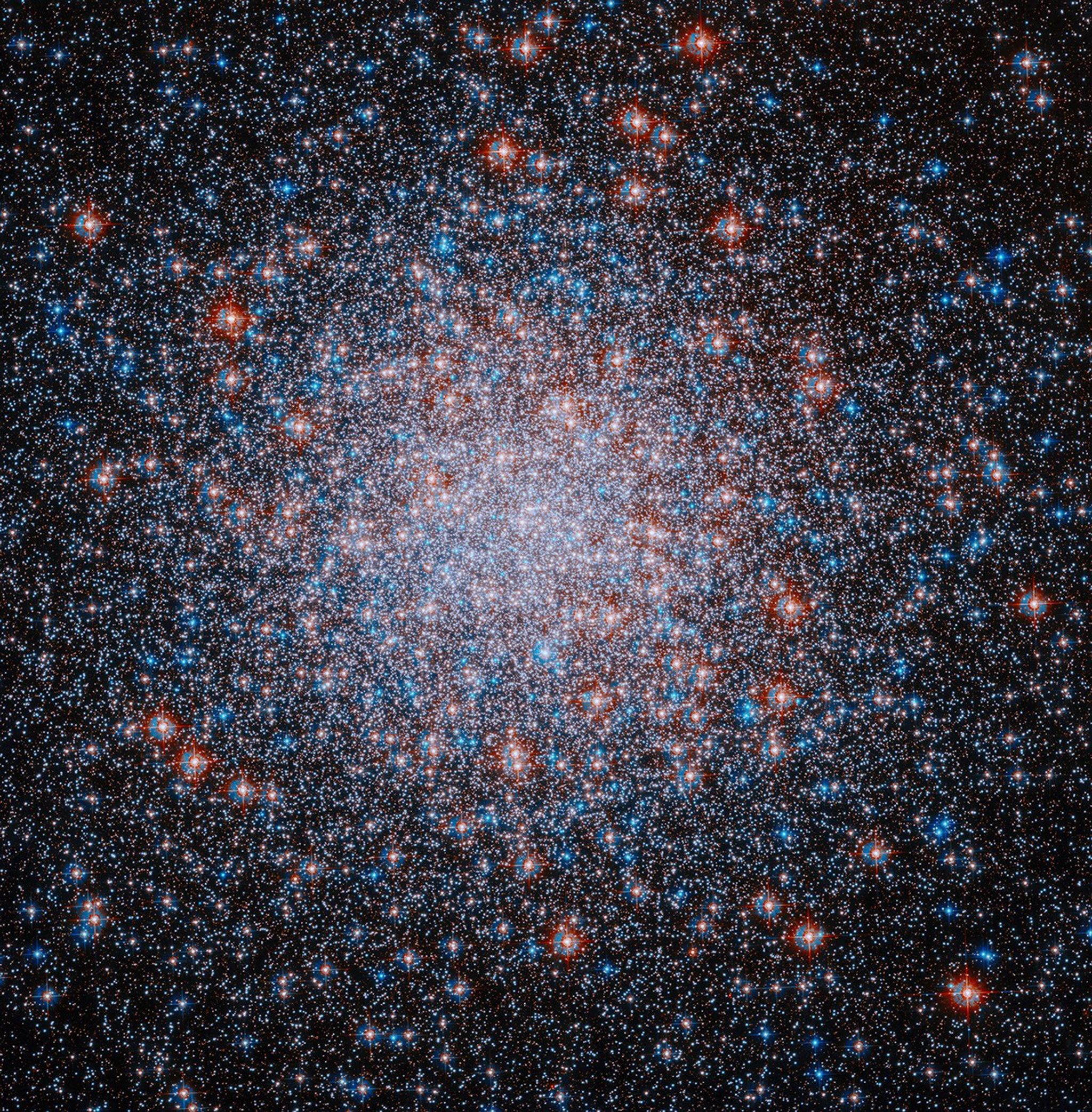
NASA’s Hubble Space Telescope has released a new view packed with more than half a million stars, timed to mark the United States’ upcoming 250th anniversary.
NASA’s Hubble Space Telescope has released a new view packed with more than half a million stars, timed to mark the United States’ upcoming 250th anniversary. The target is Messier 3, or M3—one of the Milky Way’s largest and most densely populated globular clusters, where gravity binds an immense, nearly spherical swarm of stars into a single, ancient system.
Globular clusters are stellar relics. Their stars generally formed at about the same time from the same reservoir of gas, leaving them with similar ages and chemical starting points. Astronomers have identified roughly 150 such clusters in the Milky Way, most residing in the galaxy’s outer regions. M3 stands out even among this exclusive population: despite being exceptionally massive, it sits relatively far from the galactic center and hosts an extraordinary number of a particular type of pulsating star.
That class, known as RR Lyrae variables, is especially valuable to researchers. These stars are among the galaxy’s oldest, and their brightness rises and falls in a pattern that reveals their true, intrinsic luminosity. Once that intrinsic brightness is known, astronomers can compare it to how bright the star appears from Earth to calculate distance—similar to estimating how far away a car is at night by judging the apparent intensity of its headlights. M3 contains more than 240 RR Lyrae stars, more than any other globular cluster in the Milky Way, making it a key laboratory for refining cosmic distance measurements.
Hubble’s image also highlights a second curiosity: about 70 candidates for “blue stragglers,” stars that shine with an unusually hot, blue light that makes them look younger than the typically redder, aging populations common in globular clusters. M3 was the first cluster where these odd stars were recognized. The leading explanation is that they have been “rejuvenated” by gaining mass from a companion star through gravitational interaction, effectively boosting their temperature and brightness even though their true ages remain ancient.
Some astronomers suspect M3’s peculiar mix of stellar types traces back to its origin story. The cluster contains two distinct stellar populations, a clue that it may have formed through the merger of two separate globular clusters. Those original clusters may once have belonged to the same dwarf galaxy—later absorbed by the Milky Way as our galaxy grew through mergers and accretion.
Technically, the red-white-blue appearance in the released image is produced through standard Hubble processing: blue hues represent shorter wavelengths of visible light, while reds correspond to longer visible wavelengths plus some near-infrared light, based on the filters used. Because stellar color is tied to temperature, the blue stars in the scene are hotter and the red stars cooler.
The observation is part of a Hubble Treasury program aiming to survey about half of the Milky Way’s globular clusters to assemble a more detailed timeline of how the galaxy formed. After more than three decades in orbit, Hubble remains one of NASA’s flagship observatories, working alongside missions such as the infrared-sensitive James Webb Space Telescope and the forthcoming Nancy Grace Roman Space Telescope to build an increasingly complete portrait of the universe. As part of the semiquincentennial commemoration, NASA is also sharing 13 Hubble images in a nod to the nation’s original 13 colonies.