NASA Glenn uses advanced flow and acoustic instruments to map turbofan noise, including tonal “mode” structure in ducts. Data and techniques support targeted noise-reduction designs worldwide.
Researchers at NASA’s Glenn Research Center (GRC) rely on a suite of specialized instruments to capture two things that are notoriously difficult to measure in propulsion systems: how air moves and how sound is produced. Tools such as particle image velocimetry, hot-wire anemometry, Raman spectroscopy, and sophisticated microphone systems allow teams to build detailed pictures of engine aerodynamics and acoustics. The resulting datasets don’t stay in-house—aviation noise researchers worldwide use GRC experimental results to check theoretical models and to verify noise-prediction software.
One persistent challenge is the “tone” noise that can make a turbofan sound especially irritating. Quieting that kind of narrowband noise may involve adding an advanced acoustic liner or implementing an active noise-control system tuned to the problematic frequencies. But designing the right fix requires knowing more than just how loud the tone is; engineers need to understand its modal structure—how the sound field is arranged inside the duct and how it propagates. A single stationary microphone cannot provide that information.
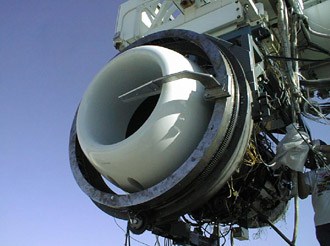
To address this, NASA Glenn engineers developed rotating-microphone measurement techniques in the 1990s. Those methods evolved into Rotating Microphone Rakes, which have since been deployed across a wide range of experiments. They have supported low-speed proof-of-concept work, including studies in the Advanced Noise Control Fan Rig and the 9- by 15-Foot Low Noise Wind Tunnel, and they have also been used in full-scale turbofan engine ground tests. By moving microphones through the sound field rather than sampling from a fixed point, these systems can extract the duct modes needed for targeted noise-reduction designs.
Another approach to pinpointing where noise originates is the use of phased microphone arrays. In these systems, microphones are arranged in one, two, or three dimensions; with proper signal processing, the combined measurements can be used to localize acoustic sources. At NASA Glenn, the Array48 microphone setup has been applied extensively to identify noise sources in scale-model jet flows, a counter-rotating open-rotor fan model, and even a full-scale F404 military engine. In parallel, NASA-funded work has produced techniques that use microphones embedded directly in an engine’s fan duct to determine where sound is generated on rotating blades—an especially difficult problem because the sources move with the rotor.
Understanding the physics behind the noise guides what must be measured. Researchers know that tonal components can arise from periodic aerodynamic interactions—for example, when the wake from a rotating fan blade strikes a downstream stator vane. They also know broadband noise can increase when an engine ingests turbulent flow. That means acoustics alone are not enough: teams must capture high-resolution velocity data upstream of the rotor, downstream of the stator, and in the space between them.
For those airflow measurements, NASA Glenn uses instruments such as hot-wire probes and Laser Doppler Velocimeters (LDV). The velocity data can be plotted to reveal flow disturbances created by the rotor, helping engineers tie specific aerodynamic features to the noise they generate. Hot-wire and LDV results are routinely used to validate the computational methods used to estimate turbofan noise.
NASA’s Glenn Research Center at Lewis Field in Cleveland, along with the Neil Armstrong Test Facility in Sandusky, Ohio, provide key ground-test capabilities supporting this work.
Why it matters
Aircraft noise affects communities near airports and constrains how, when, and where aircraft can operate. By improving the ability to locate and characterize noise sources—especially tonal components—NASA’s instrumentation work helps industry design quieter engines and strengthens the accuracy of prediction tools used across aviation. The next advances will depend on continued high-fidelity measurements that connect specific flow disturbances to the sound they produce.