When people talk about India’s economy, they almost always compare it negatively with China’s, it has not industrialized as fast, its bureaucracy is still maddening, its…
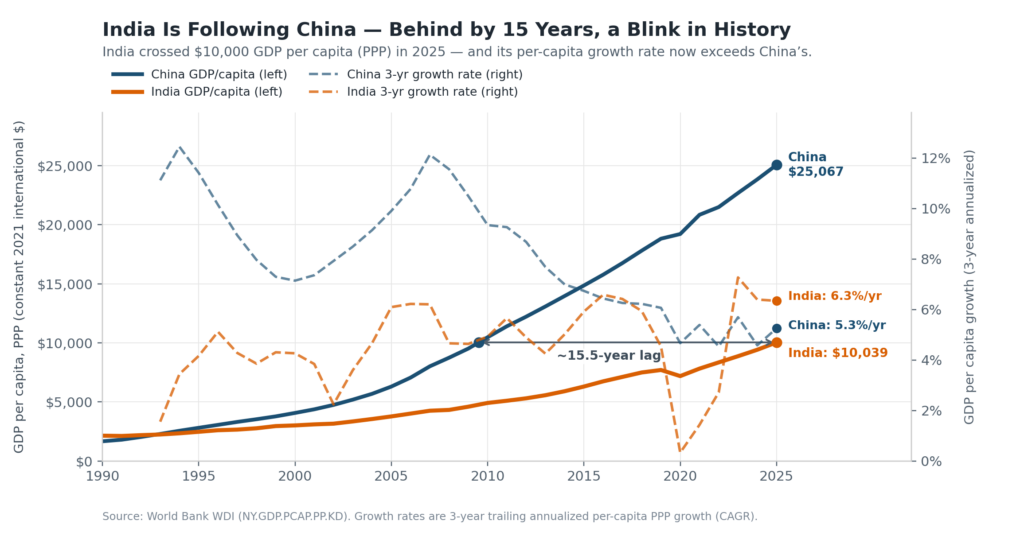
When people talk about India’s economy, they almost always compare it negatively with China’s, it has not industrialized as fast, its bureaucracy is still maddening, its cities are still choked with traffic and smog. All true. But if you step back one of the greatest stories of the twenty-first century is unfolding: India, like China before it, is on the move. India reached a GDP per capita of 20,000-per-capita middle-income country, looking more like today’s Brazil or Mexico than the India of Mother Theresa. Indeed, India’s growth has already greatly reduced the worst forms of poverty, as China’s growth did previously. Extreme poverty in India fell from 47.5 percent in 1993—and 27.1 percent as recently as 2011—all the way down to2.6 percent in 2023(using the World Bank’s extreme poverty line, $3.00 a day in 2021 PPP). Hundreds of millions of people climbed out of destitution in a single generation. Visiting India, you can see the transformation in daily life. In 2000, four in ten Indians lacked electricity and nearly three-quarters practiced open defecation. By 2024, electricity reached 99.9 percent and open defecation had collapsed from 73.2 percent to 6.7 percent. Infant mortality has fallen 72 percent since 1990, from 84.4 to 23.3 deaths per 1,000 live births, while life expectancy has climbed nearly fourteen years to 72.2 (compared to 79 in the US). India still has enormous work ahead—it needsfreer laborandland markets,cleaner air,faster courtsandmore state capacity. Of course. That is what being a rising middle-income country looks like; China in 2009 had plenty of problems too. India’s rise is part of a larger trend: the end of the big-and-poor correlation. For most of modern history, rich countries were relatively small, and when you pictured extreme poverty, you pictured a nation with a lot of people. Many observers, notably Paul Ehrlich, mistook that correlation for causation and panicked about a “population bomb.” But big and poor wasn’t causal—it was a historical contingency that a handful of smaller nations adopted capitalism first. It didn’t have to be that way, and today we are returning to historical normality: a world where gaps in GDP per capita no longer overwhelmcapita, and big countries are rich countries too. Today, none of the world’s nine largest countries are classified as low-income by the World Bank. Only Ethiopia—tenth on the list—remains in the World Bank’s low-income tier, and even Ethiopia has more than tripled its income per person since 1990. Increasingly, poverty is concentrated in smaller, fragile, and conflict-ridden states.