For more information, contact Joel W. Sills, Langley Research Center, joel.w.sills@nasa.gov Download the PDF version Complex mode shapes can emerge in a linear structure even when overall damping is low. This behavior can occur when two structural modes are closely spaced in frequency and are coupled through nonproportional damping. As the damping interaction increases, the […]
Complex-valued vibration mode shapes—often taken as a sign of substantial damping or experimental problems—can arise even in linear structures where overall damping is small, according to a new NASA technical report from Langley Research Center. The key ingredient is not “high damping” in the usual sense, but the interaction of two vibration modes that sit close together in frequency and become linked by nonproportional (non-classical) damping.
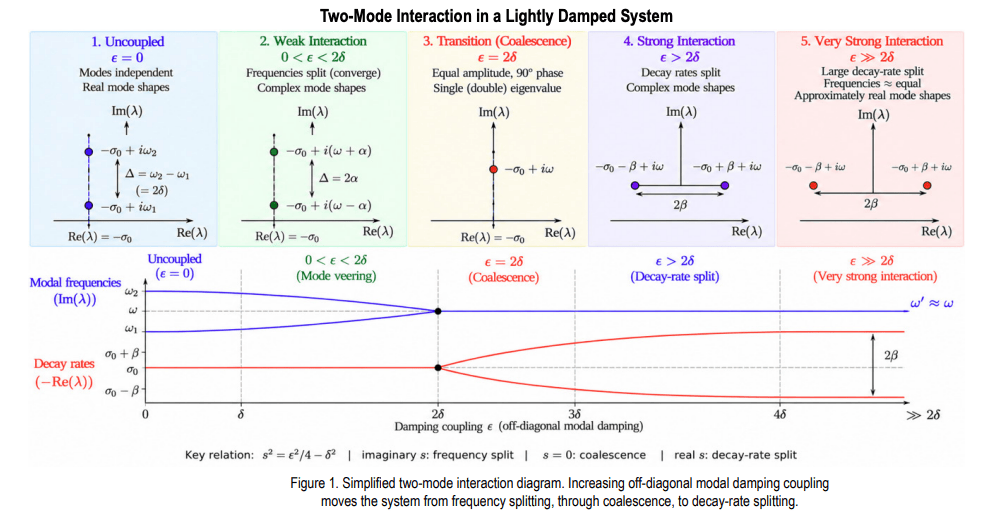
In the classical picture used in many structural dynamics workflows, lightly damped systems are treated as nearly proportional, leading to real-valued mode shapes that can be analyzed one mode at a time. That assumption can break down when two modes form a close pair. In modal coordinates, nonproportional damping introduces a coupling between the two modes that is represented by an off-diagonal term, denoted ε. The practical question becomes whether this coupling is large compared with the baseline spacing of the pair, quantified by the half-separation in frequency, δ = (ω₂ − ω₁)/2. In other words, “small damping” does not guarantee “simple modes” if ε is not small relative to δ.
The report develops a reduced perturbation approach that compresses the behavior of a close mode pair into a compact relationship. For a pair centered around a representative eigenvalue λ₀ ≈ −ζω + iω (capturing light decay and oscillation), the two coupled eigenvalues can be written as λ₁,₂ = λ₀ ± s. Under asymptotic assumptions appropriate to lightly damped, closely spaced modes, the normally more complicated quartic eigenvalue problem reduces to a single equation:
s² = ε²/4 − δ².
That expression determines how the two eigenvalues separate in the complex plane as coupling increases. When interaction is weak (0 < ε < 2δ), s is imaginary (s = ±iα), and the split is mainly vertical—meaning the modes separate primarily in frequency. As ε grows, the two frequencies “veer” toward one another and the mode shapes become increasingly complex, a pattern that can look counterintuitive in a lightly damped structure.
At the threshold ε = 2δ, the model predicts a critical condition where the two frequencies coalesce. Past that point (ε > 2δ), s becomes real (s = ±β), and the split rotates to a predominantly horizontal separation: the frequencies remain approximately the same while the decay rates diverge, producing “decay-rate splitting.” In the limit of very strong interaction, the mode shapes tend to become nearly real again—yet they are no longer the original uncoupled shapes, instead emerging as different combinations of the two baseline modes.
Beyond explaining a set of phenomena—mode veering, complex mode formation, eigenvalue coalescence, and decay-rate splitting—the work offers guidance for engineers interpreting test results. Complex mode shapes identified in experiments should not automatically be blamed on heavy damping, nonlinear behavior, or poor data quality. For close modal pairs, the report recommends examining the identified complex poles together with phase relationships in the mode shapes: frequency convergence with near-quadrature modal components aligns with the imaginary-s regime, while nearly equal frequencies paired with separated decay rates indicates the real-s regime.
The framework also connects analysis and testing through measurable quantities. The parameter s can be computed directly from identified poles via s = (λ₁ − λ₂)/2, while δ can be estimated from uncoupled or pre-test analytical predictions of modal spacing. Together, these values can be used to estimate the effective interaction strength and how close a structure is to the transition boundary at ε = 2δ.
The work is detailed in Emergence of Complex Modes in Lightly Damped Structural Systems: A Reduced Perturbation Framework (NASA/TM-20260007553, August 2026) by A. Majed, E. E. Henkel, and J. W. Sills. NASA Langley’s Joel W. Sills is the point of contact (joel.w.sills@nasa.gov).
Why it matters
Aircraft, spacecraft, and many engineered structures are designed and tested under the assumption that light damping yields straightforward, real mode shapes—yet close mode pairs can violate that assumption and complicate diagnostics. This model gives engineers a simple yardstick for when complex modes are expected and how to interpret them, reducing the risk of mislabeling valid physics as “bad test data.” Next to watch is whether the approach becomes integrated into routine modal test analysis and design verification for structures where closely spaced modes are common.