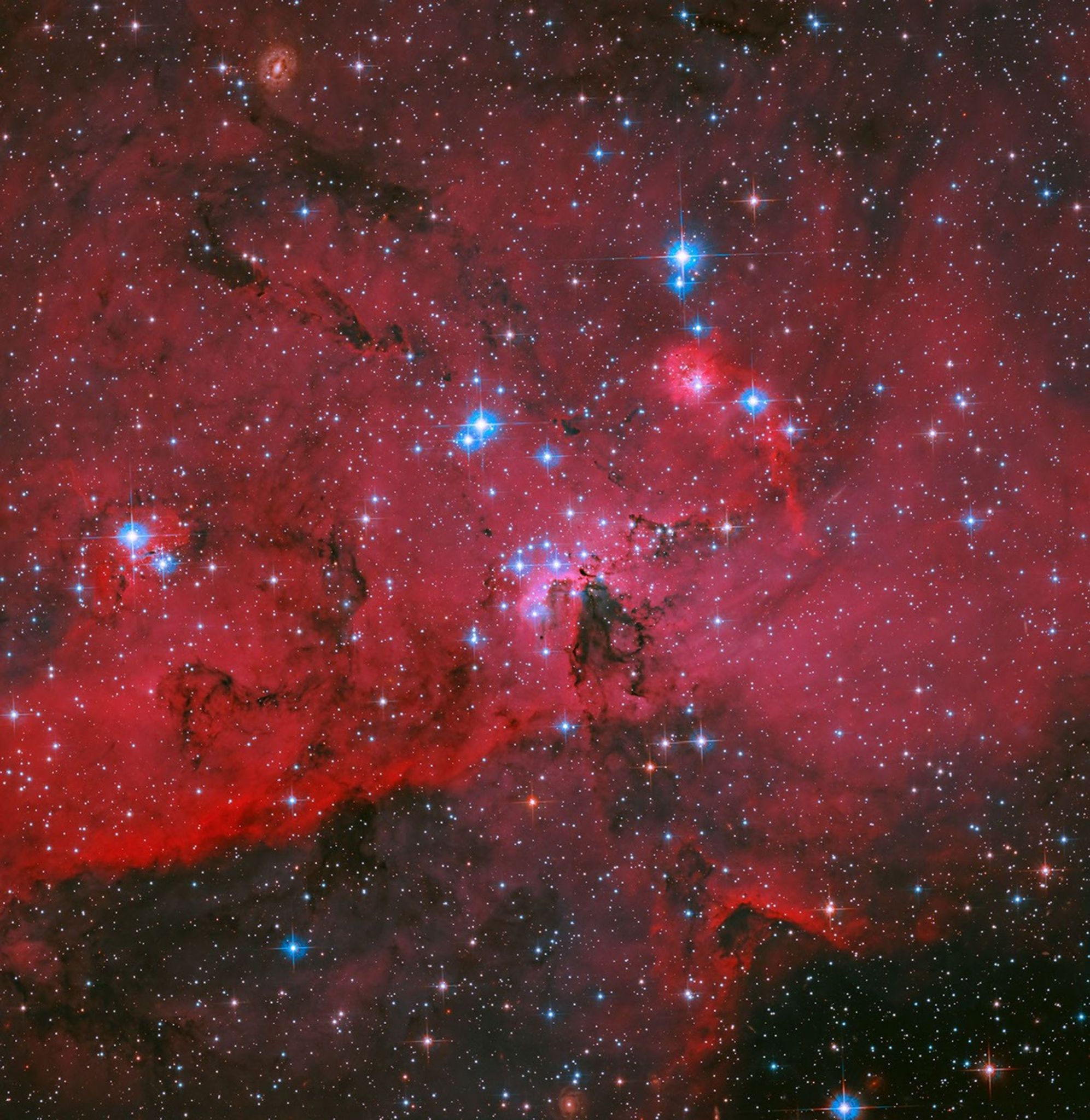
NASA’s Hubble Space Telescope has captured a striking view of the stellar nursery known as LH 95, where bright blue and white stars appear set against a deep crimson haze of glowing gas.
NASA’s Hubble Space Telescope has captured a striking view of the stellar nursery known as LH 95, where bright blue and white stars appear set against a deep crimson haze of glowing gas. The image, released July 3, 2026, highlights a busy pocket of star formation within the Large Magellanic Cloud, a small satellite galaxy that orbits the Milky Way.
LH 95 is part of a broader web of star-forming regions scattered across the Large Magellanic Cloud. In this particular scene, Hubble reveals a mix of stellar residents at very different stages and masses. Nestled in the same neighborhood are low-mass young stars—still in the earliest chapters of their lives—alongside massive, hot blue giant stars that shine intensely and dominate the surrounding light. Astronomers refer to such groupings as a stellar association: a loosely bound collection of stars that formed in roughly the same region and timeframe but can span a range of sizes and evolutionary paths.
The red background seen in the image is produced by gas energized by the radiation of nearby stars. As ultraviolet light from the hottest stars interacts with surrounding material, it can cause the gas to glow, painting the scene in warm tones that contrast strongly with the cooler-looking blue-white starlight. The result is a vivid portrait of the interplay between newborn stars and the cloud from which they emerged.
The image credit goes to NASA and the European Space Agency, with scientific contributions from N. Da Rio of The University of Virginia, G. De Marchi of the European Space Agency’s ESTEC center, and D. Gouliermis of Heidelberg University. The processing was carried out by Gladys Kober of NASA and the Catholic University of America.