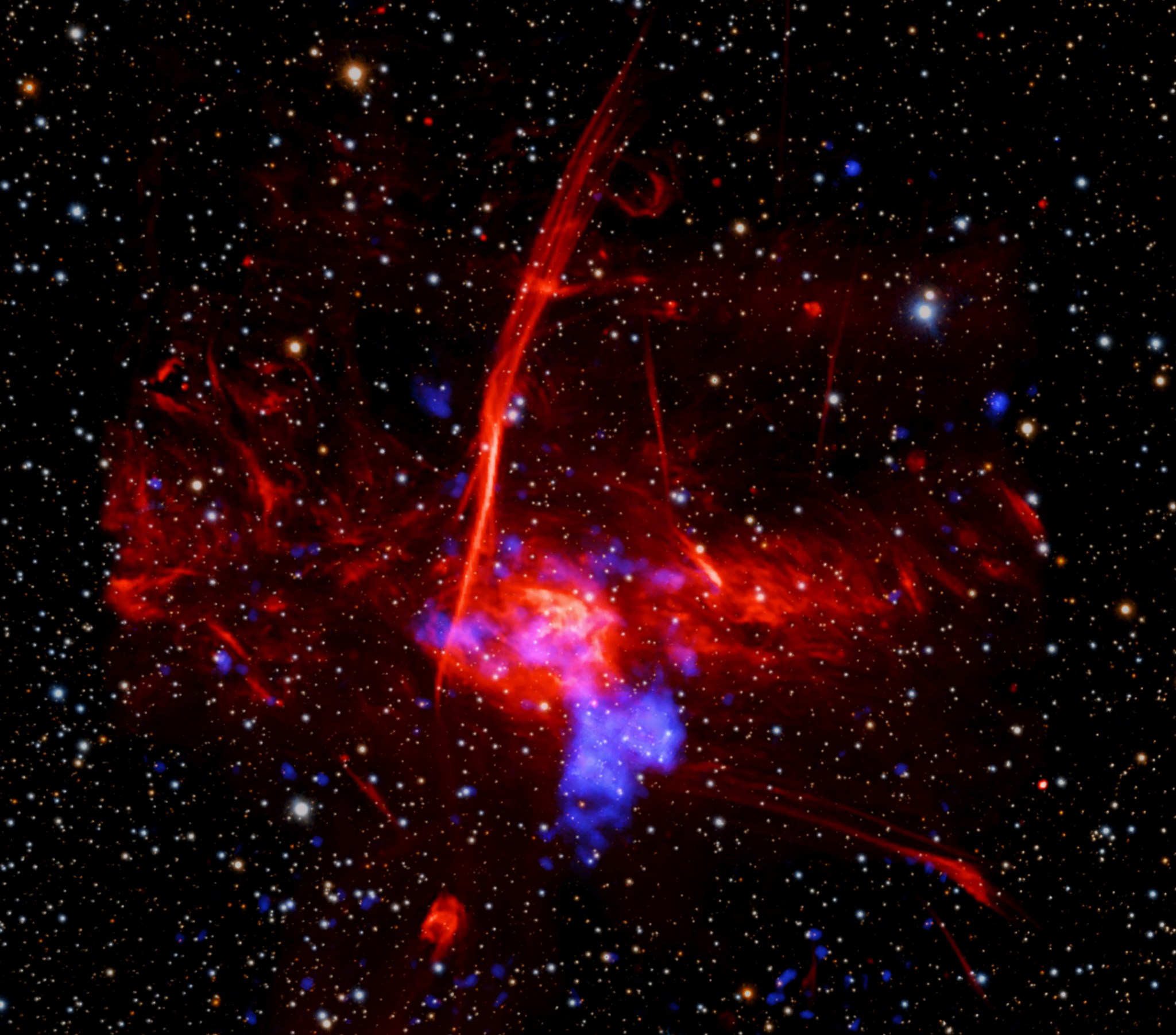
Astronomers analyzing observations from NASA’s Chandra X-ray Observatory have identified what may be a previously unknown supernova remnant in a particularly fascinating part of the Milky Way.
Astronomers analyzing observations from NASA’s Chandra X-ray Observatory have identified what may be a previously unknown supernova remnant in a particularly fascinating part of the Milky Way. The candidate object appears in an image released June 11, 2026, and represents the possible aftermath of a star that ended its life in a powerful explosion.
Supernova remnants are created when the debris from an exploded star continues to expand outward into surrounding space. Over time, these structures seed their environment with heavy elements forged in stellar interiors and during the explosion itself—materials such as iron, oxygen, and silicon. Those elements are essential building blocks for rocky planets and for the chemistry that makes life possible, making supernova remnants key contributors to the Galaxy’s long-term evolution.
What makes this potential discovery especially notable is its location. If further study confirms that the object is indeed a supernova remnant, it would rank among the closest known remnants to the Milky Way’s central supermassive black hole. The Galactic Center is an extreme and crowded region, far different from the quieter neighborhoods around the Sun. It is packed with massive stars, contains long, filament-like structures associated with magnetic fields, and hosts dense clouds of gas that move swiftly in tight orbits around the center of the Galaxy.
The image highlighting the candidate remnant draws on more than Chandra’s X-ray data alone, combining multiple views of the region to build a richer picture. Alongside Chandra, observations from ESA’s XMM-Newton helped provide additional X-ray context, while optical data from PanSTARRS, radio measurements from MeerKAT, and infrared observations from the James Webb Space Telescope (NASA/ESA/CSA) contributed complementary information. The final visualization was assembled through image processing at NASA’s Chandra X-ray Center.
Researchers emphasize that the object remains a “possible” supernova remnant pending confirmation, but its proximity to the Galactic Center makes it a compelling target. Establishing the presence of a remnant so near the supermassive black hole would offer an opportunity to study how the violent death of a star interacts with one of the most unusual environments in the Milky Way—an area shaped by intense gravity, energetic stellar populations, magnetic structures, and rapidly moving gas.