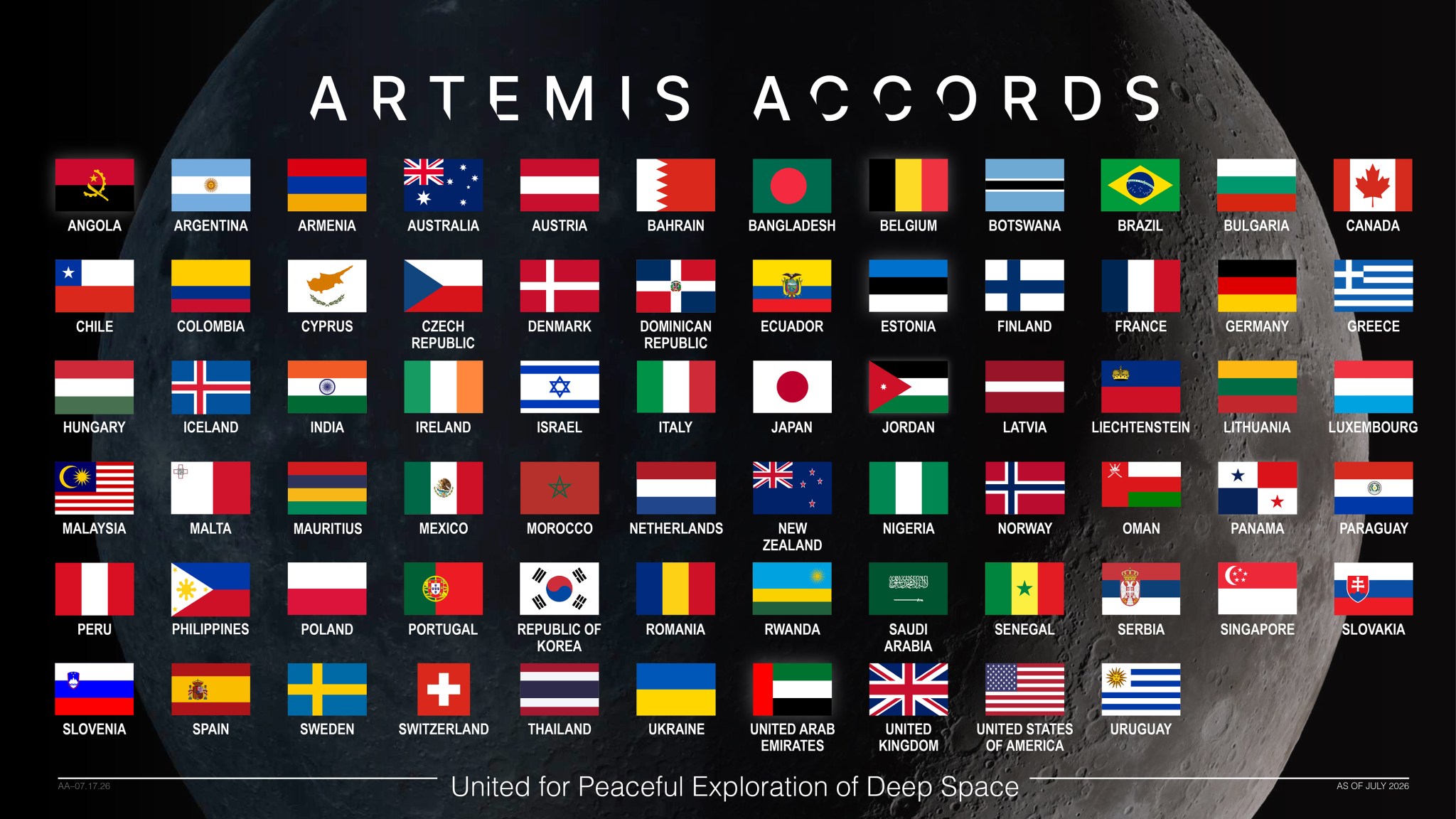
Mauritius has become the 70th nation to sign the Artemis Accords, joining an expanding international group that pledges to support responsible, transparent, and peaceful exploration of space.
Mauritius has become the 70th nation to sign the Artemis Accords, joining an expanding international group that pledges to support responsible, transparent, and peaceful exploration of space. The island nation is the seventh country in Africa to adopt the framework, which NASA and the U.S. Department of State launched to help guide civil activity on the Moon, Mars, and other destinations as interest in lunar missions accelerates.
The signing ceremony took place Friday in Ébène, where NASA Deputy Administrator Matt Anderson delivered remarks by video. Anderson said NASA welcomed Mauritius into the Accords community and emphasized that future exploration will depend on capable partners who share a commitment to norms that keep space open and beneficial. He also reiterated the agency’s goal of returning Americans to the Moon, describing the effort as part of a new era of discovery that requires international cooperation.
Mauritius signed through Navindsing Jugmohunsing, the permanent secretary at the country’s Ministry of Tertiary Education, Science and Research. U.S. officials attended as witnesses, including Sarah Troutman, the deputy assistant secretary of state for African affairs, and Craig Halbmaier, the U.S. chargé d’affaires to Mauritius.
Jugmohunsing framed the decision as a milestone in what he called Mauritius’ “New Space” trajectory. As a Small Island Developing State in the Indian Ocean, he said, Mauritius wants space-based capabilities to serve broad public interests—particularly monitoring and protecting oceans and coastlines—and to ensure that smaller nations have a voice as rules for space activity evolve. He added that Mauritius intends to contribute to future space governance while pursuing new opportunities for research, innovation, and international partnerships.
NASA’s relationship with Mauritius predates the Artemis program by decades. The agency first worked with the country during early global mapping efforts, taking advantage of Mauritius’ strategic location. From 1965 to 1980, NASA flew multiple satellite missions to improve measurements of Earth’s size and shape—data essential to geodesy. To support that work, NASA teams operated in Mauritius and at other international tracking sites, collecting satellite photography used for geodetic analysis. Those observations, NASA has noted, helped strengthen navigation techniques that underpinned missions from Apollo to today’s Artemis-era planning.
The Artemis Accords were established in 2020 by NASA and the State Department together with seven founding countries. The initiative emerged amid rising government and commercial interest in lunar activities, and it set out practical principles meant to improve safety, transparency, and coordination among participating nations as exploration expands outward from Earth.
NASA says it is now moving from principles to practice. Five years after the Accords were introduced, President Donald J. Trump’s National Space Policy directed NASA to build a sustained lunar outpost. The agency characterizes the envisioned Moon base as a vehicle for implementing the Accords, inviting all signatories—now including Mauritius—to participate. NASA expects additional countries to join in the coming months and years as it pursues what it describes as a safe, peaceful, and prosperous future in space.