NASA and Boeing have wrapped up a new round of wind-tunnel experiments aimed at answering a fundamental question in future airliner design: can an unconventional wing…
NASA and Boeing have wrapped up a new round of wind-tunnel experiments aimed at answering a fundamental question in future airliner design: can an unconventional wing architecture dramatically cut fuel burn without sacrificing practical performance?
The teams are studying a truss-braced wing—an ultra-long, slender wing reinforced by streamlined structural struts. By allowing a wing to be thinner and more extended than today’s typical airliner wings, the configuration promises better aerodynamic efficiency and, in turn, lower fuel consumption and operating costs. But the approach is not a minor refinement. At the scale of a commercial passenger jet, adopting such a wing would amount to a major redesign that demands careful validation of airflow behavior, loads, and performance across different phases of flight.
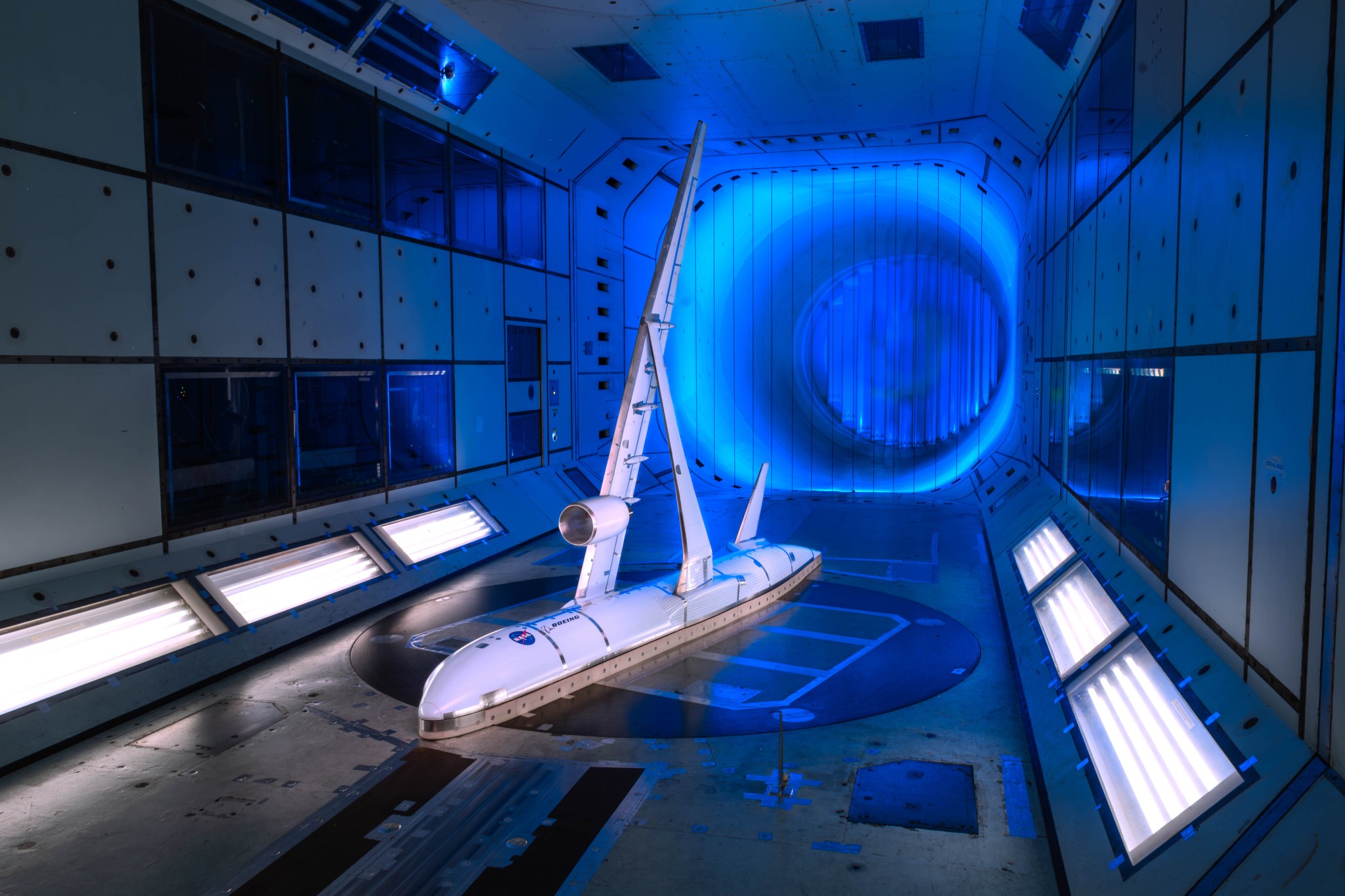
The latest tests relied on an intricate wind-tunnel model designed to capture both how air moves around the truss-braced wing and the forces the wing would experience in real-world operation. Engineers used a semispan setup—effectively half of an aircraft—mounted to the wind tunnel floor, a standard method for obtaining high-quality aerodynamic data while keeping models and facilities manageable.
Crucially, the model includes mechanisms that replicate the high-lift devices used by airliners during takeoff and landing. By changing the positions of slats, flaps, and other movable control surfaces, researchers can shift the model into low-speed, high-lift configurations representative of those critical flight conditions, when wings must generate maximum lift at relatively low airspeeds.
The work supports Boeing’s Subsonic Ultra Green Aircraft Research (SUGAR) concept, an effort focused on technologies that could significantly reduce the environmental and economic costs of subsonic transport. In December, NASA and Boeing teams completed the most recent test campaign at a QinetiQ-operated wind tunnel in Farnborough, England. That facility’s large, pressurized tunnel can reproduce conditions useful for predicting aircraft behavior during takeoff and landing. Its scale also improves the “fidelity” of the measurements—helping engineers translate model data into more confident expectations for how a full-size aircraft would perform.
During the campaign, NASA and Boeing specialists monitored results as data came in, verifying in real time that the model and instrumentation were behaving as intended. While detailed analysis is still underway, the testing has already added important information to a growing research base intended to support future fuel-saving airframe designs.
This experiment is only one step in a broader series of investigations. NASA and Boeing have been evaluating the truss-braced wing at multiple NASA facilities, accumulating datasets that, together, aim to build a comprehensive picture of the concept’s aerodynamic characteristics and practical viability.
The collaboration also illustrates NASA’s role in nurturing early-stage aeronautics innovations that can ultimately feed into commercial aviation. The transonic truss-braced wing idea emerged from NASA-supported aeronautics research, and NASA and Boeing engineers have advanced it through iterative testing designed to move the design from theory toward an aircraft-ready configuration. The effort began under NASA’s Advanced Air Vehicles Program and is continuing within the Subsonic Flight Demonstrator project, part of the agency’s Integrated Aviation Systems Program in the Aeronautics Research Mission Directorate.