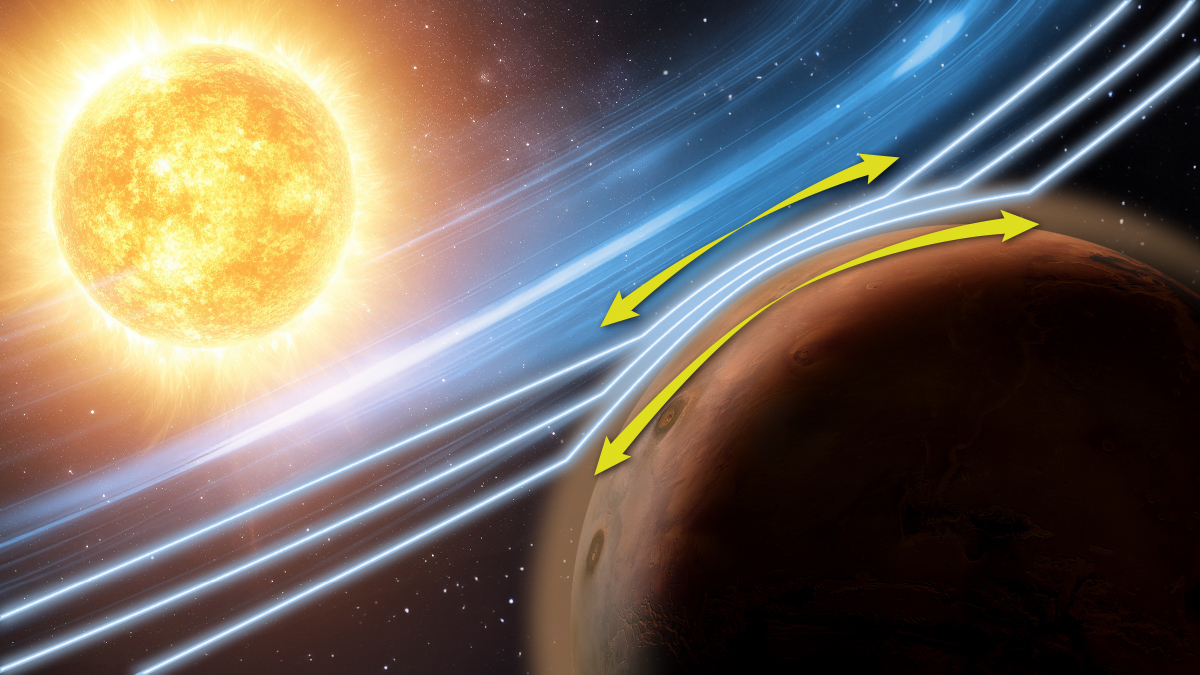
In late 2023, researchers poring over measurements from NASA’s Mars Atmosphere and Volatile Evolution MAVEN spacecraft noticed something in the Red Planet’s upper air that didn’t fit any familiar pattern.
In late 2023, researchers poring over measurements from NASA’s Mars Atmosphere and Volatile Evolution (MAVEN) spacecraft noticed something in the Red Planet’s upper air that didn’t fit any familiar pattern. The signal appeared as subtle but persistent fluctuations—“wiggles,” as the team described them—in the magnetic field data collected as the spacecraft passed through Mars’ ionosphere. What began as a curiosity has now become a first: evidence that a well-known space-physics process seen around Earth can also occur deep within a planetary atmosphere.
The new analysis, published in Nature Communications, reports the first comprehensive observations at Mars of the Zwan-Wolf effect, a phenomenon first identified in 1976. At Earth, it occurs in the magnetosphere, where charged particles are forced along magnetic structures called flux tubes and effectively squeezed and redistributed—an action often compared to pushing toothpaste through a tube. This process plays a role in shaping how the solar wind diverts around our planet and has been investigated for decades in near-Earth space.
Mars, however, is a very different target. The planet lacks a global, Earth-like magnetic field, leaving its atmosphere far more exposed to the changing conditions of the Sun. That makes the new result striking: MAVEN detected signatures consistent with the Zwan-Wolf effect not in a broad magnetospheric cavity, but within the Martian ionosphere—an electrically charged region of the atmosphere lying below about 200 kilometers altitude.
Christopher Fowler, a research assistant professor at West Virginia University in Morgantown and lead author of the study, said the meaning of the fluctuations was not obvious at first. After spotting the unusual patterns, the team turned to multiple MAVEN instruments to reconstruct the charged-particle environment where the spacecraft was flying. Those cross-checks revealed additional anomalies that suggested particles were being compressed and spread around the planet in a coordinated way.
The key to the puzzle was Mars’ induced magnetosphere—a magnetic field generated when the solar wind interacts with the ionosphere. Unlike Earth’s relatively stable magnetic shield, this induced system can expand, contract, and deform dramatically during major space-weather disturbances. That flexibility proved crucial in the December 2023 interval the scientists examined: a large solar storm struck Mars, and the resulting upheaval appears to have intensified the effect enough for MAVEN to detect it clearly.
The researchers conclude that the Zwan-Wolf effect may be operating in the Martian ionosphere much of the time, but typically at levels too subtle for the spacecraft’s instruments to pick out. The solar storm likely acted as a natural amplifier, turning a faint, persistent process into an observable signature. “No one expected that this effect could even occur in the atmosphere,” Fowler said, emphasizing that the finding points to previously unexplored physics and a new pathway by which the Sun can reshape atmospheric dynamics at Mars.
Beyond Mars, the discovery may help scientists anticipate similar behavior at other worlds without strong intrinsic magnetic fields, including Venus and Saturn’s moon Titan. It also underscores practical concerns: severe space-weather events can alter the environment around Mars in ways that could matter for spacecraft and surface assets.
“Knowing how space weather interacts with Mars is essential,” said Shannon Curry, MAVEN principal investigator and a research scientist at the University of Colorado Boulder’s Laboratory for Atmospheric and Space Physics, noting that MAVEN’s long-running dataset continues to reveal new connections between the Sun and the Martian atmosphere.
MAVEN launched in November 2013 and entered orbit around Mars in September 2014, with a mission focused on understanding how the planet’s atmosphere has evolved—and how the solar wind continues to influence it today.