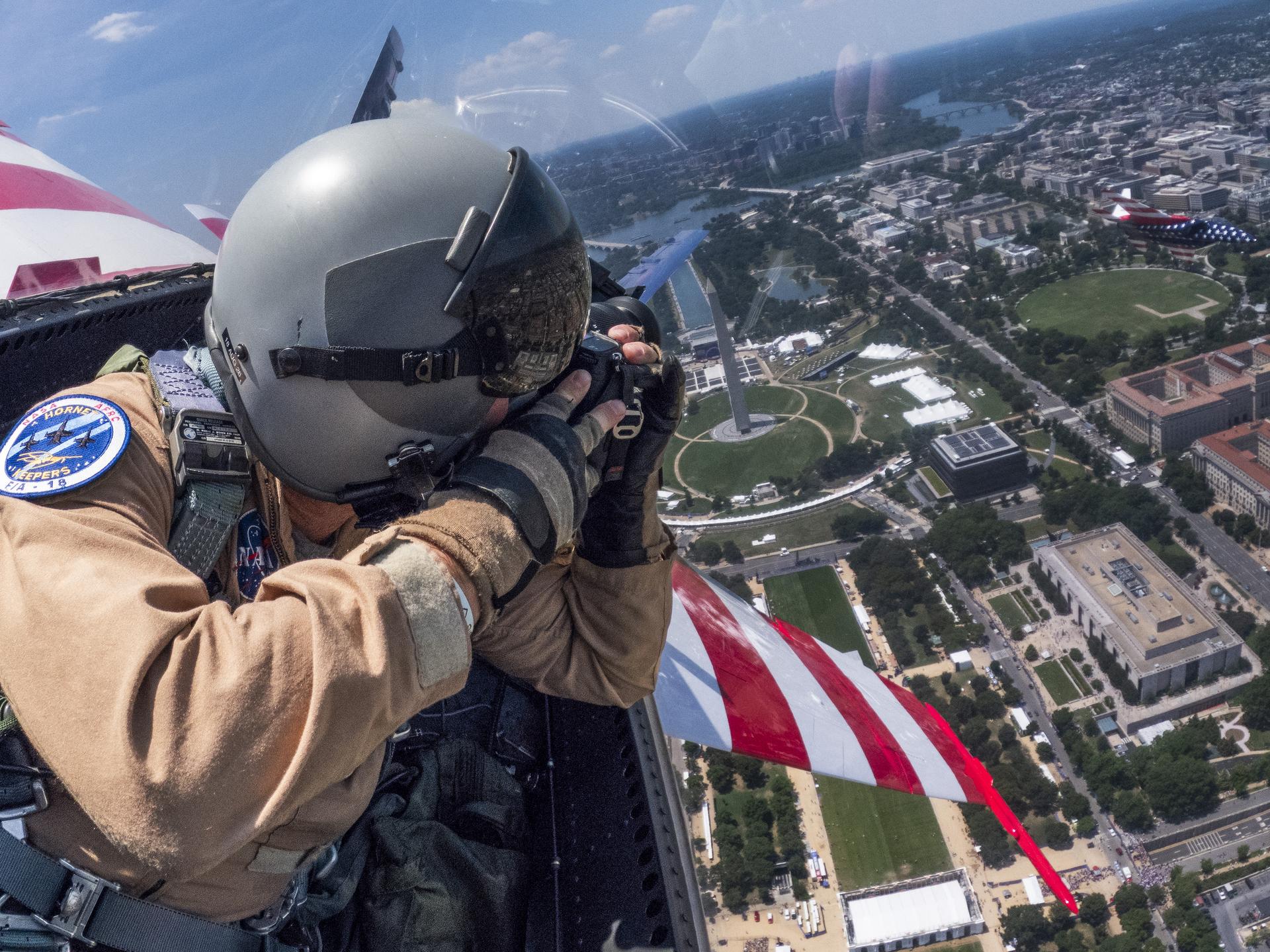
From the cockpit of a high-performance jet, NASA’s flight photographers record the agency’s work in a way that few people ever see.
From the cockpit of a high-performance jet, NASA’s flight photographers record the agency’s work in a way that few people ever see. Their assignments place them alongside research aircraft and spacecraft operations, producing images that serve both as technical documentation and as a public window into NASA missions that are otherwise out of view.
That unusual vantage point recently took NASA photographer Jim Ross above Washington, D.C., during Fourth of July celebrations, where he photographed a NASA flyover tied to America’s 250th birthday commemoration. Flying in an F‑18, Ross captured the scene from above as aircraft crossed the skies near the National Mall—an angle that turns a familiar national event into a visual record of NASA’s presence in the moment.
Ross, who works at NASA’s Armstrong Flight Research Center in Edwards, California, is no stranger to milestone missions. Over nearly four decades, he has photographed some of the agency’s most memorable aviation moments, including early flights of the SR‑71 and the delivery journey that carried Space Shuttle Endeavour to Los Angeles. More recently, he has been involved in documenting the first flights of NASA’s X‑59, the agency’s quiet supersonic research aircraft designed to advance technologies aimed at reducing the disruptive sonic boom.
For Ross, the Washington flyover was also a personal marker in a career built around being in the right place—often a rare place—at the right time. He reflected on how unlikely such opportunities once seemed. Growing up in Bozeman, Montana, back when he considered it a small town, he said he would have struggled to imagine that one day he’d be flying over the nation’s capital in an F‑18, camera in hand, recording history as it unfolded.
That sense of wonder has helped keep him in the role for decades. Ross said the chance to document aircraft launches and flight operations is a major reason he has stayed with the work for almost 37 years, turning a specialized craft into a long-running record of NASA’s aeronautics story.
Ross began his aviation photography career in 1989 when he joined the staff at NASA Armstrong—then known as Dryden. In 1997, he became the center’s lead photographer, a position he continues to hold.
NASA has published a selection of Ross’s images from the Washington flyover in an online gallery available at: https://www.nasa.gov/gallery/freedom-250/