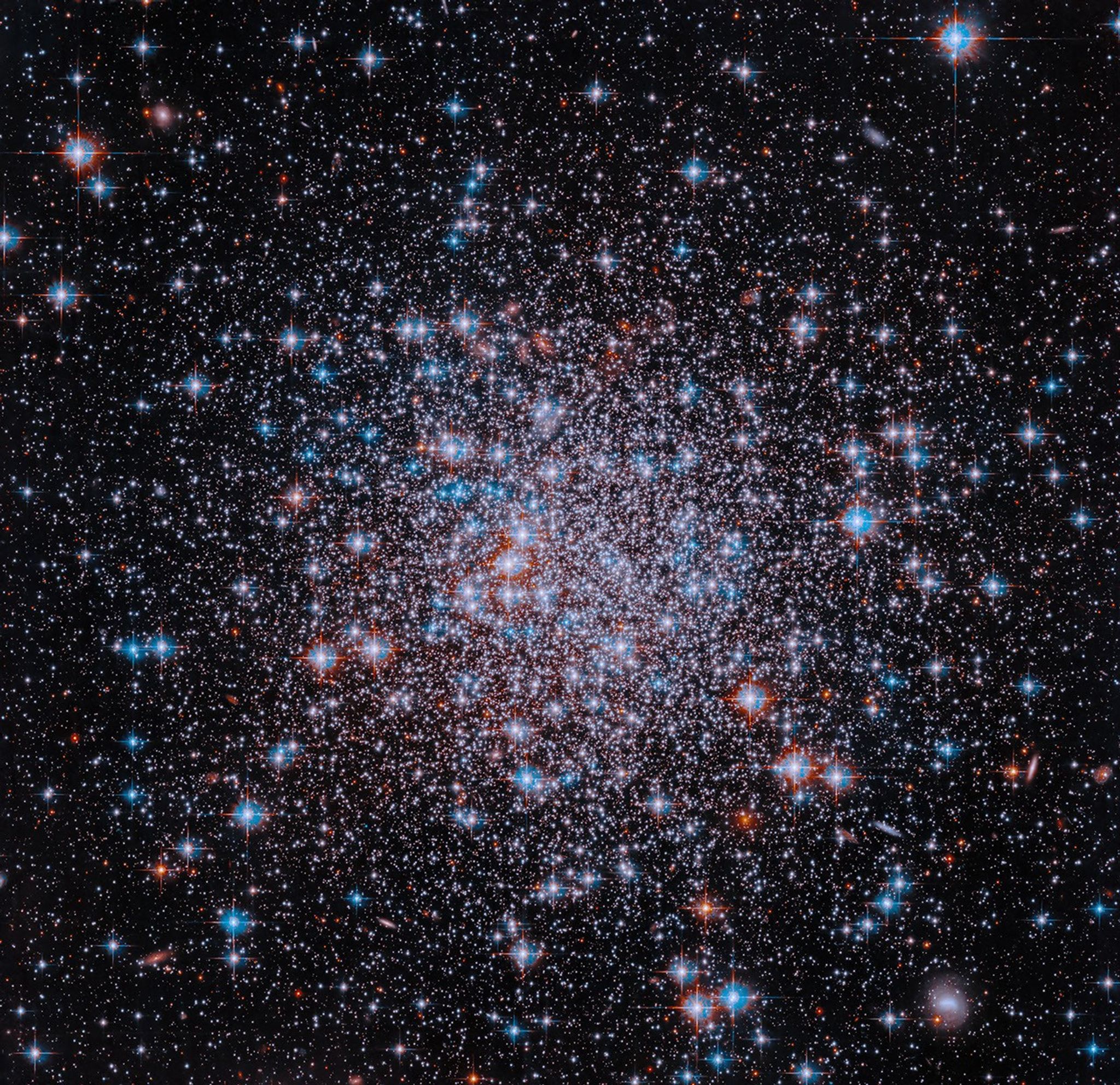
A burst of red, white, and blue starlight—resembling a sparkler traced against a dark sky—anchors a new image from NASA’s Hubble Space Telescope.
A burst of red, white, and blue starlight—resembling a sparkler traced against a dark sky—anchors a new image from NASA’s Hubble Space Telescope. NASA released the view in conjunction with celebrations of the United States’ 250th anniversary, framing it as a nod to the nation’s long-running tradition of exploration.
The target is NGC 6426, a globular cluster that lies in the outer halo of the Milky Way. Globular clusters are dense, roughly spherical swarms of stars held together by their collective gravity. Astronomers have identified about 150 of these clusters in our galaxy, and they are prized because they preserve some of the Milky Way’s earliest history. Formed from a single collapsing cloud of gas, the stars in a globular cluster are typically close in age, making such systems natural laboratories for studying how the galaxy assembled over time.
NGC 6426 is especially ancient. Researchers estimate it is around 13 billion years old—placing it among the oldest known globular clusters in the Milky Way and not far behind the universe itself, which is about 13.7 billion years old. Its antiquity is also reflected in its “low metallicity”: the stars contain relatively few elements heavier than hydrogen and helium. That chemical makeup echoes conditions in the early cosmos, when matter consisted mostly of those two light elements and heavier atoms were only beginning to accumulate as the first generations of massive stars forged them through nuclear fusion.
Hubble’s image uses color to translate the wavelengths of light captured through different filters. In the processing, blue represents shorter visible wavelengths, while red corresponds to longer visible wavelengths and includes some near-infrared light. Because a star’s color is tied to its surface temperature, the bluish stars appear hotter, while the redder ones are cooler.
Although globular clusters were long regarded as simple, single-population systems, NGC 6426 carries signs of a more complex past. Studies have found evidence for two distinct chemical groups of stars within the cluster. The interpretation is that a slightly younger, more metal-rich population formed after earlier massive stars ended their lives as supernovae, blasting newly made heavy elements into the surrounding environment. That ejected material can be incorporated into subsequent generations of stars—an enrichment process that ultimately helped seed the cosmos with the ingredients needed to build new stars and, later, planets.
The observation is part of a broader Hubble effort to examine globular clusters in the Milky Way’s halo, refining their ages and using them to reconstruct the galaxy’s formation and evolution. After more than three decades in orbit, Hubble continues to shape modern astronomy, with its findings increasingly paired with newer observatories. NASA points to the infrared-sensitive James Webb Space Telescope as a key complement, and to the forthcoming Nancy Grace Roman Space Telescope, which is scheduled for launch in late summer. Together, these missions extend Hubble’s legacy—using glittering relics like NGC 6426 to illuminate the earliest chapters of cosmic history and the life cycles of stars.