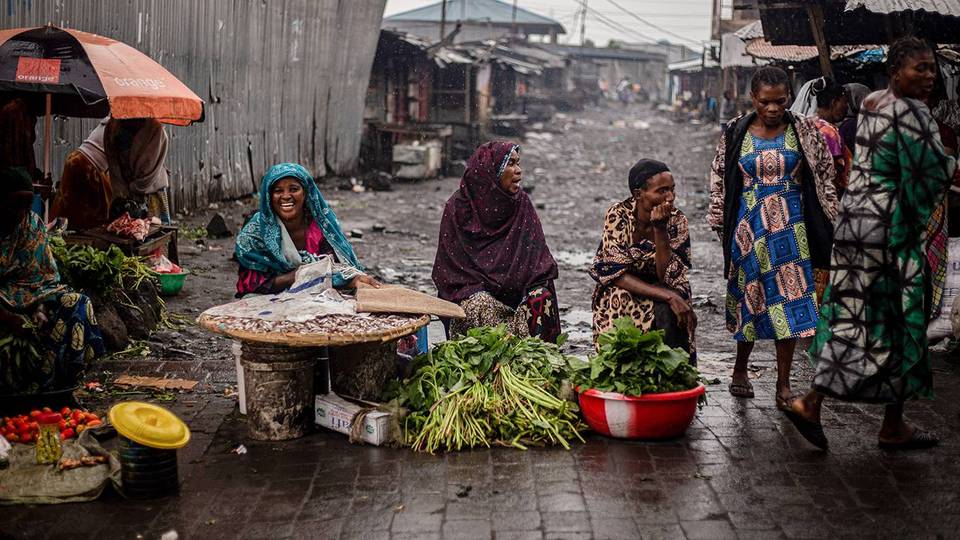
As development orthodoxies fracture, lenders still push Africa toward industrial formalization despite climate and debt pressures. Critics urge locally grounded models that value informal livelihoods and avoid new extractive “green” and digital dependency.
The global system that has long shaped development policy is splintering at the same time that the standard playbook for economic transformation is showing clear strain. Climate shocks and mounting debt burdens are narrowing governments’ options, yet many multilateral lenders and donors continue to push African countries toward a familiar endpoint: a largely formal economy anchored in industrial jobs, rising GDP, and imported technologies delivered through foreign partnerships.
That target has never been a neutral or universally reachable destination. The prosperity of today’s advanced economies was built through slavery and colonial extraction—systems that seized land, labor, and resources at scale. Now, as the world accelerates into digital and “green” transitions that depend heavily on African minerals, data, and labor, there is a real risk of repeating old patterns in new forms—entrenching unequal gains rather than broadening opportunity. The distribution of recent wealth creation underlines the danger: from 2000 to 2024, the richest 1% captured 41% of all new wealth, while the bottom half of the global population received only 1%.
Against this backdrop, simply applying the same knowledge, economic, and innovation frameworks that helped generate today’s inequalities is unlikely to resolve Africa’s development challenges. Even well-intentioned reforms can reproduce the very disparities they aim to reduce. Bridging the gap between the economies that development institutions were built to manage and the realities African societies face today requires a set of deep intellectual shifts—changes that multilateral development banks, donor agencies, NGOs, and African governments would need to embrace to support more diverse and locally grounded pathways.
The first shift is about redefining what counts as economic and innovative value. In Sub-Saharan Africa, 87.6% of workers are employed informally, typically without stable protections, legal recognition, or social insurance. Many households stitch together livelihoods across multiple activities: wage labor alongside small-scale trading, farming, caregiving, platform-based gig work, remittances, and community enterprise. These mixed arrangements are not a short-lived transitional phase on the way to formal wage employment; they are durable systems of survival and value creation that do not neatly “graduate” into a conventional formal economy.
Yet policy often treats formally registered firms and salaried employment as the norm, making access to public procurement, development finance, and business support contingent on requirements such as official registration, tax compliance, and traditional collateral. Rather than pursuing “formalization” as a one-directional solution—absorbing people into institutions designed without them—policymakers could expand protections without dismantling hybrid livelihoods. That means recognizing cooperative and communal production, taking informal work seriously as an economic foundation, and evaluating innovation not only by whether it increases output, but also by who owns the gains, who benefits, and who carries the risks.
The second shift concerns knowledge and authority: whose expertise is recognized, and who gets to decide. Innovation is not limited to multinational firms, research labs, universities, or ministries. It also emerges through apprenticeship networks, repair and maintenance cultures, communal stewardship practices, civic technology groups, informal manufacturing and production systems, and distributed forms of local governance. In many places, new solutions arise in dense urban hubs and in collaborations—sometimes tense, sometimes productive—between Indigenous knowledge and formal scientific methods.
Even so, money and decision-making power remain concentrated in central governments and elite institutions. A more effective development approach would treat marginalized actors as producers of knowledge—not merely beneficiaries—and would share resources and authority in ways that reflect how coordination and problem-solving already work on the ground.
Why it matters
If development policy continues to privilege a narrow model of formalization and technology transfer, Africa’s green and digital opportunities could replicate extractive relationships rather than deliver widely shared prosperity. Workers in informal and hybrid livelihoods—who make up the overwhelming majority—stand to gain or lose the most depending on whether protections and investment adapt to reality. The next test will be whether lenders and governments redesign financing and governance so that ownership, benefits, and decision-making extend beyond established elites.