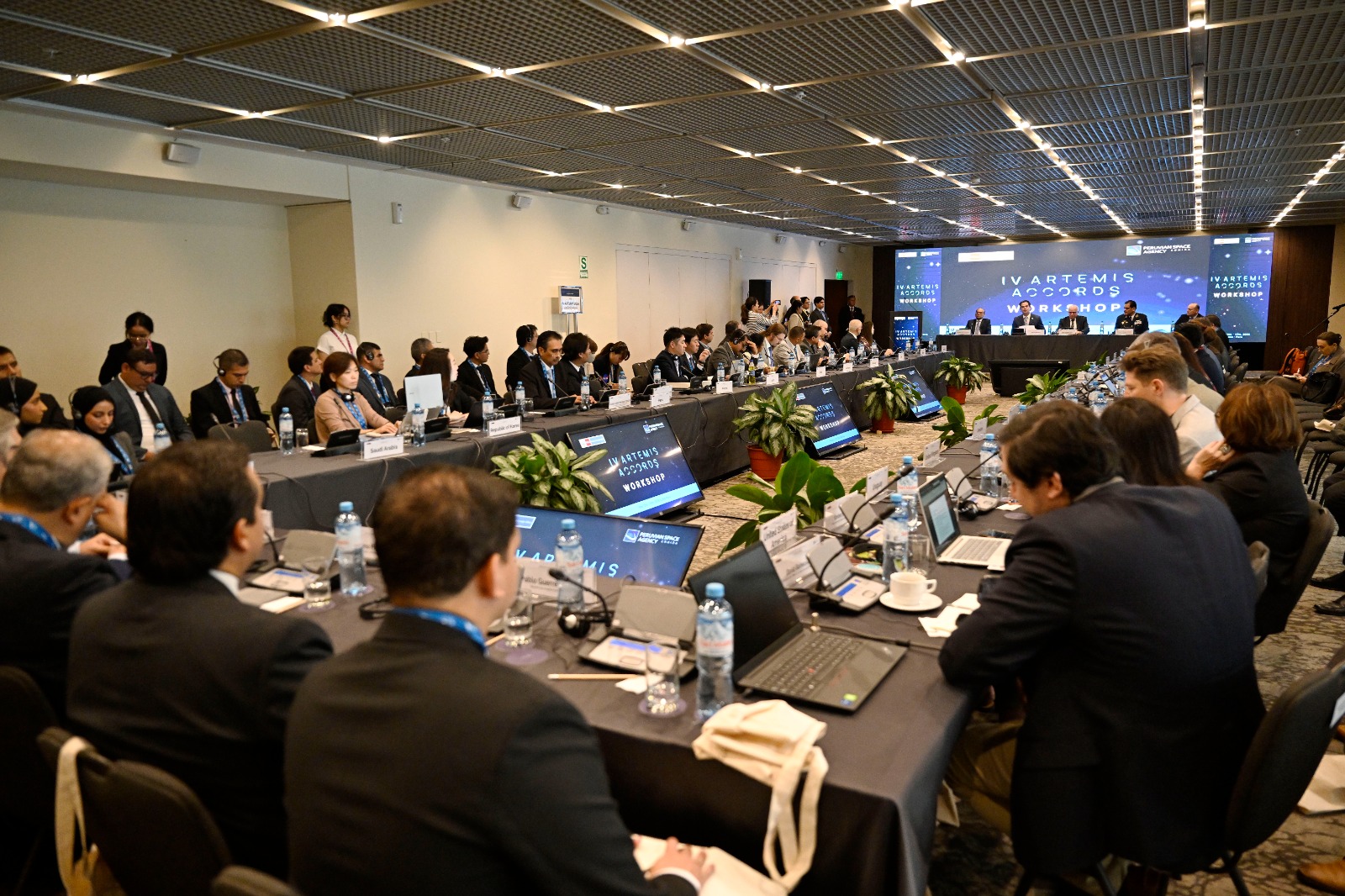
The United States took part last week in an Artemis Accords workshop in Lima, Peru, as the international agreement governing cooperative, responsible exploration of the Moon and beyond continues to expand.
The United States took part last week in an Artemis Accords workshop in Lima, Peru, as the international agreement governing cooperative, responsible exploration of the Moon and beyond continues to expand.
In the run-up to the meeting, six additional countries—Latvia, Jordan, Morocco, Malta, Ireland, and Paraguay—formally signed onto the Artemis Accords during ceremonies held at NASA Headquarters and at locations overseas. Their entry lifts the total number of participating nations to 67, reflecting what NASA officials describe as accelerating global alignment around shared norms for lunar activity.
NASA Administrator Jared Isaacman said the workshop underscored the growing momentum behind both the Artemis program and the Accords framework. He noted that the Accords were initiated during President Donald Trump’s first term and said NASA is applying those principles as it carries out U.S. national space policy. Isaacman framed the partnership as a way for signatory nations to contribute directly to plans for a long-term human foothold on the Moon—an effort often described as laying the groundwork for a first permanent lunar outpost—rather than remaining observers.
Held May 13–14, the Lima workshop brought together representatives from NASA and the U.S. Department of State alongside officials and technical experts from 30 countries, including several of the newest signatories. The agenda combined detailed technical exchanges with a tabletop exercise designed to test decision-making and coordination in challenging lunar operating conditions.
Peru hosted the fourth annual Artemis Accords workshop, and the event marked the first time the gathering has been convened in South America. Maj. Gen. Roberto Melgar Sheen, director of Peru’s space agency CONIDA, said a central goal of bringing the meeting to Lima was to boost regional engagement. According to Melgar Sheen, all South American nations that have signed the Accords participated, with about 90% attending in person and 10% joining virtually.
Participants reviewed planned lunar missions—including both landers and orbiters—across the countries represented at the workshop. With more than a dozen lunar landing attempts expected globally over the next 18 months, discussions focused on practical issues likely to shape near-term operations: avoiding harmful interference between missions, ensuring systems can work together, sharing scientific data, and managing orbital debris and mitigation strategies. NASA also presented an exploration roadmap that emphasizes an accelerated cadence of missions to the Moon.
The meeting came after NASA’s March 24 “Ignition” event, which the agency says has widened opportunities for Accords signatories to contribute to a developing “Moon Base” concept and to take on deeper roles within the wider Artemis effort.
Peru, which joined the Artemis Accords in 2024, described the workshop as an avenue for engaging with emerging global approaches to exploration and for building international scientific and aerospace partnerships. Vice Minister of Foreign Affairs Ambassador Felix Denegri said Peru aims to strengthen cooperative ties with other signatories in ways that support the country’s research and industrial development.
NASA and the State Department established the Artemis Accords in 2020 with seven other founding nations, responding to rising interest in lunar activity from governments and private companies. The Accords set out commitments to peaceful, transparent conduct in space; assistance to those in distress; open access to scientific data; coordination to prevent interference; and the protection of heritage sites and artifacts through shared best practices. NASA expects additional countries to join in the coming months and years as the agency pursues what it calls a safe, peaceful, and prosperous future in space.