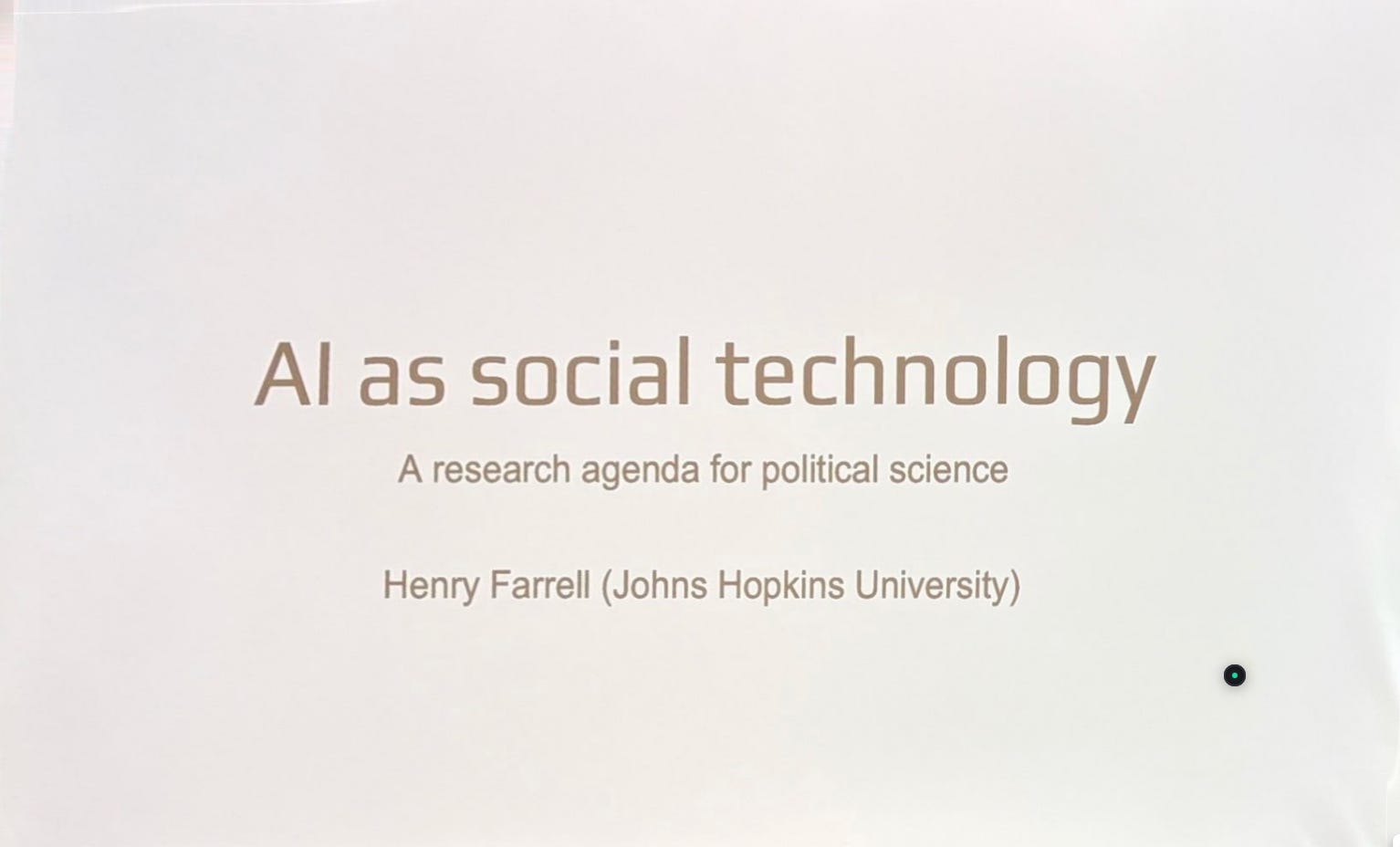
Political scientist Henry Farrell will speak at UC Berkeley, arguing that AI and large language models should be studied as “lossy” social technologies shaping democratic publics.
Henry Farrell, a political scientist at Johns Hopkins University, is set to speak at the Berkeley Economy & Society Initiative’s “Capitalism & Democracy” lecture series. His talk—titled “AI as Social Technology: A Research Agenda for Political Science”—will argue that the tools and concepts political scientists need to understand artificial intelligence are hiding in plain sight, including in the work of one of AI’s own founders.
Farrell’s starting point is a historical irony: Herbert Simon, widely regarded as a pioneer of artificial intelligence, was also a political scientist. Yet, as Farrell notes in the event description, political science has only begun to develop a systematic approach to how AI may transform core topics in the field—power, collective decision-making, institutions, and democratic life.
Drawing on ongoing collaborations with researchers including Alison Gopnik, James Evans, Cosma Shalizi, and Hahrie Han, Farrell plans to revive Simon’s idea of “collective information processing” as a foundation for new political science research on AI. Simon argued that individual cognition is sharply constrained; no one person can take in and evaluate all the relevant facts needed to navigate a complex society. Institutions—markets, bureaucracies, and other large-scale systems—function in part as mechanisms that pool information and compress complexity into more usable forms.
Farrell will connect that institutional view to a parallel set of arguments emerging in computer science and physics. In those fields, concepts such as “lossy representations” and “coarse graining” describe how systems simplify reality by discarding detail in order to produce workable summaries. The claim Farrell will advance is that large language models operate in a similar way: they generate powerful, usable representations of the world, but those representations necessarily omit information. In that sense, he argues, LLMs should be understood not only as computing tools but as social technologies—systems that shape how groups interpret, communicate, and act on information.
Seeing AI through this lens, Farrell contends, opens up a research agenda for political science and political theory. One item he intends to sketch is how “lossy” representational technologies influence the formation of democratic publics—how citizens come to share (or fail to share) common frames of reference, narratives, and understandings of social reality.
Farrell is the SNF Agora Professor of International Affairs at Johns Hopkins’ School of Advanced International Studies. He received the Friedrich Schiedel Prize for Politics and Technology in 2019, an award recognizing major contributions to cross-disciplinary work linking politics and technology, jointly granted by the Friedrich Schiedel Foundation and the Technical University of Munich. Before joining Johns Hopkins, he held faculty positions at George Washington University’s Department of Political Science and the Elliott School of International Affairs.
His research spans the relationship between democracy and information, the security implications of global economic networks, and international political economy. He is also co-author, with Abraham Newman, of Underground Empire: How America Weaponized the World Economy (2023), which won a Bronze Medal for the Council on Foreign Relations’ Arthur Ross Book Award.
The announcement also gestures at a broader question hovering over AI debates: how much can any era reliably foresee the social and political consequences of its transformative technologies—especially when earlier waves of industrial change produced outcomes that few expected.
Why it matters
If AI systems function as “lossy” ways of representing the world, they may shape public opinion and democratic discourse not only through overt persuasion, but through what they simplify, omit, and standardize. That has implications for researchers, policymakers, and platforms attempting to manage misinformation, polarization, and the integrity of civic debate. Farrell’s agenda points to new work political scientists may need to do quickly: mapping how AI-mediated representations alter who gets heard, what becomes legible, and how publics are formed.