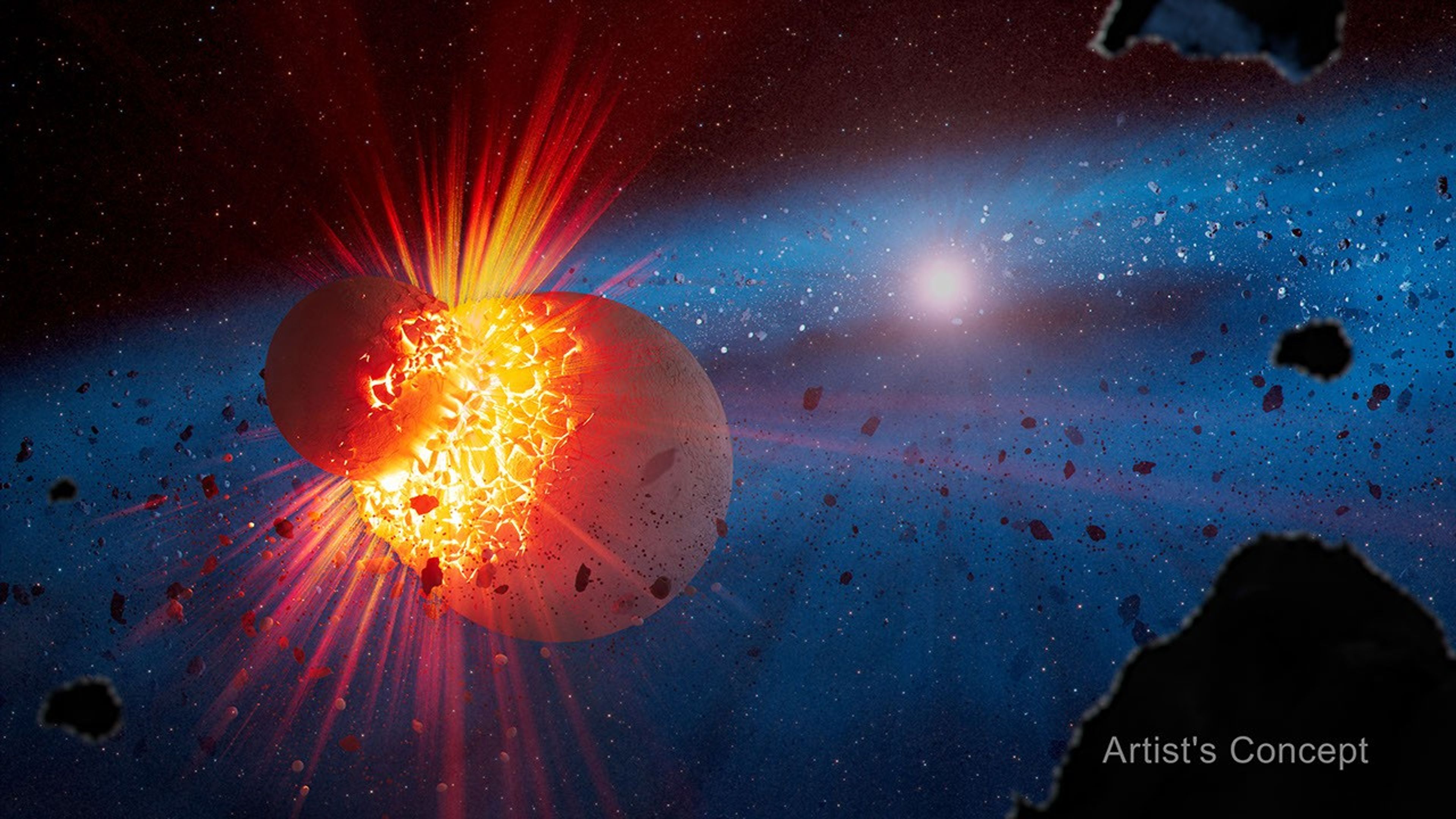
Long before life emerged on Earth, the young solar system was a violent place.
Long before life emerged on Earth, the young solar system was a violent place. One leading scenario for the Moon’s origin holds that a body roughly the size of Mars—often referred to as Theia—struck the early Earth with enough force to melt and vaporize enormous quantities of rock. Debris blasted into orbit later gathered into the Moon, the destination of NASA’s Artemis missions as the agency prepares for eventual crewed journeys to Mars. Now, astronomers are using a new window on other planetary systems to study similarly catastrophic events as they unfold around distant stars.
A team led by Kate Su of the Space Science Institute in Boulder, Colorado has used NASA’s James Webb Space Telescope to investigate a rare kind of young star system that appears to be strewn with the aftermath of major collisions. Their analysis, published Thursday in The Astrophysical Journal, probes how much energy those impacts release and what the debris is made of—key clues to how rocky planets assemble and evolve in chaotic early environments.
Stars begin their lives surrounded by thick, gas-rich protoplanetary disks, the raw material from which planets grow. Over time those disks thin out, leaving behind gas-poor debris disks composed mainly of dust and fragments produced by ongoing impacts among leftover building blocks. NASA’s now-retired Spitzer Space Telescope studied many debris disks and identified an especially unusual subset: “extreme debris disks,” systems with abnormally large amounts of warm dust located close to their stars—regions comparable to the orbits of rocky planets in our own solar system.
Theory suggests astronomers should see many of these systems, but observations tell a different story. Based on data so far, scientists estimate that only about 1% of young stars show detectable signs of this short-lived phase—one our own solar system may have passed through during its formative years.
Even so, Su’s team assembled the largest sample yet: 21 extreme debris disks. Five came from Spitzer archival observations, while Webb contributed 16, including 12 disks observed for the first time and four revisited targets previously seen by Spitzer. With that expanded dataset, the researchers say they can finally characterize what makes these systems distinct.
Webb’s and Spitzer’s mid-infrared spectra revealed three hallmarks shared across the group: dust grains that are smaller than those typically found in either protoplanetary disks or standard debris disks, a pronounced concentration of warm dust near the star, and irregular changes in brightness over time.
To understand what could produce those signatures, the team examined the disks’ mineral compositions. The spectra separated the systems into two categories—silica-rich and silica-poor—materials that point to different kinds of impacts. Silica-rich compositions are associated with high-energy collisions capable of vaporizing large fractions of rock, comparable to smashups between Mars-sized bodies. About one-third of the sample falls into this category. The remaining two-thirds are silica-poor, consistent with lower-energy events such as glancing collisions between smaller, roughly Moon-sized objects. The classification may also help explain why these disks fluctuate in infrared brightness.
“For me, the most exciting thing was seeing their mid-infrared emission and detailed spectral features with Webb, which let us identify their compositions,” said coauthor Agnes Kóspál of Konkoly Observatory in Budapest. She noted that these planet-building bodies are too small to observe directly, making debris chemistry one of the few available probes.
The study also finds that silica-rich extreme debris disks appear only around stars younger than 300 million years, tying the most violent impacts to an early chapter in planetary system evolution.