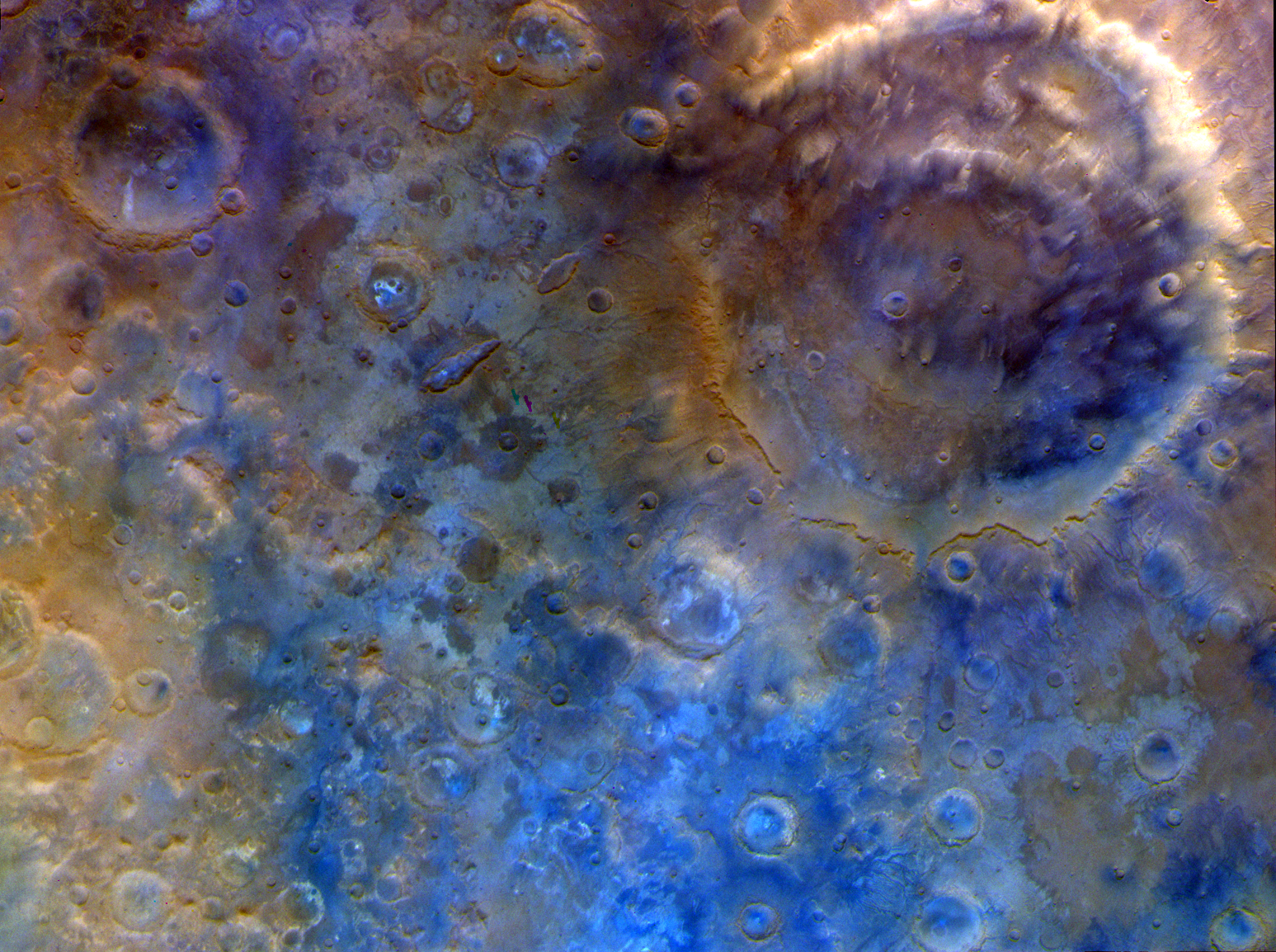
NASA’s Psyche spacecraft has returned a striking new look at Mars, capturing an enhanced-color image of the planet’s ancient southern highlands dominated by the prominent Huygens crater.
NASA’s Psyche spacecraft has returned a striking new look at Mars, capturing an enhanced-color image of the planet’s ancient southern highlands dominated by the prominent Huygens crater. The view, recorded by the mission’s multispectral imager, highlights Huygens in the upper left: a massive, double-ring impact structure measuring about 290 miles (470 kilometers) across.
The surrounding landscape is densely pocked with craters, a hallmark of the southern highlands and a sign of terrain that has endured billions of years of impacts with comparatively little resurfacing. The scene is centered near 15 degrees south latitude and showcases an old, heavily battered region of the Martian crust.
While the colors are not what a human observer would see, they are grounded in real spectral information. Mission scientists processed the data into an enhanced-color composite designed to emphasize subtle variations that are otherwise difficult to discern. Differences in hue across the cratered plains are thought to reflect changes in the composition or physical properties of surface materials—such as dust coatings, sand deposits, and exposed bedrock—spread across this rugged landscape.
The image was acquired by Imager A on May 15, 2026, at approximately 1:18 p.m. PDT, shortly after Psyche’s closest approach to Mars. At the time of observation, the camera’s resolution corresponded to about 2,200 feet (670 meters) per pixel, providing a broad regional portrait rather than fine-scale detail.
To produce the final view, the team combined data from red, green, and blue filters on the multispectral instrument. By blending these channels and stretching the color differences, the processing brings out contrasts linked to surface composition and texture—an approach commonly used in planetary science to help interpret geology and material variations.
The Mars flyby imagery offers an additional scientific return for the Psyche mission as it continues toward its primary destination: the asteroid Psyche. Further details about the mission and its objectives are available from NASA’s Psyche mission resources online.