Guadalajara is preparing to welcome the FIFA World Cup once again, and satellite views show just how dramatically the region has changed since it last hosted matches in 1986.
Guadalajara is preparing to welcome the FIFA World Cup once again, and satellite views show just how dramatically the region has changed since it last hosted matches in 1986. Over four decades, the metropolitan area has surged westward, transforming former agricultural land into neighborhoods, industrial parks, and a modern stadium set against terrain molded by long-quiet volcanoes.
When World Cup games came to Guadalajara in June 1986, the venue now known as Guadalajara Stadium—also called Estadio Akron—did not exist. It would not be built until 2010 in Zapopan, the rapidly expanding municipality northwest of the city, as the home of Club Deportivo Guadalajara, better known as Chivas. In 1986, many tournament fixtures were played instead at Jalisco Stadium in northeastern Guadalajara. That stadium hosted a match that has since become part of World Cup lore: France’s quarterfinal victory over Brazil decided by a penalty shootout, often cited among the tournament’s most unforgettable games.
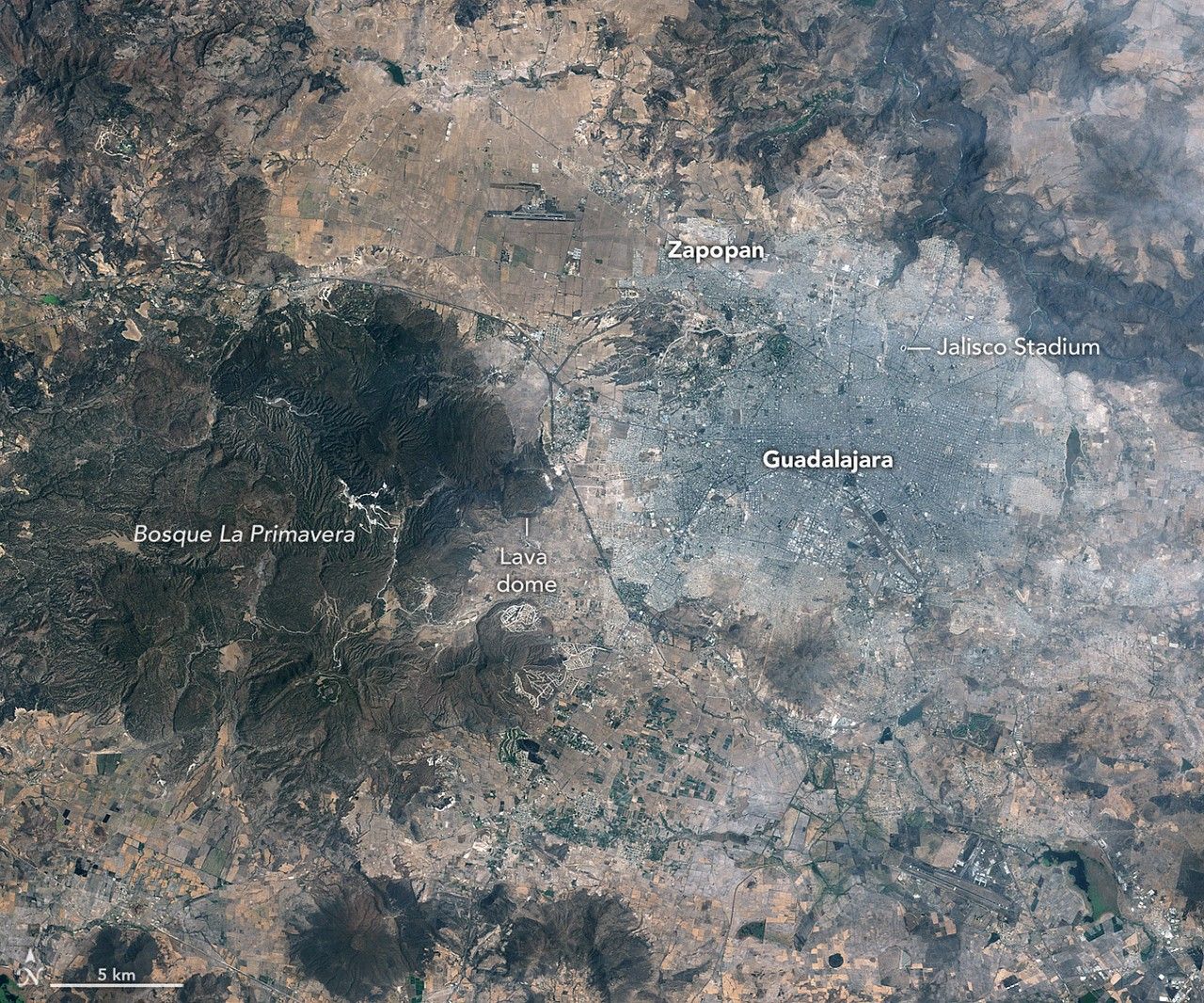
Landsat imagery from NASA and the U.S. Geological Survey underscores the physical shift. The land where Estadio Akron stands today appears as farmland in 1986. Now it sits close to the Sierra la Primavera volcanic complex, a landscape marked by lava flows, volcanic domes, steam vents, and hot springs. Designers drew directly from that setting: the stadium emerges from a grassy earthen berm intended to evoke a volcano’s slopes, while its white roof is meant to resemble a cloud above a volcanic peak.
The geology beneath that scenic backdrop reaches deep into prehistory. Roughly 95,000 years ago, the Sierra la Primavera system produced a major eruption that caused the ground to collapse into an 11-kilometer-wide (7-mile) caldera. Water pooled in the depression for tens of thousands of years, but gradual tectonic uplift and accumulating sediment eventually eliminated the lake. Over time, erosion stripped away softer rocks around the caldera, leaving more resistant volcanic material within the circular structure standing noticeably higher than the surrounding terrain.
Volcanic activity continued later along the caldera’s southern edge. Beginning about 60,000 years ago, multiple lava domes formed there. The youngest, Cerro del Colli, dates to about 30,000 years ago. It created the dome-shaped feature just south of the stadium and is part of a broader landscape scattered with other domes and cinder cones.
Even as development spread, much of the ancient caldera has been protected as the La Primavera Biosphere Reserve. Yet the reserve has increasingly found itself ringed by growth. The Guadalajara metro area’s population has climbed from about 2.7 million in 1986 to more than 5.5 million today. Zapopan has been a major driver of that expansion and has gained a reputation as a technology center sometimes dubbed “Mexico’s Silicon Valley.” Landsat images also highlight recent development such as Guadalajara Technology Park and the proliferation of new greenhouses—especially south of the reserve—used largely for fruit and vegetable production.
Soccer, meanwhile, remains central to the city’s identity. Guadalajara is hosting World Cup matches for the third time. During Brazil’s celebrated 1970 championship run led by Pelé, Jalisco Stadium hosted the team’s first-round, quarterfinal, and semifinal games. In May 2026, the city honored Pelé with a 9.5-meter (31-foot) bronze statue. Festivities have even reached the Guadalajara Zoo, where animals including elephants, gorillas, giraffes, capybaras, pumas, and macaws have been enlisted for playful “predictions” by choosing among objects. One report described a puma named Muluk picking South Korea to beat Czechia by sniffing and nudging a ball.
Guadalajara’s four first-round matches are scheduled for June 12 (South Korea vs. Czechia), June 18 (Mexico vs. South Korea), June 23 (Colombia vs. Democratic Republic of the Congo), and June 26 (Uruguay vs. Spain), as the city’s evolving landscape once again becomes part of the World Cup stage.