NASA has selected 302 SBIR/STTR projects for up to $171 million to help small U.S. firms develop technologies for Artemis and future Moon and Mars missions.
NASA is channeling fresh seed money to hundreds of U.S. small businesses in an effort to close key technology gaps for future missions to the Moon and Mars—while also strengthening the broader space economy.
Through its Small Business Innovation Research and Small Business Technology Transfer (SBIR/STTR) program, the agency has selected 302 projects for early-stage research and development, representing up to $171 million in potential funding. NASA says the portfolio targets a wide range of technical needs tied to Artemis, the push to establish a sustained U.S. presence on the Moon, and concepts that underpin a future Moon Base. Among the areas highlighted: improved energy storage, robotics designed to cope with harsh lunar conditions, and construction-enabling tools such as methods for building durable landing pads.
SBIR/STTR is designed to help entrepreneurs, startups, and small companies mature technologies that can either be adopted by NASA missions or commercialized in the private sector. The program advances projects in stages, and the latest selections span two of those phases.
New Phase I contracts can provide as much as 1.3 million apiece—to push forward concepts that began in Phase I projects chosen in 2025, with an emphasis on demonstrating performance and delivering usable technology.
Several of the newly supported efforts illustrate how NASA’s near-term Moon priorities overlap with longer-range Mars ambitions—and with potential uses on Earth.
In one Phase II SBIR award, Opterus Research and Development Inc. is working on a modular power system based on rollable solar arrays intended for deployment on the lunar and Martian surface. NASA describes the arrays as robotically manageable, compatible with different support structures, and capable of operating in dusty environments. The system could be expanded to produce as much as 50 kilowatts, offering a power option for both NASA and commercial partners as they build surface infrastructure.
Another project, funded through a Phase I SBIR award to Intelligent Fiber Optic Systems Corporation, aims to give lunar rovers more autonomy. The company is developing an extendable robotic arm—about 10 feet long—that combines a camera with sensors that register touch. Those sensors are designed to quantify surface texture, contact force, and temperature, enabling the arm to “see” and “feel” while performing tasks. NASA envisions such capabilities supporting automated work such as cleaning solar panels, placing habitat components, and retrieving scientific samples from difficult-to-reach locations. Similar instrumented arms could also be adapted for terrestrial jobs including inspection and repair in dangerous settings like power lines or nuclear facilities.
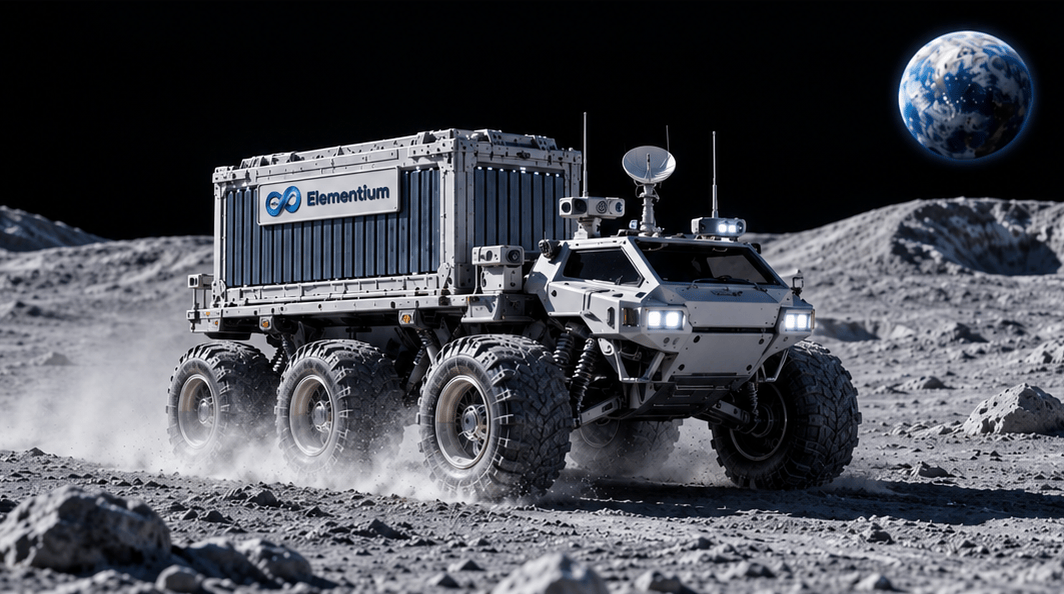
Energy storage is also a focus. Elementium Materials Inc., selected for a Phase I SBIR award, is developing a battery module engineered to function in extreme cold—down to minus 76 degrees Fahrenheit—without active heating. Operating without heaters could reduce the mass and volume devoted to thermal management on lunar missions, freeing spacecraft capacity for additional instruments. The company’s concept could help keep rovers, habitats, and other assets operating during the Moon’s roughly 14-day-long night, and potentially support future missions on Mars. The technology could also have applications in cold climates on Earth.
Landing infrastructure is another challenge NASA wants to solve before lunar traffic increases. Under a Phase I STTR award, Slate Geotechnical Consultants Inc. and the Colorado School of Mines will compare two methods for preparing lunar regolith to withstand repeated landings. Without robust pads, rocket exhaust can eject loose, gravel-like material, loft dust, and carve craters—hazards that can damage spacecraft and nearby equipment. The team also plans to study rover-based techniques for repairing and maintaining these surfaces.
Why it matters
As NASA and commercial providers plan more frequent trips to the Moon, technologies such as reliable surface power, cold-capable batteries, autonomous robotics, and reusable landing pads become prerequisites—not luxuries. The SBIR/STTR awards spread early funding across many small teams, aiming to de-risk ideas quickly and move the most promising concepts toward flight-ready demonstrations. Watch for which projects graduate into Phase II and, ultimately, get “infused” into Artemis hardware and lunar surface operations.