A team of researchers is outlining a path toward one of exoplanet science’s most ambitious targets: directly reconstructing a visible-light image of an Earth-like world…
A team of researchers is outlining a path toward one of exoplanet science’s most ambitious targets: directly reconstructing a visible-light image of an Earth-like world orbiting a nearby star, detailed enough to begin resolving surface structures rather than registering the planet as a single unresolved point.
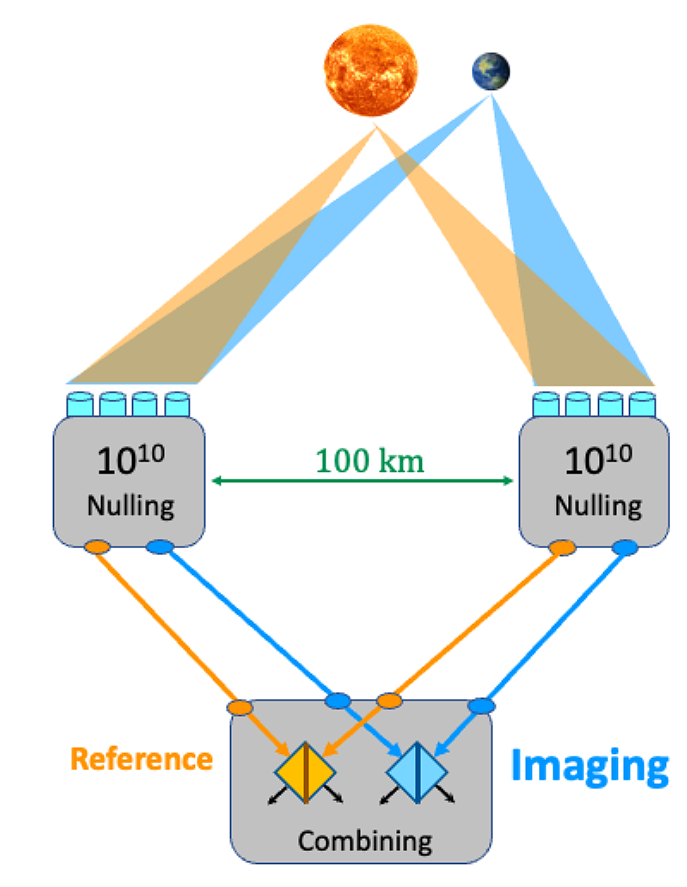
The proposal hinges on a two-part technological advance. The first step is a new approach to suppressing overwhelming starlight—an obstacle that has long limited direct imaging of small, rocky planets. The concept, called “dynamic hierarchical nulling,” is a next-generation nulling interferometer designed to merge light collected by multiple apertures in a way that cancels the star’s contribution while preserving the much fainter signal from an orbiting planet. In the visible band, an Earth twin next to a Sun-like star demands extreme separation of brightness; the design aims for star-to-planet suppression at a level of 10^10 contrast or better, a threshold considered necessary to isolate the planetary light.
Unlike conventional nullers that focus solely on rejecting starlight, the hierarchical strategy is intended to sort the incoming light into distinct outputs. One beam contains the planet-friendly “nulled” signal where the star is strongly suppressed, while the star’s light is not discarded entirely but routed into a separate channel. That preserved stellar beam is not treated as a nuisance; it becomes an asset, retained specifically so it can later serve as a stable phase reference for precision interferometry.
That phase reference is central to the second stage, which tackles the problem of angular resolution—the ability to separate fine details on a distant planet’s disk. The plan calls for pairing the outputs of two dynamic hierarchical nullers mounted on separate spacecraft flying roughly 100 kilometers apart. With that long baseline, the system would operate as an optical very long baseline interferometer, using Michelson-style interferometric imaging to synthesize a telescope far larger than any single mirror that could realistically be launched.
In practice, the architecture would first perform the difficult task of teasing the planet’s faint visible light away from its host star, and then use the widely separated spacecraft to measure interference fringes that encode spatial information. By combining those measurements, scientists could reconstruct an image rather than a simple brightness measurement—an essential shift for studying geography-like features, patterns, and other surface-related structure on Earth-sized exoplanets.
The researchers argue that the science payoff would be substantial. Imaging an Earth analog in reflected light—and beginning to map what is on its surface—would move the field from detection and basic characterization into a regime of comparative planetology across other solar systems. The concept also aligns closely with NASA’s long-standing interest in identifying and characterizing potentially habitable worlds, and it carries an obvious public appeal: the prospect of seeing, in visible light, the first resolved features of a planet resembling Earth around another star.