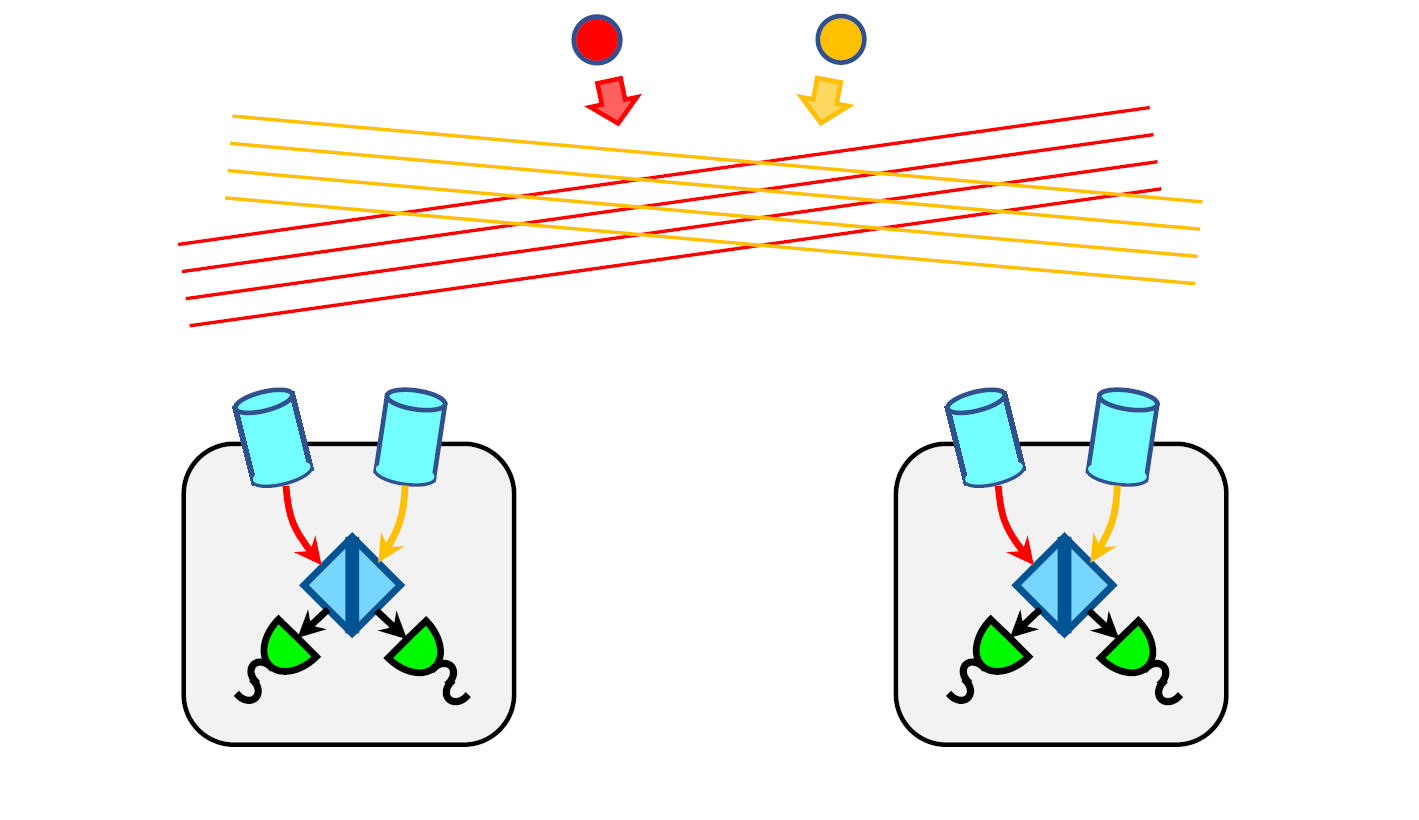
A team of researchers is advancing a concept that could open a largely inaccessible window on the gravitational-wave universe: the ultra-low-frequency band spanning roughly microhertz down to nanohertz.
A team of researchers is advancing a concept that could open a largely inaccessible window on the gravitational-wave universe: the ultra-low-frequency band spanning roughly microhertz down to nanohertz. In this regime, gravitational waves evolve so slowly that they evade most existing detectors, leaving scientists with few practical ways to probe the signals expected from some of the universe’s most massive and long-lived phenomena.
The proposed strategy pivots on a subtle, all-sky effect predicted by general relativity. As a gravitational wave passes near Earth, it slightly distorts spacetime in a way that produces a coordinated, minuscule shift in the apparent positions of distant celestial objects. Instead of looking for a temporary change in the distance between test masses—an approach used by facilities such as LIGO and planned missions like LISA—this method aims to detect the wave’s imprint through precision astrometry: measuring tiny changes in where objects appear on the sky. Because the effect is correlated across the sky, it offers a distinctive signature that, in principle, can be separated from random measurement noise or the intrinsic motions of individual sources.
The key technical innovation is a new approach to high-precision astrometric measurement based on quantum two-photon interference, recently reported in the scientific literature. Two-photon interference exploits quantum correlations to extract phase information with exceptional sensitivity. Crucially, in the mission architecture being outlined, this technique allows two interferometric spacecraft stations to function without a direct optical link between them. That independence represents a major simplification compared with traditional space interferometers, which typically require stable, long-baseline laser connections and the demanding pointing, metrology, and formation-flying constraints that come with maintaining an optical path across large separations.
By removing the need for an optical connection between spacecraft, the concept reduces mission complexity while still targeting scientifically meaningful sensitivity. The researchers argue that a relatively straightforward space mission—built around two modest-sized spacecraft placed into free-fall orbits—could be sufficient to measure the collective, gravitational-wave-driven astrometric signal. The free-fall configuration is essential: it minimizes non-gravitational forces and helps ensure that the measured positional shifts arise from spacetime effects rather than spacecraft disturbances.
If realized, an instrument of this kind would address a notable gap in the global gravitational-wave toolkit. The microhertz-to-nanohertz band is particularly compelling because it overlaps with processes that unfold over long timescales, including dynamics relevant to galaxy assembly and the behavior of supermassive black holes. Detecting gravitational waves in this low-frequency domain could therefore provide new constraints on how galaxies form and evolve, and on the population and interactions of supermassive black holes at their centers.
Beyond the scientific payoff, the researchers emphasize the broader appeal: extending gravitational-wave astronomy into a frequency range with few competing methods would not only deepen our picture of the universe’s largest structures, but also offer a striking new way to “see” spacetime in motion—an idea likely to capture public interest alongside the continuing expansion of gravitational-wave discovery.