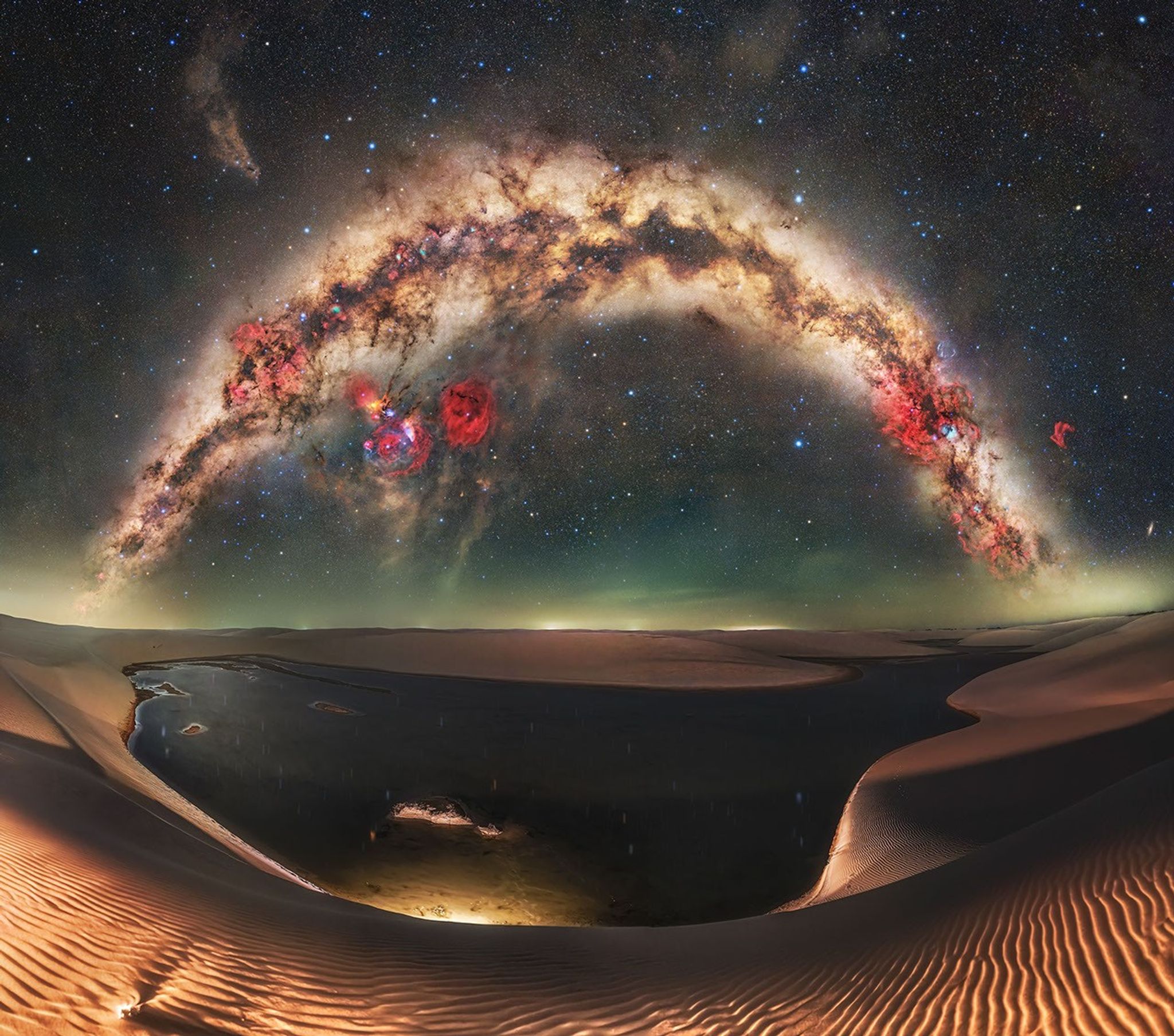
A composite photo over Lençóis Maranhenses National Park frames the Milky Way and a dark lagoon as a “cosmic eye,” revealing dust lanes and nebulae.
A striking night-sky scene from northern Brazil is drawing attention for the way it seems to merge landscape and cosmos into a single, eye-like form. In the image, the Milky Way stretches across the sky above Lençóis Maranhenses National Park, a region known for its pale sand dunes punctuated by dark, rain-fed lagoons.
The photograph is a composite assembled from exposures taken later at night in July, from a vantage point near 2 degrees south latitude—close to the equator. From that location, the Milky Way’s appearance changes noticeably over the course of a night and across seasons as Earth rotates and orbits the Sun, causing different sections of the galaxy to come into view and shift position relative to the horizon.
In this particular view, several hallmark structures of the Milky Way are visible. Dark dust lanes cut through the bright band of starlight, tracing the presence of interstellar material that blocks and scatters light. Patches of color reveal glowing nebulae—regions where gas and dust are illuminated, often associated with sites of active or recent star formation.
At first glance, the galaxy appears to arc cleanly across the sky like a luminous rainbow. But the scene’s dramatic curvature is not a literal depiction of the Milky Way’s shape overhead. The pronounced bend is an optical effect produced by a wide-angle lens, which can exaggerate curvature toward the edges of the frame and reshape straight or gently curving features into more dramatic arcs.
The photographer uses that distortion to artistic advantage. The bright galactic band is positioned so it follows the outline of one of the park’s dark lagoons, making the sky and ground seem to echo each other. Together, they create the illusion of a “cosmic eye,” with the lagoon forming a pupil-like darkness and the Milky Way forming a luminous lid—half of the eye in the heavens, half reflected in the landscape below.
The result is a carefully composed blend of natural features and astronomical detail: a reminder that what we see in astrophotography can be both scientifically informative—showing dust lanes and nebulae in our home galaxy—and visually inventive, shaped by lens choice, timing, and framing. The image invites viewers to linger on the question implied by its design: if the sky can resemble an eye, it can also feel as though it is looking back.
Why it matters
Astrophotography like this can make complex galactic structures—dust lanes, nebulae, and seasonal sky changes—accessible to a wider audience without sacrificing scientific authenticity. It also highlights how tools such as wide-angle lenses influence what the public perceives as “real” in space imagery. As skyglow and light pollution increase worldwide, scenes from dark-sky regions like Lençóis Maranhenses may become both rarer and more valuable to document.