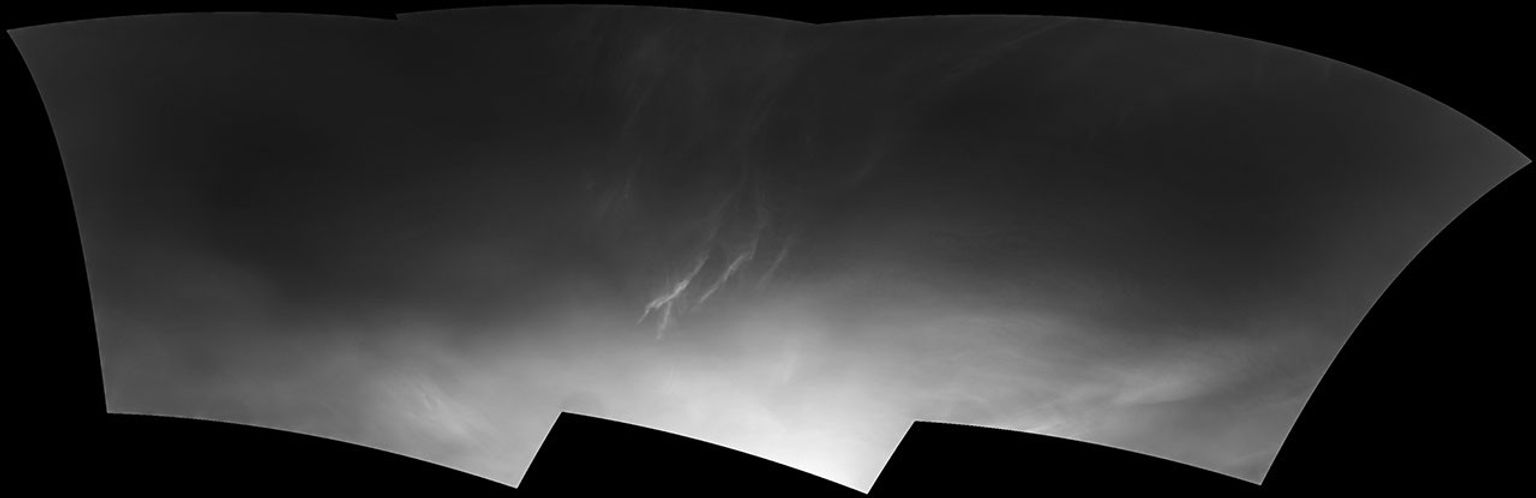
NASA’s Curiosity rover captured delicate “twilight clouds” drifting over Gale Crater after sunset, using its navigation cameras to monitor this brief seasonal Martian phenomenon.
NASA’s Curiosity rover has recorded a new view of delicate clouds drifting across the Martian sky, using its navigation cameras to watch the scene after the Sun had set.
The images were taken on Oct. 31, 2026—Curiosity’s 5,061st Martian day, or sol, on the mission. The cloud formations are known as “twilight clouds” because they appear in the brief window following sunset, when lingering light can still illuminate high-altitude haze and cloud bands.
Scientists have learned that these post-sunset clouds are a seasonal phenomenon at Gale Crater, the broad basin Curiosity has been investigating for more than 14 years. They typically show up for only a short period each Martian fall, making them both fleeting and valuable to capture. Curiosity’s navigation cameras, designed primarily to help the rover drive and avoid hazards, also provide an efficient way to monitor such atmospheric events when conditions are right.
Curiosity is a NASA mission managed by the agency’s Jet Propulsion Laboratory (JPL), which is run by the California Institute of Technology (Caltech) in Pasadena. JPL oversees operations for NASA’s Science Mission Directorate in Washington as part of the broader Mars Exploration Program.
Why it matters
Twilight clouds offer a window into Mars’ changing atmosphere, including seasonal shifts over Gale Crater that can influence dust, temperature, and circulation patterns. Each successful observation adds to a long-term record built by Curiosity, helping researchers track how the Red Planet’s weather behaves year after year. Continued monitoring could reveal whether these short-lived fall clouds vary with broader climate cycles on Mars.