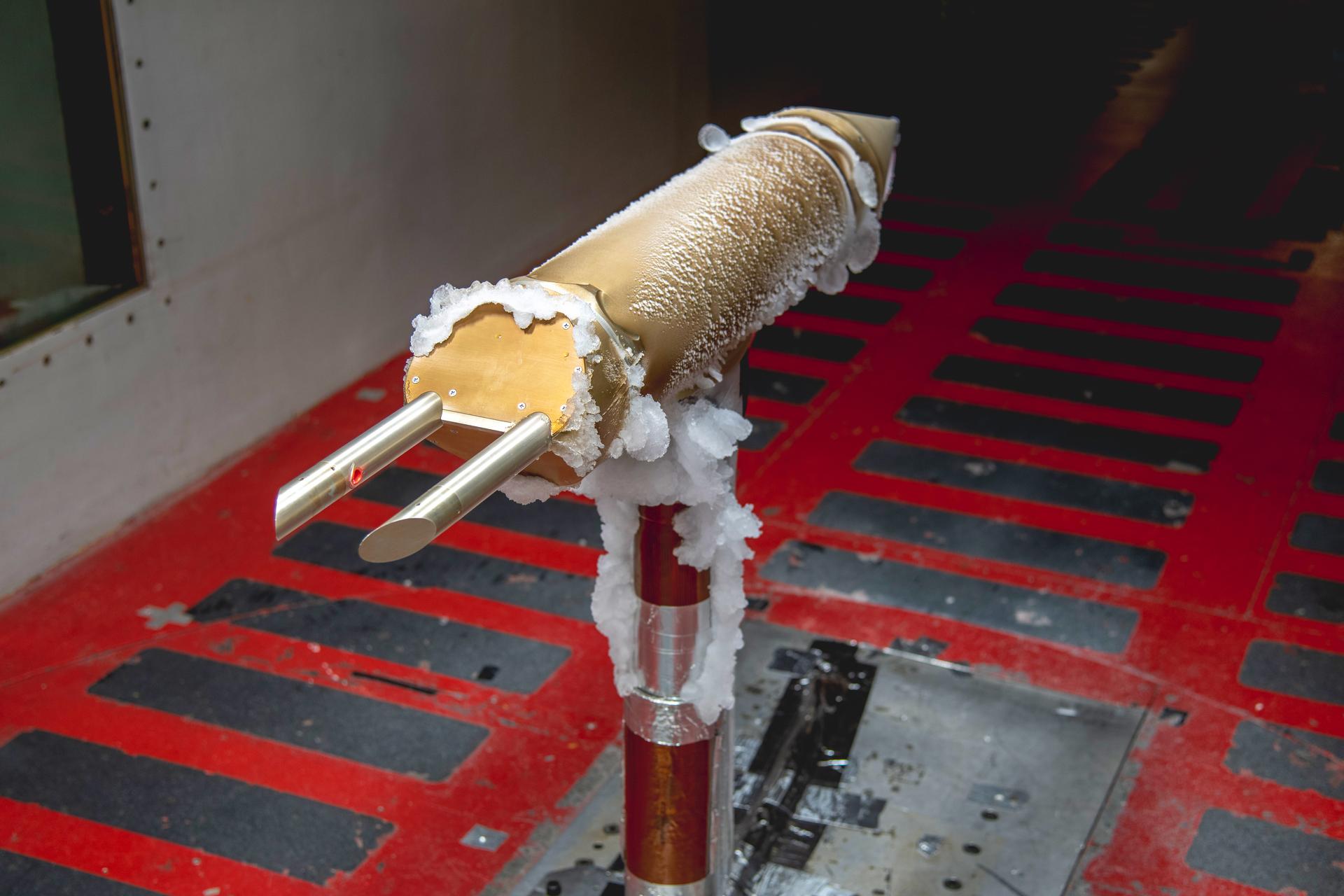
NASA is upgrading its Icing Research Tunnel experiments to better measure and model supercooled large droplet icing, a hazard that can cause ice to form beyond standard protection systems.
NASA is upgrading its experimental toolkit to tackle a stubborn aviation safety challenge: ice that forms when aircraft fly through clouds filled with unusually large, supercooled water droplets.
The hazard, called supercooled large droplet icing, arises when liquid water drops remain unfrozen even though they are below the normal freezing point of 32°F (0°C). In many clouds, this “supercooled” state is common because droplets do not necessarily crystallize until they encounter microscopic particles—such as dust—that can act as seeds for ice formation. Trouble starts when an aircraft passes through these cold liquid drops. On impact, the water can freeze quickly onto aircraft surfaces, including areas not designed to accrete ice.
To better understand the phenomenon and improve the tools used to design safer aircraft, NASA researchers have launched a series of experiments in the Icing Research Tunnel at the agency’s Glenn Research Center in Cleveland. The goal is to help U.S. industry evaluate whether current engineering models—largely developed around more typical icing conditions—accurately represent the complex behavior of much larger droplets.
Under standard icing assumptions, aircraft are built to withstand clouds dominated by droplets roughly 2 to 100 microns in diameter. (For scale, a human hair is about 70 microns wide.) But in rarer atmospheric conditions, clouds can contain droplets as large as 2,000 microns across. These are akin to the drops encountered in freezing rain at ground level, except they can exist aloft in a liquid state despite subfreezing temperatures.
Those oversized droplets pose an outsized engineering problem. Because of their momentum, they can strike and spread differently than smaller droplets—sometimes splashing and flowing farther aft along the airframe. That means ice can accumulate behind conventional ice-protection systems, potentially affecting components and surfaces that designers would not expect to be at risk in normal icing encounters.
NASA’s work in the Icing Research Tunnel focuses on strengthening the experimental foundation behind computer tools used by aircraft manufacturers. While current modeling approaches perform well for typical cloud conditions, engineers have raised questions about whether those tools fully capture the physics of supercooled large droplet impacts, splashing, and freezing behavior.
To close that gap, NASA is enhancing the tunnel’s ability to generate and precisely characterize experimental clouds. Researchers have been testing new probe technology aimed at improving calibration of droplet size distributions produced inside the facility. The new probes can detect droplets larger than 45 microns and calculate their size distribution in real time. NASA plans to validate those real-time measurements against a more time-consuming method that involves post-processing droplet imagery collected in the tunnel.
To ensure the full range of droplet sizes is captured, the team will also combine the large-droplet probe data with measurements from another instrument designed for droplets smaller than 45 microns. Together, the paired measurements provide a complete “spectrum” of droplet sizes—critical information for interpreting icing behavior and assessing how well design tools match reality.
The test campaign represents a key step for NASA’s Subsonic Flight Demonstrator project within the agency’s Research and Technology Mission Directorate. Detailed analysis of the tunnel data is still underway, and NASA says it will release findings to the broader aerospace community once the work is complete.
Why it matters
Icing remains a serious operational risk, and rare large-droplet conditions can challenge aircraft protections designed around more common cloud physics. Better measurements and validated models could influence how manufacturers certify aircraft and how operators assess weather-related hazards. The next watch point is whether NASA’s improved droplet characterization leads to updated industry tools and, ultimately, changes in design or certification practices for supercooled large droplet environments.