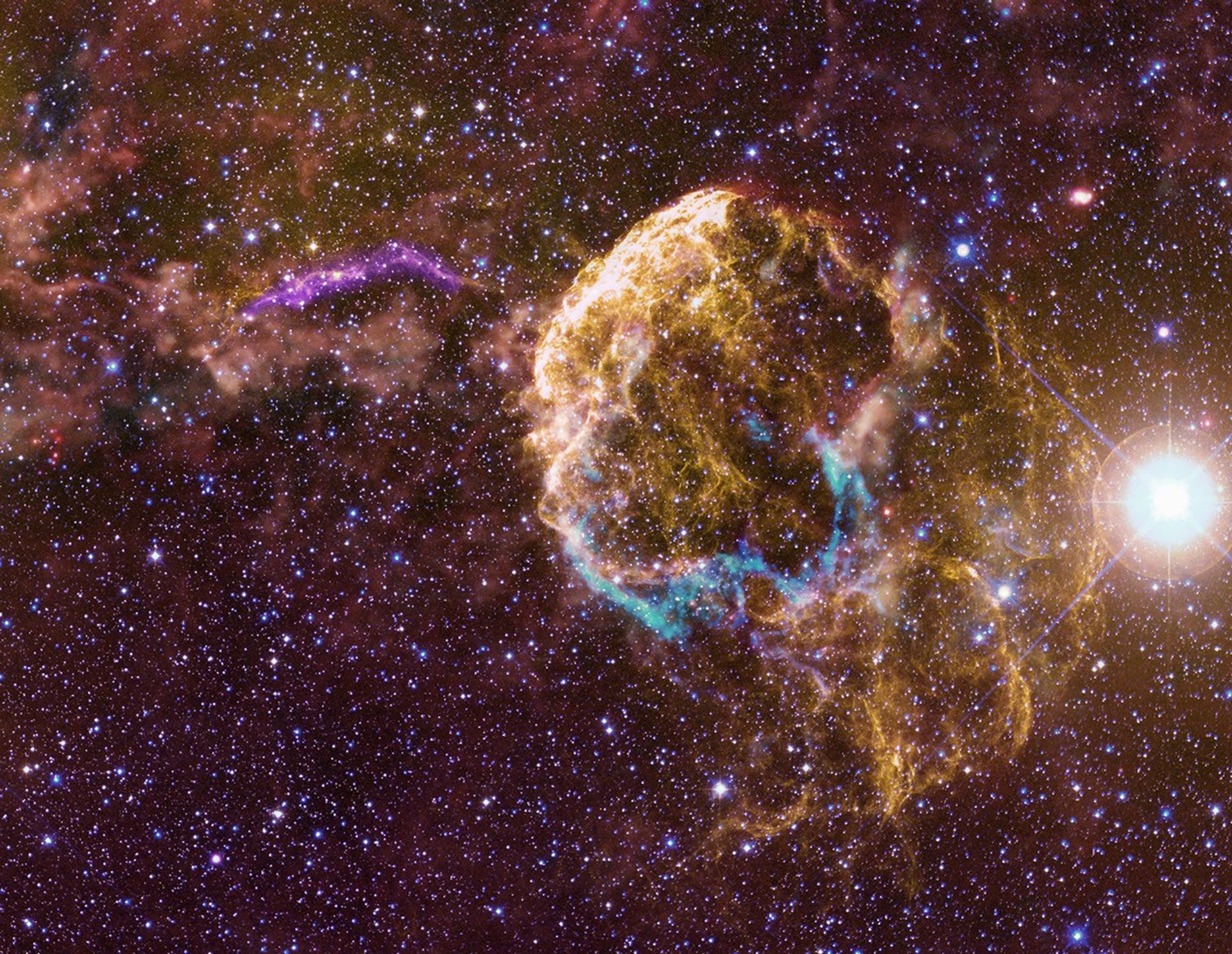
Two overlapping clouds of stellar wreckage in the constellation Gemini may be the aftermath of an extraordinary family drama: a pair of massive stars that once orbited…
Two overlapping clouds of stellar wreckage in the constellation Gemini may be the aftermath of an extraordinary family drama: a pair of massive stars that once orbited each other, each ending its life in a supernova.
In research based on 16 years of observations from NASA’s Fermi Gamma-ray Space Telescope, astronomers report evidence that a faint remnant known as G189.6+3.3 is emitting gamma rays—despite being largely masked by the intense high-energy glow of its much brighter neighbor, the Jellyfish Nebula (IC 443). The team argues that multiple links between the two objects point to a shared origin in a binary star system, potentially making this the first known case in which both members of a stellar pair exploded as supernovae.
“Using 16 years of data from NASA’s Fermi Gamma-ray Space Telescope, our analysis uncovered gamma rays associated with a supernova remnant that was hidden in the glare of its neighbor, the Jellyfish Nebula, one of the brightest gamma-ray-emitting supernova remnants known,” said Miltiadis Michailidis, a postdoctoral researcher in Stanford University’s physics department. “There are so many striking connections between the two remnants that we conclude they’re likely related, giving us the first known example of a binary system where both stars have undergone supernova explosions.” Michailidis presented the results at the 248th meeting of the American Astronomical Society in Pasadena, California. A paper describing the work is slated for a future issue of Nature Communications.
Supernova remnants are expanding shells of hot gas and debris driven outward by the shock waves of stellar explosions. Massive stars trigger these blasts when their energy-generating cores exhaust their fuel and collapse under gravity. Astronomers have identified roughly 300 such remnants in the Milky Way.
The new study focuses on G189.6+3.3, a relatively dim remnant best seen in X-rays, and IC 443, one of the sky’s most luminous gamma-ray supernova remnants. X-ray images show the two structures partly overlapping, and recent X-ray evidence suggests hot plasma associated with G189.6+3.3 may span the entire region—hinting that the overlap could be close to complete.
Fermi’s Large Area Telescope (LAT) has long been used to investigate how supernova shocks accelerate charged particles to near-light speed. More than a decade ago, LAT observations strengthened the case for a mechanism first proposed in 1949 by physicist Enrico Fermi, in which shock waves boost particles into the population known as cosmic rays. Those particles can generate gamma rays—the most energetic form of light—when they collide with interstellar gas.
Because protons account for about 99% of cosmic-ray particles, researchers look for a telltale gamma-ray signature that indicates proton acceleration. When energetic protons strike gas atoms, the collisions can produce neutral pions, short-lived particles that quickly decay into two gamma-ray photons. This characteristic emission falls within an energy range that LAT can detect.
In 2013, Fermi data showed that IC 443 produces gamma rays via this neutral-pion pathway as it interacts with part of a hydrogen cloud complex called Sharpless 249. G189.6+3.3 was first identified in 1994 during an X-ray survey by the German-led ROSAT mission. In the region between the two remnants, a bright filament of gas has now been scrutinized in new observations; the results indicate that the shock from G189.6+3.3 plowed into dense gas there and slowed sharply—evidence that both remnants are pushing into the same interstellar cloud system.
The Jellyfish Nebula is also considered a candidate “PeVatron,” a source capable of accelerating protons to such extreme energies that the resulting gamma rays can reach trillions of times the energy of visible light. If G189.6+3.3 proves to be a second accelerator in the same neighborhood, it could provide a rare opportunity to study how nearby supernova remnants evolve and how they energize cosmic rays.