NASA is weighing a reconnaissance concept that could dramatically accelerate how it assesses off-world resources: a compact spacecraft that identifies minerals from tens…
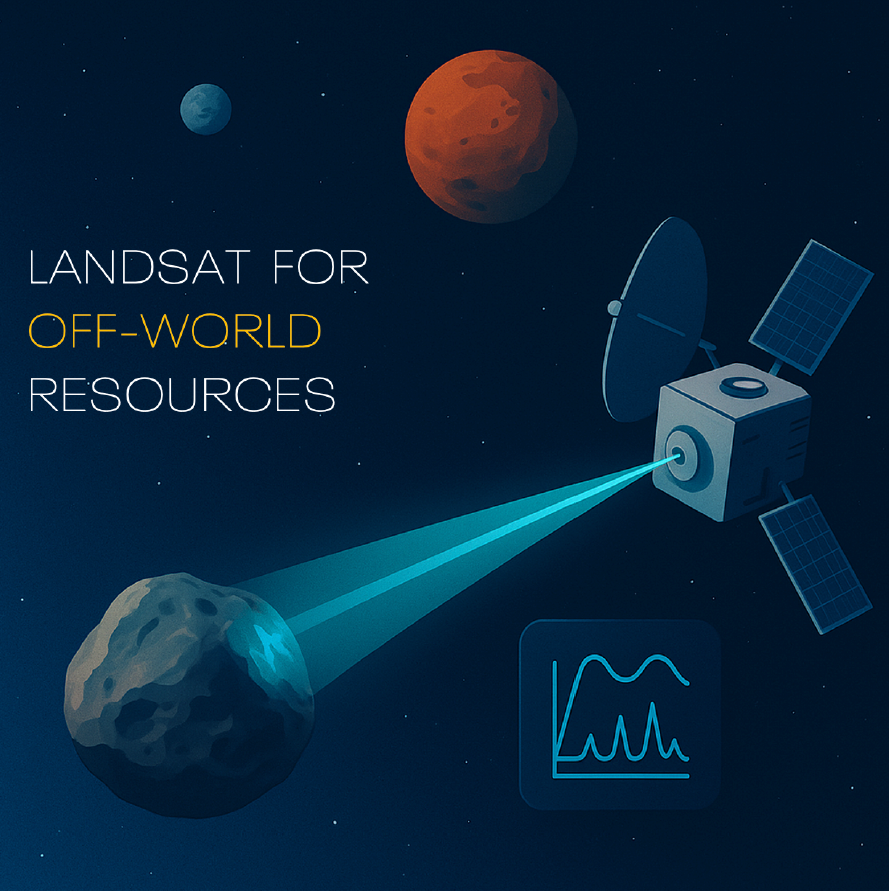
NASA is weighing a reconnaissance concept that could dramatically accelerate how it assesses off-world resources: a compact spacecraft that identifies minerals from tens of kilometers away using Raman spectroscopy during rapid orbital passes and flybys. The idea, outlined in a new NIAC Phase I study proposal, aims to deliver detailed “what is it made of?” answers without the cost and complexity of landing, lingering in orbit for long periods, or returning samples to Earth.
Raman spectroscopy works by illuminating a target with laser light and measuring subtle wavelength shifts in the reflected photons—shifts that act as molecular fingerprints for specific minerals. On Earth, Raman is common in laboratories and field instruments; on other worlds, it has been confined to close-range use, typically meters from the target on rover payloads. The proposal’s central challenge is to push that capability into a new regime: detecting diagnostic Raman lines from a standoff distance of roughly 30 to 50 kilometers, while the spacecraft is moving quickly relative to the surface.
If that can be made to work, the payoff is significant. Compared with passive optical reflectance or neutron measurements, Raman can provide more specific compositional identification, potentially distinguishing key resource-bearing materials that matter for exploration logistics. NASA’s long-term objectives—sustaining a lunar presence, evaluating asteroid resources, and planning Mars supply chains—depend on understanding not just where deposits are, but what phases and mixtures are actually present.
The reference mission concept keeps the platform small: a single roughly 300-kilogram spacecraft using solar electric propulsion to execute three reconnaissance “legs” across the inner Solar System. First, it would enter a 50-kilometer polar orbit at the Moon to map ice and ilmenite, a titanium-iron oxide often discussed in the context of oxygen extraction. Second, it would perform a close 30-kilometer flyby of a near-Earth asteroid to identify silicates, metallic components, and organics. Third, it would orbit Phobos or Deimos at about 30 to 50 kilometers to search for volatile-bearing mineral phases relevant to future Mars mission operations and in-situ resource utilization planning.
To isolate faint Raman signals from orbit, the payload concept relies on a high-energy pulsed laser paired with a time-gated, photon-counting detector—an approach that can reject background light by only “listening” during carefully selected time windows. A radiation-hardened beam-steering system would precisely aim the laser and account for motion during passes. The proposal argues that no existing sensor suite or current mission class offers this combination of long-range molecular specificity and rapid survey capability.
The NIAC Phase I effort is structured around three feasibility questions. First, can the instrument detect key mineral Raman signatures with sufficient signal-to-noise at 50 kilometers? Second, can pointing control and image smear be managed during fast flybys to allow meaningful integration over the short time a target remains in view? Third, can a 300-kilogram spacecraft realistically close the design—propulsion, power, and attitude control—across all three destinations?
To answer these, the team plans first-principles photon-return modeling using known Raman cross-sections, analyses of spacecraft jitter and pointing stability, and trajectory design using NASA’s standard mission-planning tools. Sensitivity studies and decision gates are built in to show how changes in photon yield or pointing performance would affect viability, and the team will also examine alternate architectures, including lower flyby altitudes and different propulsion options.
The investigators bring relevant heritage in both Raman and spaceborne laser systems. Principal investigator Sobron has led 120-meter-range field Raman efforts and contributed to the Mars instruments SuperCam and SHERLOC. NASA Goddard’s Lee and collaborator Yu add experience from ICESat-2 and other orbital laser missions, while NASA Ames’ Casell leads early mission design with prior NIAC involvement. The work is supported by SETI and a commercial partner, OffWorld.
If the concept succeeds, it could define a first-of-its-kind architecture for orbital Raman mineral detection, enabling high-resolution molecular mapping without landing. Even partial validation would sharpen the physics models underlying long-distance Raman sensing and inform future decisions on Artemis site selection, asteroid mining assessments, and Mars resource planning—potentially providing a scalable, Discovery-class template for a fleet of “scout” spacecraft delivering Landsat-like mineral intelligence beyond Earth.