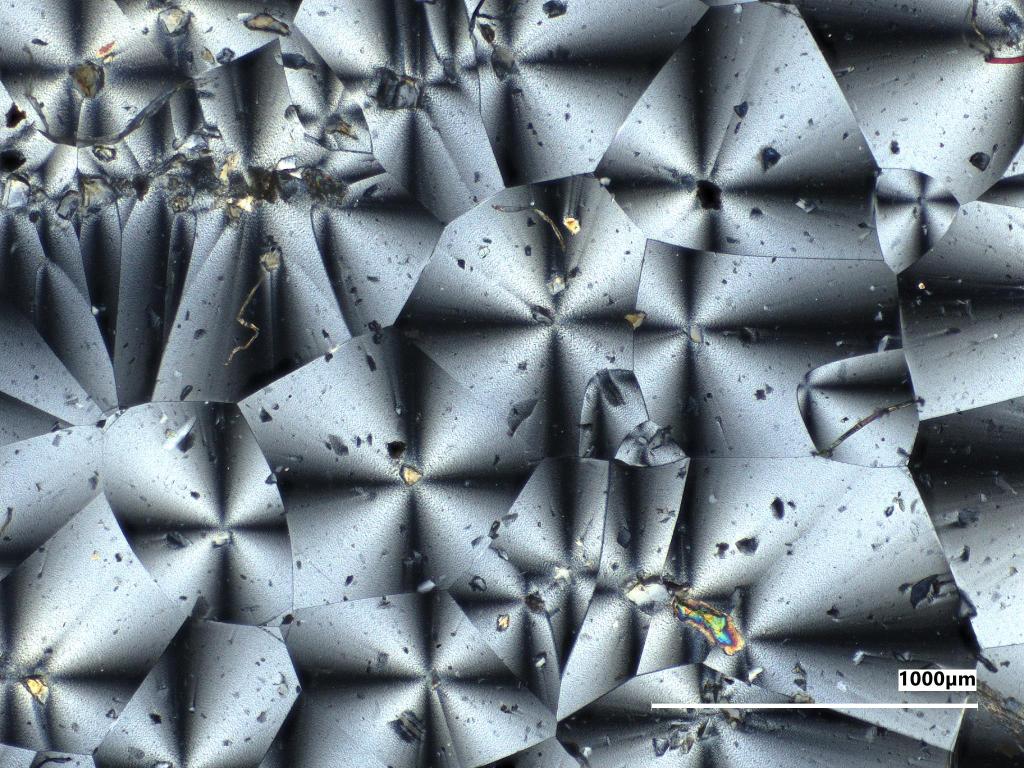
Microscope images are offering a vivid first look at a new NASA-developed manufacturing material designed with future Moon and Mars missions in mind.
Microscope images are offering a vivid first look at a new NASA-developed manufacturing material designed with future Moon and Mars missions in mind. Under magnification, the substance forms brightly colored, mosaic-like crystals—an eye-catching signature of a practical goal: helping astronauts make tools and hardware where they live, rather than launching every replacement from Earth.
The material was created at NASA’s Glenn Research Center in Cleveland, where research chemical engineer Allison Christy led a project aimed at producing usable “space plastics” from resources that could be generated off-Earth. The concept addresses a major constraint of deep-space exploration: every kilogram launched is expensive, and long missions can’t realistically carry backups for every part that might fail.
Christy’s team, which included summer interns Tyler Klinchuch, Ethan Bilodeau, and Emma Levenson, produced the material by combining a specialized biodegradable plastic with simulated lunar and Martian soil. The plastic in question can be made biologically: bacteria can generate it when fed inputs that could plausibly be available in a habitat, including crew waste or carbon dioxide. As Christy describes it, the polymer effectively accumulates inside microbial cells—an approach that could allow manufacturing feedstock to be “grown” during a mission.
The key advance came from mixing the plastic with fine particles resembling Moon and Mars dust. Glenn researchers found that adding these simulated regolith particles improved performance, making the composite both stronger and easier to work with. By changing the type of dust and adjusting how much was added, the team could tune the material’s characteristics for different needs.
The microscope imagery highlights how the regolith source influences the final product. Samples produced with mock lunar dust appear gray, while those made with Mars simulant show a reddish tone—visual reminders that the same underlying recipe can incorporate local materials from two very different worlds.
NASA envisions a range of practical uses inside future habitats. The composite could be shaped into functional components such as structural brackets, hand tools like wrenches, or everyday items such as chairs. More broadly, the approach points toward on-demand fabrication systems that are fully recyclable and rely heavily on what crews can produce or collect locally. That capability aligns with NASA’s longer-term ambition of sustaining a permanent presence on the Moon by reducing the need for constant resupply launches and giving astronauts more autonomy to build, repair, and adapt equipment on site.
“You can’t just bring everything with you to the Moon or Mars,” Christy noted, emphasizing that versatility is essential when replacement parts are months away.
The next question is whether the material can move beyond indoor habitat use. The Glenn team plans to evaluate how it handles the punishing conditions on the lunar and Martian surface, where temperature swings and other extremes can quickly degrade conventional materials. Testing is already underway in Glenn’s Lunar Environment Structural Test Rig, which subjects samples to severe thermal conditions. Additional specimens are scheduled to fly on Materials International Space Station Experiment 23 (MISSE-23), where they will be mounted outside the International Space Station to face intense exposure in space.
Funding for the effort comes through NASA Glenn’s 2026 Center Innovation Fund, overseen by NASA’s Research and Technology Mission Directorate.