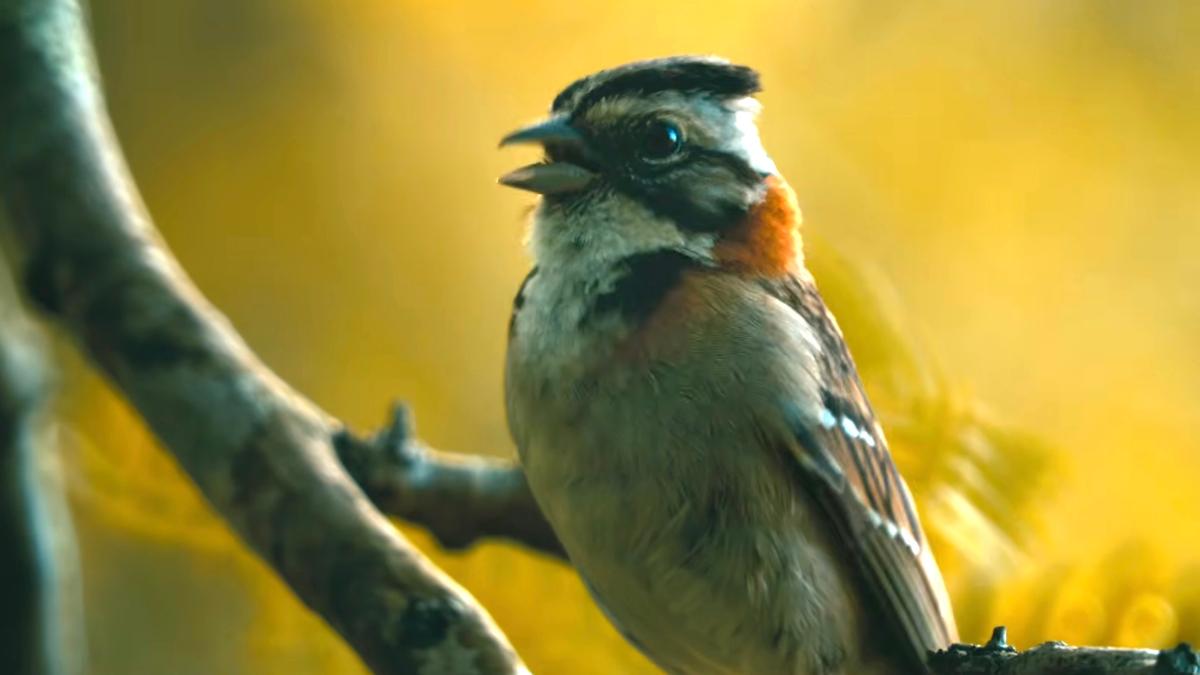
A documentary follows physicist Gabriel Mindlin’s quest to revive vanished chingolo songs, using mathematical reconstructions and robotic tutors to test whether sparrows will relearn lost traditions.
Argentine physicist Gabriel Mindlin has devoted much of his scientific life to a deceptively simple question: how do birds learn to sing? His work centres on the rufous-collared sparrow (Zonotrichia capensis), a familiar sight and sound in cities and suburbs across Argentina, where many people know it as the “chingolo.”
For this species—like many other songbirds—song is not something males are born knowing. Instead, young males acquire their vocal repertoire by listening to adult males. Once learned, these songs become a lasting part of their lives, used to mark and defend territory and to attract mates. In other words, birdsong functions as a kind of cultural inheritance, passed from one generation to the next.
A short documentary by Argentine filmmaker Martín Benchimol follows Mindlin as he pursues a new and unusual line of inquiry: what happens to that inheritance over long stretches of time. The project began with a comparison across decades. Mindlin looked at contemporary chingolo songs alongside versions that had been painstakingly written down by hand in the 1960s. That side-by-side view revealed a striking pattern. Some melodies appeared to have persisted essentially intact, surviving the churn of generations. Others, once present in the historical record, seemed to have vanished from today’s populations.
Rather than treating those missing songs as irretrievably lost, Mindlin and his colleagues approached them as a scientific and mathematical problem. Drawing on mathematical modelling, the team worked to reconstruct the disappeared vocal patterns—reviving songs that no longer seemed to exist in the wild. The ambition did not stop at recovery on paper or in code. The researchers set out to return those reconstructed tunes to living birds and see whether a new generation could learn them.
Benchimol’s film tracks the effort as it moves from analysis to field experiment. To act as instructors, the team built robotic song tutors—devices designed to play back the recreated chingolo songs with consistency in real-world conditions. These artificial “teachers” were then placed outdoors, in the birds’ natural environment, where young sparrows would have the opportunity to hear the sounds during the critical learning period.
The researchers’ goal is as bold as it is carefully framed: to test whether a population can be prompted to adopt vocal traditions that had dropped out of circulation. Doing so requires more than broadcasting audio. It means monitoring how juvenile birds respond, and determining whether the revived melodies are copied and retained rather than ignored or overwritten by other, more common song variants.
Through Benchimol’s cinematic lens, the project becomes both a field study and an experiment in “cultural engineering”—an attempt to intervene in the transmission of animal culture using tools from physics, mathematics and technology, while keeping a close watch on what the birds themselves decide to learn.
Why it matters
Birdsong is a real-world model of cultural evolution, offering clues about how learned behaviours persist—or disappear—over time. If researchers can identify why certain songs endure while others fade, it could reshape how scientists think about animal learning and tradition. The work also raises broader questions about whether and when humans should attempt to restore lost behavioural traits in wild populations, and what the ecological consequences might be.