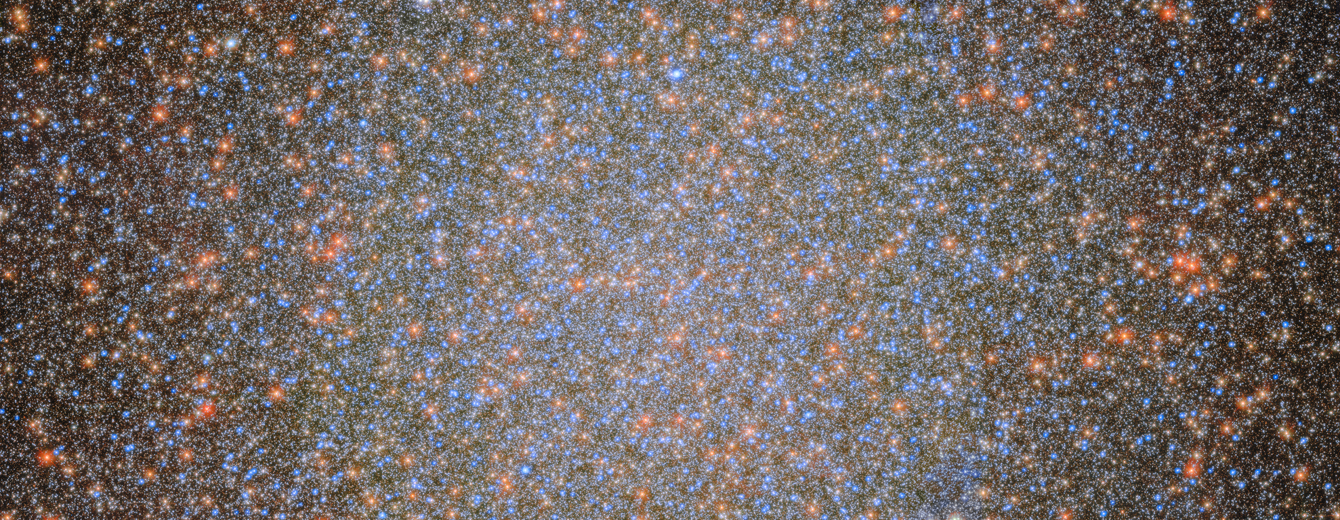
For years, Omega Centauri has stood out as one of astronomy’s more stubborn mysteries.
For years, Omega Centauri has stood out as one of astronomy’s more stubborn mysteries. The immense globular cluster—packed with roughly 10 million stars bound together by gravity—ought to be teeming with black holes produced when massive stars ended their lives in explosions. Yet repeated searches have turned up little sign of the expected population.
Now researchers say they have finally found the first clear example of a stellar-mass black hole inside Omega Centauri, using a painstaking reanalysis of NASA’s Hubble Space Telescope archives combined with follow-up measurements from the James Webb Space Telescope. The results, published Monday in The Astrophysical Journal Letters, mark the first detection of what models suggest should be a much larger hidden group of black holes in the cluster and could sharpen scientists’ understanding of how black holes form in environments like this one.
Omega Centauri has long intrigued researchers not only for its size, but also because earlier Hubble work hinted that an intermediate-mass black hole may sit near its center. At the same time, theoretical models indicate the cluster should harbor on the order of 10,000 smaller black holes—those a few times the mass of the Sun that form from individual massive stars. Traditional efforts to find them have largely relied on watching stars’ line-of-sight motions (the radial-velocity technique) or hunting for radio and X-ray signals from gas being pulled onto a compact object. Those approaches, however, can miss black holes that are quiet and not actively feeding.
The new study took a different route: astrometry, the precise tracking of stars’ positions on the sky over time. By combing through more than two decades of Hubble observations and using Webb data to further improve the positional accuracy, the team identified a star whose motion revealed it was circling an unseen, massive companion. The invisible object, they concluded, must be a black hole. They have named it oMEGACat BH-2.
The binary system, located about 18,000 light-years away in the crowded interior of Omega Centauri, stands out for two reasons. First, the black hole’s mass is lower than researchers expected for a cluster that is relatively metal-poor—an environment where massive stars are often thought to leave behind heavier black holes. Second, the system’s orbit is extraordinarily wide. The visible companion is a main-sequence star, and the pair completes one orbit only once every 94 years, making it the longest-period black hole binary currently known.
Matthew Whitaker of the University of Utah, the paper’s lead author, said the detection depended on the exquisite stability and resolution of both space telescopes. The analysis tracked the companion star’s subtle drift—measurable only as a tiny fraction of a detector pixel—as it moved fastest during its closest passage to the black hole.
The work also revises an earlier interpretation of the same star system. A previous study had suggested the dark companion might be a neutron star. With Hubble measurements spanning 2002 to 2023 and Webb’s near-infrared data improving the astrometric precision, the new team was able to better pin down the companion’s mass and rule out the neutron-star explanation. Coauthor Anil Seth said the star’s mass is about 0.78 times that of the Sun, while the unseen object weighs in at 4.46 solar masses—too heavy to be a neutron star, but unexpectedly light given Omega Centauri’s low metallicity.
The unusually long orbit also hints at the system’s history. Rather than forming together as a normal stellar pair, the researchers argue the black hole and its companion likely met later through gravitational encounters within the dense cluster—an origin consistent with the complex, dynamic environment of Omega Centauri.