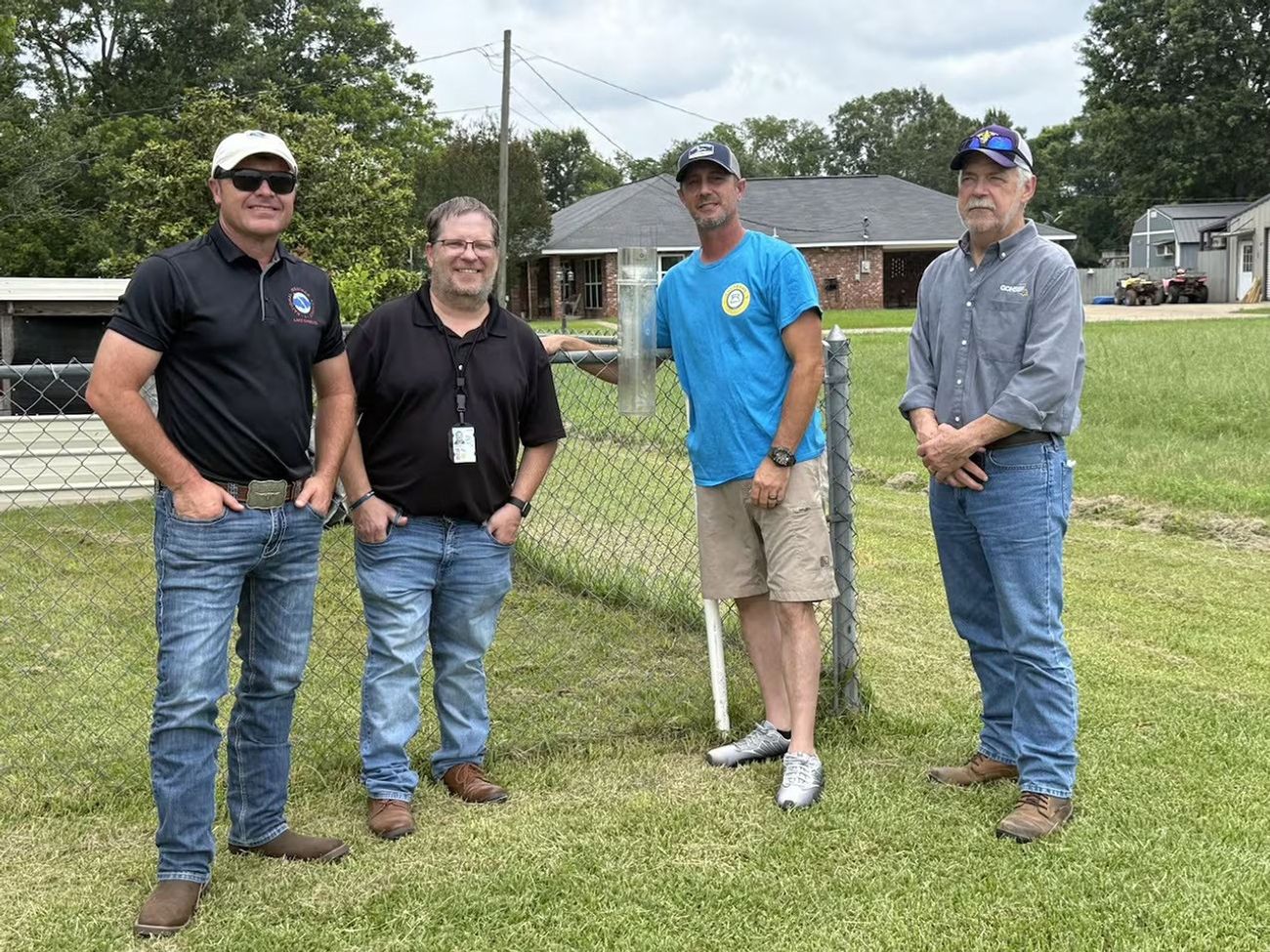
Matt Carnicle wasn’t chasing history when he stepped outside to check his rain gauge.
Matt Carnicle wasn’t chasing history when he stepped outside to check his rain gauge. A volunteer observer for the NASA-supported Community Collaborative Rain, Hail, and Snow Network—better known as CoCoRaHS—Carnicle says he simply follows the routine: read the gauge and report whatever it holds, whether that’s nothing at all or a fraction of an inch.
On June 18, 2026, the number staring back at him was anything but routine. Carnicle recorded 29.06 inches of rain in a 24-hour period, a measurement that surpasses Louisiana’s standing state record of 22.00 inches set in 1962. Even more striking, the bulk of that total fell in under 12 hours.
CoCoRaHS (pronounced “KO-ko-rozz”) is built around ordinary people making careful measurements in their own neighborhoods. The project links thousands of volunteers—students, retirees, weather enthusiasts, and others—who use standardized instruments to track rain, hail, and snow. Those daily reports are publicly posted online and have become a widely used data source for everything from refining forecasts to supporting water and land management decisions. The information also feeds into atmospheric modeling and can help authorities issue flash-flood and severe-weather alerts.
Carnicle’s path into the program began in a storm-spotter course, where he learned that CoCoRaHS contributes to a NASA hail research effort focused on the Gulf States and the broader Southeast. In that work, volunteer hail reports and photographs help scientists study how quickly hailstones melt as they fall—comparing satellite-based estimates of hail size within storms to what actually reaches the ground.
To participate, Carnicle bought the standardized manual rain gauge required by the network. The instrument is designed to measure precipitation to the nearest one-hundredth of an inch and meets National Weather Service specifications. CoCoRaHS does not accept readings from automated gauges for official reporting, emphasizing consistency and precision across the nationwide volunteer network.
After the June deluge, Louisiana State Climatologist Jay Grymes reviewed and confirmed Carnicle’s measurement in coordination with National Weather Service representatives. Grymes said an event of this intensity in that part of the state is expected to occur less than once in 1,000 years, underscoring the rarity of the storm.
The record is not yet final in the formal sense. A committee convened by the National Oceanic and Atmospheric Administration (NOAA) is expected to meet in the coming months to evaluate the documentation, verify the result, and archive the new benchmark if it meets all criteria. For broader perspective, the national U.S. record for rainfall in 24 hours belongs to Hawaii, where 49.69 inches has been recorded.
CoCoRaHS organizers say Carnicle’s experience illustrates what the program is designed to do: harness many careful observations to build a detailed picture of weather extremes. Volunteers who want to contribute can sign up through NASA’s citizen science portal and submit “official” precipitation reports that are shared with the National Weather Service. In the Southeast, the network is also encouraging participants to report hail as the NASA research continues into how hail changes from cloud to ground.