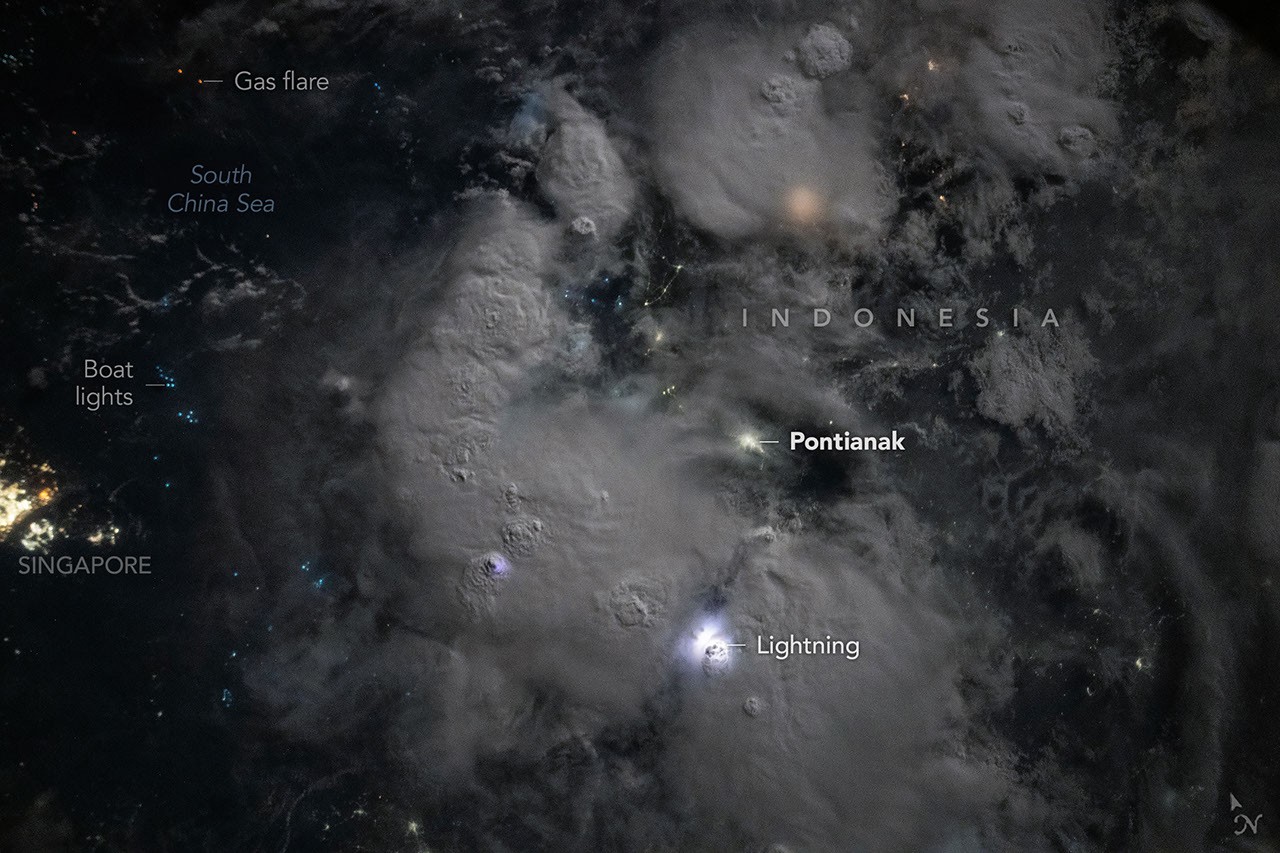
A photo from the International Space Station captures lightning-lit thunderstorms over Southeast Asia alongside city lights, fishing fleets and possible gas flares.
From the International Space Station, nighttime on Earth can rival the starfield beyond the windows. Astronauts have long described the planet’s after-dark glow as a mix of human activity and atmospheric drama—city grids and coastlines traced in light, fleets working the oceans like artificial constellations, and storms pulsing with lightning.
NASA astronaut Donald Pettit, an avid photographer, once wrote in Air & Space that cities viewed from orbit resemble illuminated tendrils, their brightness evoking the glitter of theater marquees. He also noted that intense clusters of lights at sea—often fishing operations—can look like unfamiliar star patterns scattered across dark water. Sally Ride, the first American woman in space, highlighted another orbital spectacle in an essay for the same magazine: lightning. From the ground, people watch bolts under clouds; from orbit, astronauts see flashes bloom through cloud tops, spreading into bright, rounded bursts. When storm systems stretch for hundreds of miles, she wrote, the effect can resemble fireworks arcing from cloud to cloud.
A single pass of the space station over the South China Sea near Borneo showcased all three phenomena at once. At 14:20 UTC on October 28, 2026 (9:20 p.m. Western Indonesian Time), an Expedition 75 crew member photographed the region with a Nikon Z9 camera. In the image, thunderstorms dominate the scene, including several “overshooting tops”—bulging domes that push above a storm’s flat anvil cloud and can even intrude into the stratosphere. These features signal especially strong updrafts and are typically associated with powerful, vigorous storms. Two of the overshooting tops were caught in the moment of illumination from lightning within the cloud system.
Human lights anchor the left side of the view. Singapore—home to about 6.2 million people—appears brightly lit, separated from Indonesia’s Batam and Bintan islands by the curving Singapore Strait. West of Singapore, a compact grouping of blue points stands out against the black sea, reminiscent of the Pleiades star cluster. The likely source is fishing boats using powerful lamps to attract squid or schooling fish such as sardines and anchovies. Farther offshore to the northwest, scattered orange glows are consistent with gas flares.
For many astronauts, however, it is lightning that leaves the most lasting impression. NASA astronaut Anil Menon recently described it as his favorite view from space, likening the frequent flickers along Earth’s dark edge to fireflies. He has noted how difficult lightning is to capture and convey, but said that real-time video of the phenomenon best communicates the scale of storms and the rapid, dancing cadence of the flashes.
Lightning’s prevalence is staggering. NASA scientists estimate that roughly 2,000 thunderstorms are active worldwide at any given moment, generating close to 60 lightning flashes per second—about 5 million per day.
The photograph, designated ISS075-E-250951, was taken with a 14-millimeter focal length and is distributed through NASA’s ISS Crew Earth Observations Facility and the Earth Science and Remote Sensing Unit at Johnson Space Center. NASA reports the image was cropped and contrast-enhanced, with lens artifacts removed. The station’s program supports Earth-imaging efforts through the ISS National Lab, making astronaut photography broadly available to scientists and the public through NASA’s online archives.
Why it matters
Astronaut imagery offers a unique, top-down view of severe storms, offshore industrial activity, and night fishing—features that are difficult to contextualize from the ground. Observations such as overshooting tops and lightning bursts can help scientists better understand storm intensity and atmospheric dynamics. As more high-quality imagery is released quickly to the public, researchers and educators gain fresh material to track change and explain Earth systems in real time.