Two centuries after cannons thundered at the edge of Baltimore, the port city remains etched into U.S.
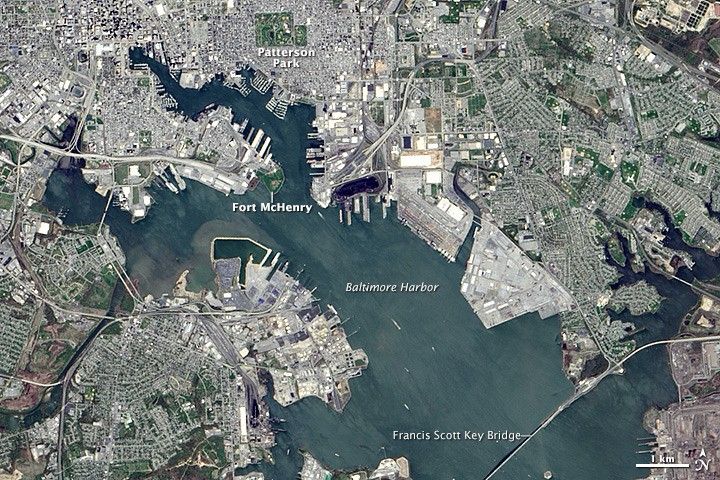
Two centuries after cannons thundered at the edge of Baltimore, the port city remains etched into U.S. history as the setting that inspired the words Americans still sing before ballgames and civic ceremonies. A modern view underscores just how specific that moment was: on April 24, 2014, Landsat 8’s Operational Land Imager captured Baltimore and its harbor from orbit, with Fort McHenry’s distinctive star-shaped walls guarding the entrance to what is now the Inner Harbor.
In September 1814, that shoreline became a focal point in the War of 1812. British commanders pressed toward Baltimore after a bold August 24 raid that burned the White House and the U.S. Capitol in Washington, D.C. On September 12, British troops came ashore at North Point, about 5 miles (8 kilometers) southeast of Baltimore—just beyond the lower right portion of the satellite image—and skirmished with American defenders in a series of smaller engagements.
By September 13, the British land advance neared the city but met stiff resistance. U.S. Army units and Maryland militia forces had prepared a defensive line stretching roughly a mile, reinforced with earthen fortifications and trenches along Hampstead Hill, close to today’s Patterson Park near the top center of the scene. The ground assault stalled.
Offshore, the British navy tried a different approach. On the morning of September 13, warships positioned themselves near the area labeled Baltimore Harbor in the image and opened a sustained attack on Fort McHenry. For 25 hours, they fired rockets and cannonballs while keeping their distance—close enough to reach the fort, but far enough to stay outside the effective range of American guns. The bombardment failed to force a surrender. The defenders also benefited from a deliberate obstacle: several merchant vessels had been sunk to hinder passage through the harbor. By the morning of September 14, the British called off the attack.
That night’s spectacle was witnessed by Francis Scott Key, a young American lawyer and negotiator who had boarded a British ship in the Patapsco River to seek the release of American prisoners of war. Maryland tradition holds that the HMS Tonnant lay at anchor near the site of today’s Key Bridge, a location that would have given him a clear line of sight toward Fort McHenry and the nighttime barrage—later immortalized as “the rockets’ red glare” and “the bombs bursting in air.” At dawn on September 14, a fresh American flag measuring 30 by 42 feet was raised above the fort, visible proof that the defenses had held.
Key put his reaction into four verses titled “Defense of Fort M’Henry,” which appeared in print on September 20, 1814, in the Baltimore Patriot and the Advertiser. The song would be renamed “The Star-Spangled Banner” and, much later, officially adopted as the U.S. national anthem in 1931.
Baltimore’s importance did not end with that battle. Long a major East Coast seaport, the city benefited from road and rail connections to agricultural and industrial centers farther inland, especially in the Midwest. Set on the Chesapeake Bay, Baltimore is now home to more than 600,000 people. Some media reports estimate that nearly one-quarter of jobs in the region are tied to science, technology, engineering, and mathematics. The city also hosts the Space Telescope Science Institute, the operations center for the Hubble Space Telescope.