Skywatchers who have witnessed a full Moon climbing above the horizon know how quickly the scene can transform—both in color and mood—as daylight fades.
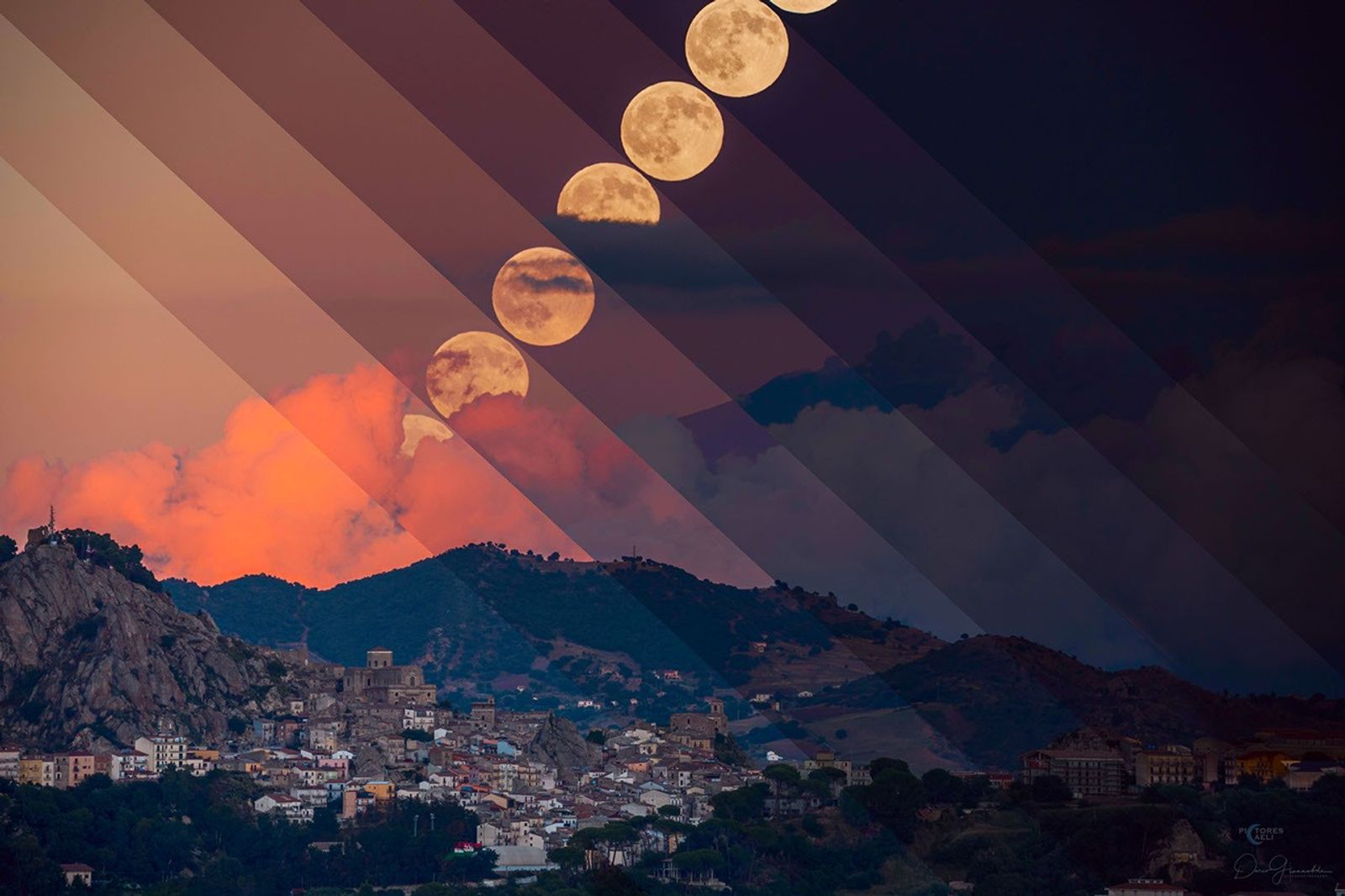
Skywatchers who have witnessed a full Moon climbing above the horizon know how quickly the scene can transform—both in color and mood—as daylight fades. A striking example was captured last weekend in Sicily, just outside the town of Nicosia, where the rising full Moon appeared against a sky shifting from late twilight into night.
The image, made as a composite, tracks the Moon’s ascent over time rather than freezing a single instant. As the sequence progresses, the background deepens in tone, revealing layered atmospheric effects. Low-lying clouds take on the warm, subtle hues of antitwilight—colors that emerge opposite the setting Sun. Higher in the distance, the view includes Mount Etna, where an active plume of ash and gas adds a dramatic, natural counterpoint to the Moon’s steady climb.
One of the most eye-catching elements sits close to the horizon: a soft pink arc known as the Belt of Venus. This band is a familiar feature of twilight, caused by sunlight scattered through Earth’s atmosphere and often paired visually with the darker band of Earth’s shadow beneath it. In the Sicilian scene, the Belt of Venus provides a pastel base layer for the composition, while the volcanic emissions create a textured backdrop above.
The timing of a full Moon explains why it so often feels like a celestial handoff between day and night. At full phase, the Moon and Sun occupy opposite sides of the sky as seen from Earth. As the Sun drops in the west, the full Moon rises in the east, making moonrise and sunset effectively synchronized.
That alignment is part of the Moon’s repeating cycle of phases, which returns roughly every 29.5 days. The number is longer than the Moon’s approximate 27-day trip around Earth because Earth itself is moving along its orbit around the Sun; the Moon must travel a little farther to recreate the same Sun–Earth–Moon geometry that produces each phase.
Cultural traditions have long attached seasonal names to full Moons, reflecting the rhythms of agriculture and local climate. In parts of the Northern Hemisphere, the full Moon occurring in September is often referred to as the Harvest Moon, a nod to its historical association with the harvest season.
The featured image and explanation were presented as part of the long-running “Astronomy Picture of the Day” series, which highlights a new view of the universe daily with commentary from a professional astronomer. The project also notes two logistical updates for readers and contributors: the email address used for image submissions has changed, and APOD’s primary NASA home has moved from apod.nasa.gov to science.nasa.gov/apod.