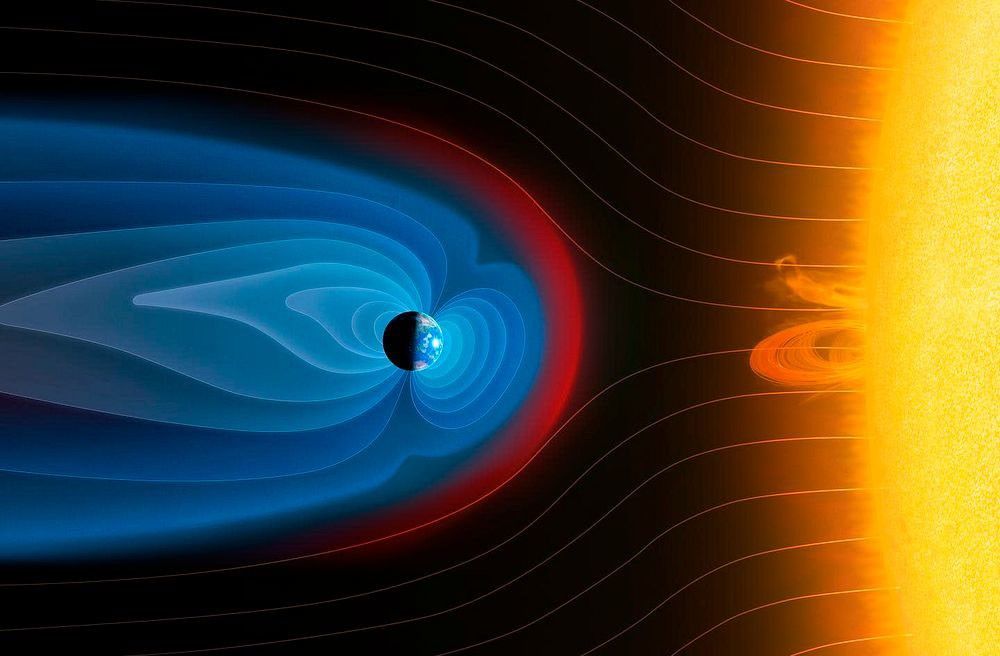
A torrent of electrically charged particles constantly streams outward from the Sun at immense speed.
A torrent of electrically charged particles constantly streams outward from the Sun at immense speed. On the sunward side of Earth, that solar wind slams into our planet’s magnetic defenses about 56,000 miles (90,000 kilometers) away, piling up into a persistent shock wave that arcs around Earth and extends hundreds of thousands of miles into space. NASA is now asking the public to help investigate this vast boundary through a new citizen-science effort called Shock Detectives.
The target of the project is Earth’s “bow shock,” the space-weather equivalent of the pressure wave that forms ahead of a supersonic aircraft. At this collision front, the solar wind’s magnetic field and plasma can behave in markedly different ways. Sometimes conditions remain relatively orderly, producing what researchers describe as a smooth, stable—or “peaceful”—flow. At other times the region becomes turbulent and highly variable, creating “chaotic” plasma.
That distinction matters because turbulence can open pathways for more energy from the solar wind to leak deeper into Earth’s magnetosphere. When that happens, the effects can cascade into the technologies modern life depends on. Enhanced energy transfer can contribute to space-weather events that disturb GPS performance, degrade communications, and in extreme cases stress electrical power grids. Yet scientists still don’t have a complete picture of what triggers the switch between peaceful and chaotic behavior, or how reliably those changes translate into greater energy input to Earth’s near-space environment.
One reason the puzzle remains unsolved is the sheer scale of the available observations. NASA’s Magnetospheric Multiscale (MMS) mission—designed to probe the dynamics of Earth’s magnetic environment—has been flying through these regions for more than a decade, returning an enormous archive of measurements. The dataset is so large that researchers cannot realistically classify every interval on their own. Shock Detectives aims to bridge that gap by enlisting volunteers to help sift through MMS observations and identify where the bow shock appears calm versus turbulent. Those human classifications can provide scientists with a set of labeled examples—critical clues for deeper analysis of when and why the plasma becomes chaotic.
The implications extend beyond Earth. Bow shocks are not unique to our planet; they arise wherever a fast stellar wind encounters a magnetic obstacle. By clarifying how the Sun’s wind couples to Earth’s magnetosphere at this shock front, researchers can improve their understanding of how other stars may influence the space environments of planets orbiting them—a step toward interpreting space weather across the galaxy.
Shock Detectives is also designed to complement another NASA-supported public project, Space Umbrella, which uses MMS data and imagery to examine the broader boundary separating Earth’s magnetic shield from the solar wind. Where Space Umbrella looks at that large-scale interface, Shock Detectives zooms in just outside it, focusing on the transition region near the shock itself—an area that can be up to about 10 miles (17 kilometers) thick—to better capture how plasma behaves as it crosses the boundary. Together, the two efforts aim to assemble a more complete, multi-layered portrait of Earth’s space environment.
Volunteers can join the project and start contributing through NASA’s Shock Detectives page: https://go.nasa.gov/42FhNlZ. An introduction video is also available for those who want a quick orientation before beginning.