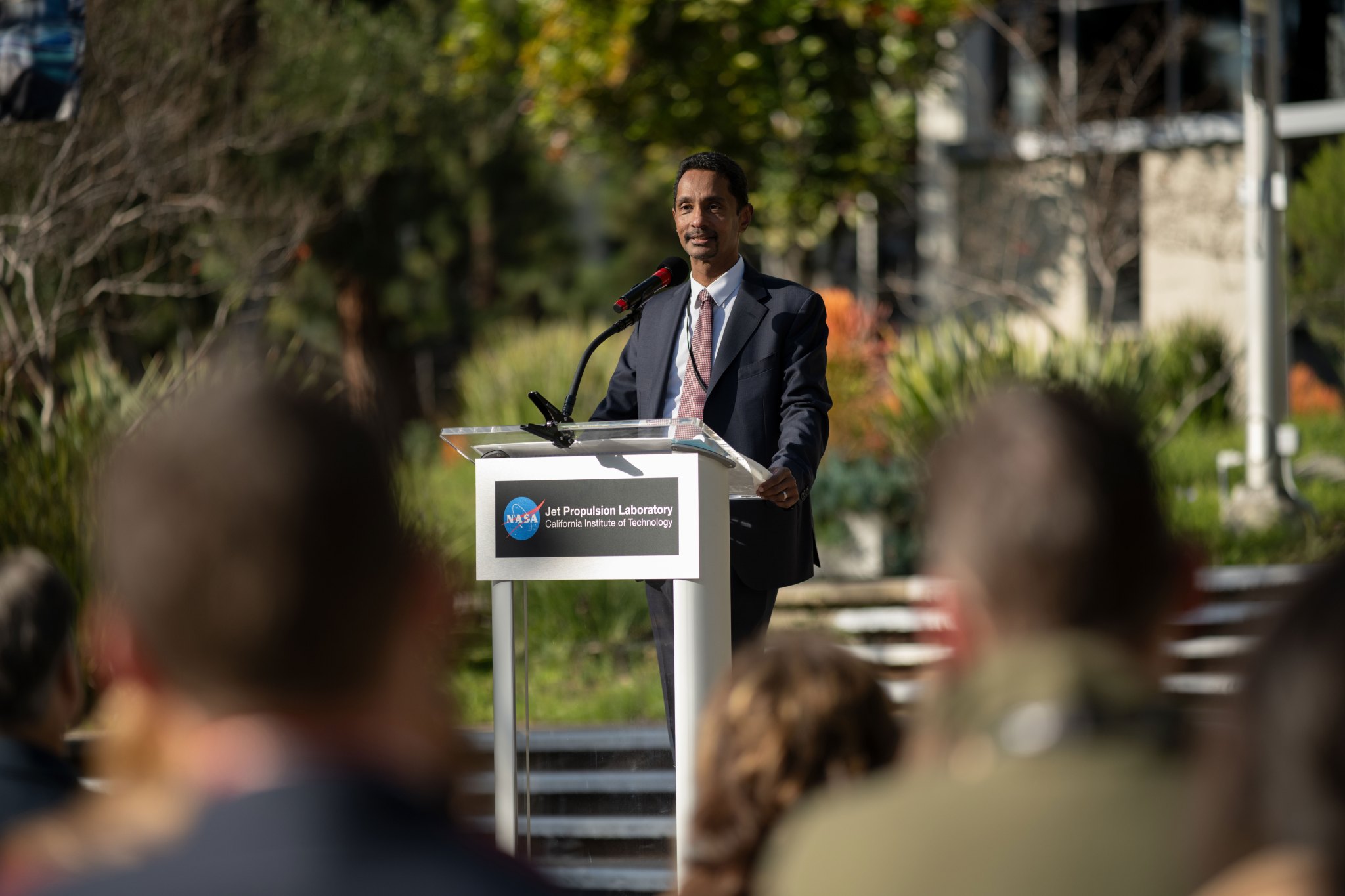
Ray Jayawardhana officially starts work today as the 10th president of the California Institute of Technology, taking over leadership of the Pasadena-based research…
Ray Jayawardhana officially starts work today as the 10th president of the California Institute of Technology, taking over leadership of the Pasadena-based research university and adding the Sonja and William Davidow Presidential Chair to his new role as a professor of astronomy. Caltech announced his appointment on Jan. 6. He replaces Thomas Rosenbaum, who led the institute beginning in 2014.
Jayawardhana arrives at an institution with an outsized footprint in U.S. science and engineering. Founded in 1891, Caltech has long been intertwined with the nation’s space ambitions through its management of NASA’s Jet Propulsion Laboratory. JPL’s roots reach back to 1936, when Caltech graduate students and fellow rocket enthusiasts began experimenting with rocket propulsion. After NASA was created in 1958, JPL became the agency’s first—and still only—federally funded research and development center.
In his first message to the Caltech community, Jayawardhana framed his presidency as a continuation of a legacy of exploration shared by the campus and JPL. He described Caltech and the lab as longstanding symbols of humanity’s drive to discover and said he intends to champion the institute’s mission and the people who carry it out. Among his priorities, he pointed to investments in high-risk, high-reward “blue-sky” research across campus, JPL, and Caltech’s global observatory network; strengthening education for undergraduate and graduate students as well as postdoctoral scholars; and deepening the institute’s connection with the public.
JPL Director Dave Gallagher cast the leadership transition as arriving at a consequential time for Caltech, the lab, and NASA. Gallagher said the laboratory is eager to work with Jayawardhana on projects aimed at expanding U.S. exploration in the solar system, enabling major scientific advances, and motivating the next generation.
Before coming to Caltech, Jayawardhana served as provost at Johns Hopkins University, where he supervised the institution’s 10 schools along with a wide range of interdisciplinary initiatives, academic centers, and major administrative and operational functions. Earlier, he was Cornell University’s Harold Tanner Dean of the College of Arts and Sciences and held the Hans A. Bethe Professorship as well as a professorship in astronomy. His academic career also includes the University of Toronto, where he held a Canada Research Chair and advised the university president on science engagement.
Trained as an astronomer, Jayawardhana earned a Ph.D. from Harvard University and bachelor’s degrees in astronomy and physics from Yale University. He is known for research on how planets and planetary systems arise and change over time, and on the formation of stars and brown dwarfs. His work relies on remote sensing observations from leading facilities on Earth and in space, including the W. M. Keck Observatory—co-managed by Caltech and the University of California—and NASA’s James Webb Space Telescope. With collaborators, he studies exoplanets by probing their properties and atmospheres, with the broader goal of evaluating the potential for life beyond Earth.
Jayawardhana is also part of the core science team for Webb’s Near Infrared Imager and Slitless Spectrograph (NIRISS) instrument, and his group has led Gemini Observatory large programs focused on high-resolution spectroscopy of exoplanet atmospheres. Caltech says he will continue that research while carrying out his presidential duties as a faculty member in the Division of Physics, Mathematics and Astronomy.
Reflecting on the institution he now leads, Jayawardhana wrote that he has been repeatedly impressed not only by the ambition and quality of work underway at Caltech and JPL, but also by a community he sees as unwilling to leave the hardest questions unresolved.