Inconsistency turns out to be the organizing feature of the chapter 8 in which I “the most prolific academic critic of the emergency docket” repeatedly appear.
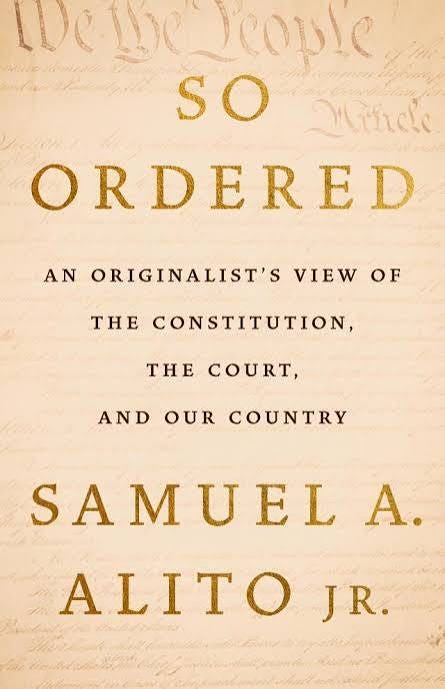
Inconsistency turns out to be the organizing feature of the chapter [8] in which I (“the most prolific academic critic of the emergency docket”) repeatedly appear. The central inconsistency… is structural…. Alito mashed together the speech he gave five years ago at Notre Dame Law School with a “postscript.” The former was deeply flawed…. The latter tries to move the goalposts…. The result is to leave readers with a disjointed, inaccurate, and misleading sense of what the debate is evenabout—to say nothing of how the Court’s own behaviorsinceSeptember 2021 (including Alito’s) has only further undermined the already-flawed claims Alito made back then… Alito was adamant, in his Notre Dame speech, that rulings on emergency applicationsdon’thave precedential value…. But now we have the July 2025 ruling inTrumpv.Boyle… [holding that] the result in a different case was “squarely controlled by” an earlier emergency docket ruling[:]… “Although our interim orders are not conclusive as to the merits, they inform how a court should exercise its equitable discretion in like cases.” 2021 Alito asserted that this just wasn’t true; 2026 Alito doesn’t bother to reconcile the contradiction because he doesn’t even acknowledge that it exists… I think Steve Vladeck has it right. They are corrupt. They are hyperpartisan. Their malevolent impact on the state of the law needs to be rolled back by court expansion to neutralize their votes in the future and to rollback their illegal and unconstitutional decisions in the past: https://www.stevevladeck.com/p/256-so-unexplained-justice-alitos https://www.stevevladeck.com In the pre-publication galleys to his new book,So Ordered: An Originalist’s View of the Constitution, the Court, and Our Country, Justice Alito spelled my last name inconsistently.1This is, I suspect, the pettiest possible point on which to open in discussing a Supreme Court justice’s new memoir, and I would never have mentioned it except for the fact that inconsistency turns out to be the organizing feature of the chapter in which I (“the most prolific academic critic of the emergency docket”) repeatedly appear. The central inconsistency of Chapter 8, which is devoted to the emergency docket, is structural: Rather than tackle the subject holistically (as one might expect in a book), Alito mashed together the speech he gave five years ago at Notre Dame Law School with a “postscript.” The former was deeply flawed even at the time (among lots of other things, Alito repeatedly insisted that there was “nothing new” about the Court’s behavior on emergency applications during the first Trump administration and COVID); and the latter tries to move the goalposts away from the specific phenomena to which critics like me have actually objected. The result is to leave readers with a disjointed, inaccurate, and misleading sense of what the debate is evenabout—to say nothing of how the Court’s own behaviorsinceSeptember 2021 (including Alito’s) has only further undermined the already-flawed claims Alito made back then. Somewhere between the galleys of Alito’s book and the final product (which hits bookstores today), someone apparently figured out that my last name should be spelled the same way (and correctly!) throughout. The other, more significant inconsistencies were, apparently, harder to fix. It may help to start by doing something Justice Alito doesn’t—to put his September 2021 speech into the context in which Alito made it. September 2021 was the first time the term “shadow docket” had broken through into the mainstream media ecosystem. Specifically, public attention was turbocharged by the Court’s5-4 order late in the evening on September 1(almost certainly written by Alito) that had allowed Texas’s six-week abortion ban (“SB8”) to go into effect nine monthsbeforeDobbs. The dramatic uptick in rulings on emergency applications during the first Trump administration and then during COVID had certainly gottensomemedia coverage. But the firstusageof the “shadow docket” term in a Supreme Court opinion had come in Justice Kagan’s SB8 dissent,2whereshe argued (my emphasis added) that Today’s ruling illustrates just how far the Court’s “shadow-docket” decisions may depart from the usual principles of appellate process. That ruling, as everyone must agree, is of great consequence. Yet the majority has acted without any guidance from the Court of Appeals—which is right now considering the same issues. It has reviewed only the most cursory party submissions, and then only hastily. And it barely bothers to explain its conclusion—that a challenge to an obviously unconstitutional abortion regulation backed by a wholly unprecedented enforcement scheme is unlikely to prevail.In all these ways, the majority’s decision is emblematic of too much of this Court’s shadow-docket decisionmaking—which every day becomes more unreasoned, inconsistent, and impossible to defend… A couple of weeks later, the Senate Judiciary Committee picked up on these critiques, devoting a full Committee hearing (at which I wasone of the majority witnesses) to “Texas’s Unconstitutional Abortion Ban and the Role of the Shadow Docket.” Alito, rather transparently, decided to use a (kinda-sorta-)public address at Notre Dame to push back.3 Alito’s speech, as reconstructed in the book, purported to defend the Court’s behavior by identifying whathedescribed as the “ten criticisms” of the emergency docket, and then explaining why each criticism was unpersuasive.As I explained in detail at the time, the common theme of Alito’s arguments was that the Court was merely reacting to events beyond its control; that it wasn’t doing anything unusual (“nothing new”) in how it was reacting; and that its tendencies both to not explain its rulings and to hand them down at all hours of the night could be attributed to the fact that all of these cases unfolded againstexternaldeadlines (which wasn’t true even then in the vast majority of them; even in the SB8 case, where therewasa deadline from when the law went into effect, the Court missed it by 23 hours). Meanwhile, Alito insisted, the Court was consistently following the standards governing emergency relief. Moreover, the fact that none of these rulings had any precedential value mitigated any concern over their broader, downstream effects. Even in September 2021, Alito’s arguments were inconsistent with the facts—as I laid out during a presentation for the American Constitution Society chapter at Notre Dame one week after Alito’s speech, in a live-streamed videothat’s still online. There were, already, countless examples during the first Trump administration and in COVID-related cases of the justices (Alito included) doing exactly what Alito disclaimed at Notre Dame; here’s the Courtin February 2021 treating an order without a majority opinion as a precedent; here’san April 2021 ruling granting an injunction(which requires a “clear and indisputable right to relief”) based upon a novel interpretation of the Free Exercise Clause. Andthere were lots of examplesfrom the Trump I era of the Court already accepting that the “government” suffers irreparable harm anytime it is subject to an injunction. By caricaturing what the criticisms actually were, and by asserting things that weren’t true, Alito was able to duck the single most important criticism then being made of the Court’s emergency docket behavior—that, in deciding so many high-profile cases on the emergency docket with such truncated process and so little explanation, the Court was also behavinginconsistently, so that it appeared that its rulings were motivated more by the political preferences of a majority of the justices than by the faithful application of neutral legal principles. Again, to quote Justice Kagan’s SB8 dissent, these rulings were increasingly becoming “more unreasoned, inconsistent, and impossible to defend.” Consider, in this respect, the May 2022 Texas social media case, whereAlito dissentedfrom the