Deep in the Milky Way, a swollen, star-packed region encircles the galaxy’s core.
Deep in the Milky Way, a swollen, star-packed region encircles the galaxy’s core. Known as the galactic bulge, it is crowded not only with stars but also with planets and untethered “free-floating” objects. Astronomers have scrutinized this area for decades using an array of observatories, from ground-based facilities to NASA’s Hubble Space Telescope and the James Webb Space Telescope. Now the bulge is about to take center stage in a way it never has before: NASA’s upcoming Nancy Grace Roman Space Telescope will make it a cornerstone of its primary mission.
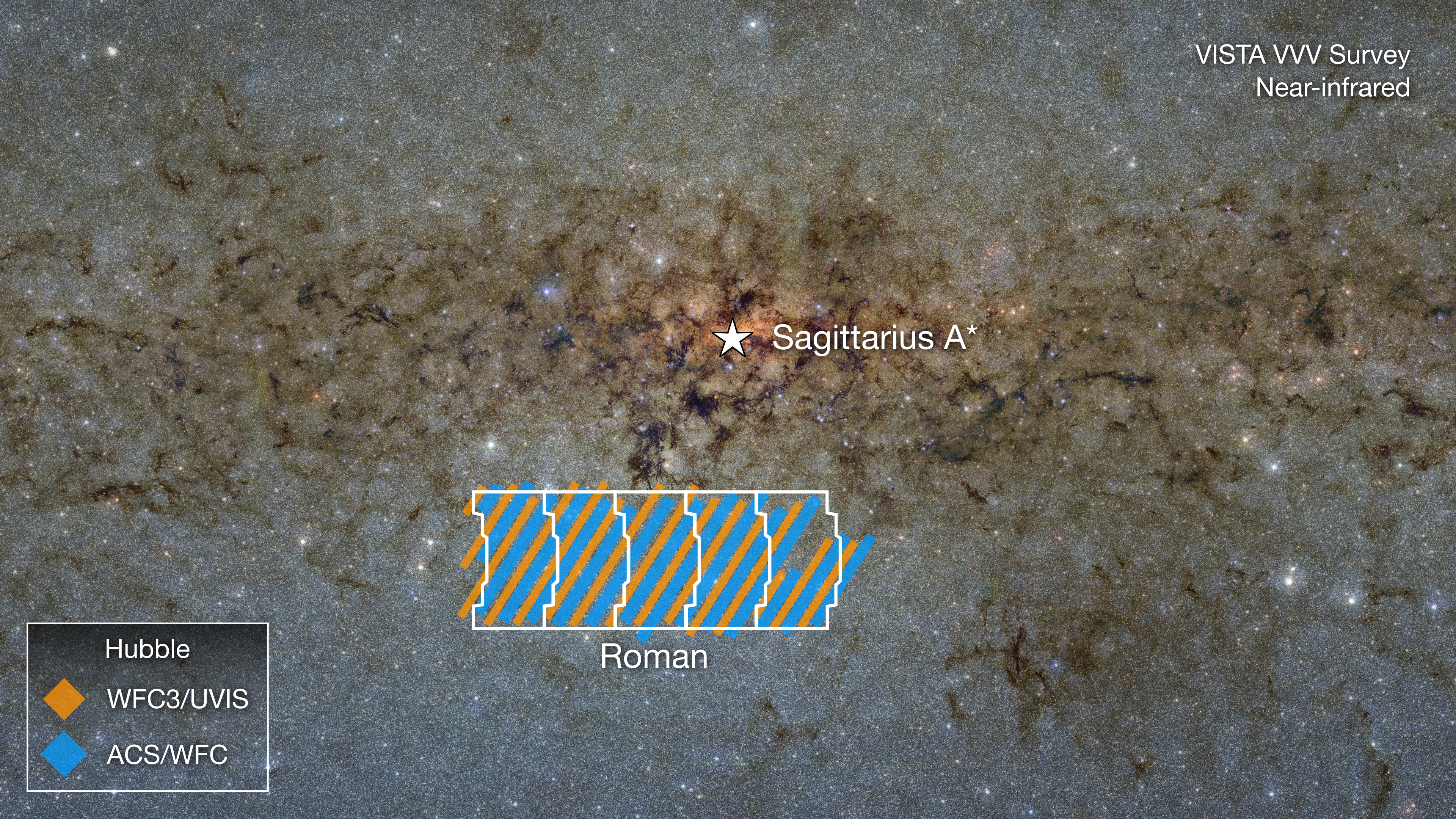
Roman is designed to watch wide swaths of sky repeatedly and quickly—capabilities that will let it monitor millions of bulge stars and, researchers expect, uncover thousands of new exoplanets. To ensure the flood of Roman data can be interpreted as cleanly as possible, astronomers have turned to Hubble for advance “baseline” measurements in many of the same bulge fields Roman will target. By comparing Hubble images taken months or years earlier with Roman’s time-series observations, scientists will be better positioned to separate overlapping sources and understand what Roman detects.
“A top priority of our Hubble survey is to cover as much sky area as possible,” said Sean Terry of the University of Maryland, College Park, and NASA’s Goddard Space Flight Center, who leads the project. The team’s work was reported in a paper published May 11, 2026, in The Astrophysical Journal. Roman’s launch is targeted for as soon as early September 2026.
A key reason the bulge is so scientifically rich is that it offers a testing ground for how planetary systems form and evolve. Many systems likely follow a path similar to the solar system’s: a gas cloud collapses, a star grows, and planets assemble in a surrounding disk. But gravitational upheavals can also fling planets into interstellar space. Roman’s bulge campaign is expected to spot hundreds of these “rogue planets.” The same observations should also reveal previously unseen isolated neutron stars—and even black holes with masses comparable to the Sun’s.
Roman’s core bulge program, the Galactic Bulge Time-Domain Survey, will be conducted across six observing seasons, each lasting 72 days. During each season, Roman will image the same fields every 12 minutes. The survey will cover about 1.7 square degrees of the bulge—roughly the sky area of 8.5 full moons.
Although Roman will detect many types of objects, the survey is built to capture microlensing events. Microlensing is a subtle form of gravitational lensing that occurs when a nearer object’s gravity bends and magnifies light from a more distant background source. Unlike the dramatic arcs produced by galaxies and galaxy clusters, microlensing plays out on the scale of individual stars. It can expose planets—sometimes even low-mass worlds—otherwise invisible to direct imaging.
“The great thing about microlensing is that we’ll be able to do a complete census of objects as small as Mars that are moving between us and these fields in the bulge, no matter what it is,” said co-author Jay Anderson of the Space Telescope Science Institute.
But microlensing also poses a practical challenge: in the bulge’s extreme crowding, light from a foreground “lens” and a background star can blur together, complicating efforts to determine which object is responsible for what the telescope records. That is where timing becomes crucial. If scientists can identify and measure the stars before a microlensing event, they can more readily disentangle them when Roman observes the transient brightening.
To provide that critical pre-event context, the team began a large Hubble survey in spring 2025, mapping much of the same bulge territory Roman will repeatedly scan. The program surpasses earlier Hubble bulge surveys—each about 0.5 square degrees—and even exceeds the effort behind Hubble’s famed Andromeda mosaic, which took more than a decade to complete. The overarching aim is straightforward: identify, in advance, the objects that will later participate in Roman’s microlensing discoveries.