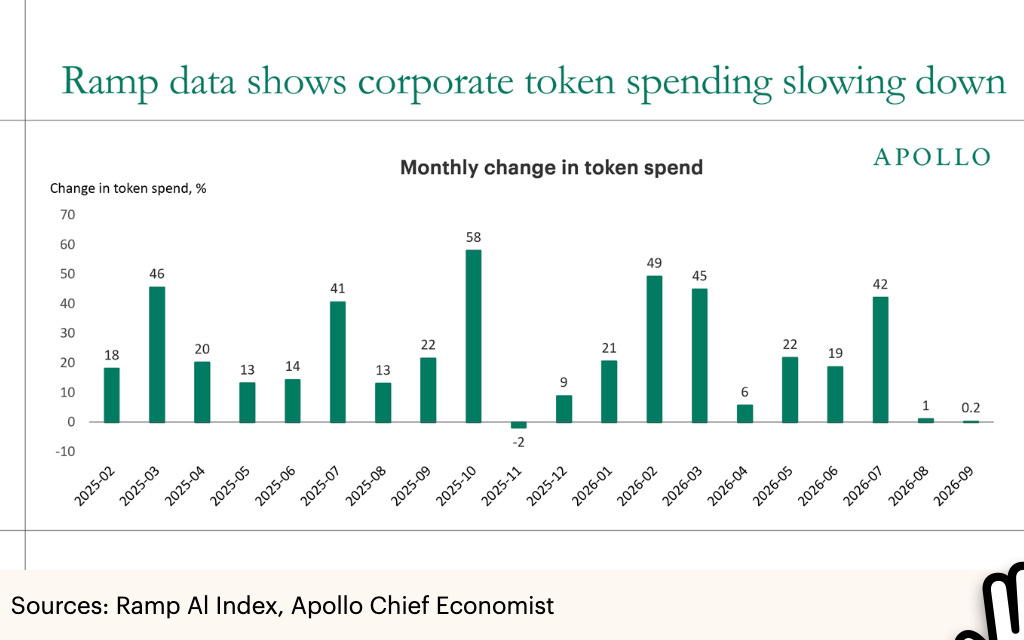
Transaction data from Ramp suggest AI token spending is cooling and highly price-sensitive, challenging assumptions of endless compute demand amid a data-center building boom.
Spending on AI “tokens” is showing signs of cooling, and a new set of transaction-based indicators is sharpening the debate over whether demand for compute can keep rising as fast as data-center buildouts.
One view is that the current pace of investment in AI infrastructure will only be sustainable if companies adopting AI see a dramatic jump in profits. Another explanation is less tidy: spending is being propelled not only by the hope of outsized gains, but also by competitive anxiety. For many firms, the fear is straightforward—if they fail to offer fast, reliable natural-language interfaces, a better-equipped rival could wedge itself between them and their customers, siphoning off relationships and margin. In that environment, “results” matter, but the pressure to act can arrive long before proof does.
The incentives span the entire ecosystem. Cloud hyperscalers have lucrative platform positions to defend. Leading AI labs such as Anthropic and OpenAI are racing to scale products that could become the default interface layer for consumers and businesses alike—and heavy spending on data-center access is also a way to reassure investors that growth is possible and revenues can follow. Meanwhile, many engineers want to experiment with cutting-edge tools, ideally financed by startup capital. And, as in other technology booms, there is a cohort of momentum-driven participants—people accustomed to “number goes up” narratives—who are less sensitive to near-term fundamentals.
Against that backdrop, a recent TechCrunch report noted that AI spend per employee at top firms slipped in August, raising the question of whether the decline was a seasonal lull or an early warning sign. Torsten Slok, drawing on Ramp’s AI tracking, argues the data point to a more structural constraint: compute demand appears “flat” and “highly price-sensitive,” such that even small token price changes can cause customers to cap usage or shift to cheaper open-source alternatives. Slok also points to stress on the supply side, noting that returns on invested capital for the five largest hyperscalers are falling because capital is being deployed faster than earnings are rising.
That combination—price-sensitive demand alongside weakening capital efficiency—undercuts claims that data-center demand is effectively limitless. The core economic test, Slok argues, is whether the marginal value users get from compute exceeds the marginal cost of providing it. So far, the broad-based financial payoff from AI for many firms “has been slow to materialize,” implying companies will only keep paying premium prices if they can translate that compute into meaningful top-line growth.
Much of this debate is now anchored to Ramp’s AI Index, built from Ramp’s corporate card and bill-pay transaction data. Ramp’s chief economist, Ara Kharazian, began compiling the index in early spring 2025; it now covers roughly 70,000 companies, and has gained wider visibility after being incorporated into the Federal Reserve Bank of St. Louis’s FRED database, including breakdowns by provider, industry, and customer size.
The dataset has important caveats: Ramp customers skew technology-forward; it misses free tools, personal accounts, and purchases routed through intermediaries not using Ramp; and spending is heavily concentrated, with 80% coming from the top 1% of Ramp customers. Still, it is one of the few large-scale windows into real-world AI purchasing.
Kharazian recommends watching not just dollars spent, but also usage volumes and prices. His October data show Anthropic charging an average of 0.00000048 for OpenAI—about two-thirds higher. At the peak of “Claude-Code” enthusiasm in March, prices averaged 0.0000007 for OpenAI, putting Anthropic at just under 1.5 times OpenAI’s rate. The implication: part of the slowdown in token-spend growth may reflect intensified pressure on Anthropic’s premium pricing.
Why it matters
Token spending is a direct, transaction-level signal of how much businesses are actually using generative AI—and how sensitive that usage is to price. If demand proves capped or easily substituted, it could reshape data-center investment plans, cloud-provider economics, and pricing strategies for AI model vendors. The next key question is whether measurable revenue gains from AI adoption arrive fast enough to justify continued high-cost compute at scale.