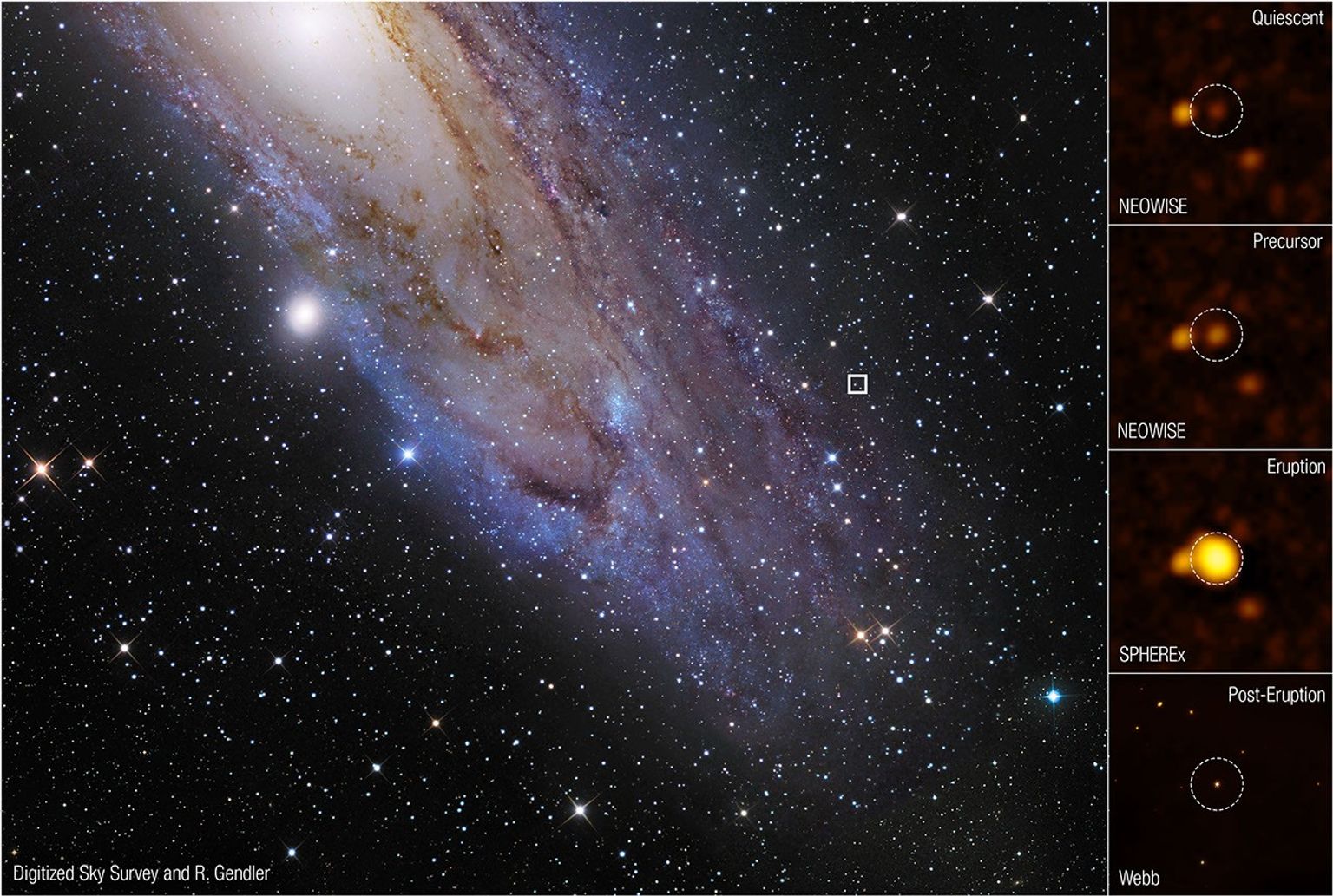
Astronomers report a rare stellar merger in Andromeda, where a Sun-sized star spiraled into a supergiant’s envelope and coalesced. Webb data confirmed the event’s rapid flare and aftermath.
Astronomers have captured what appears to be an unprecedented kind of stellar collision: a star slightly smaller than the Sun spiraling into the bloated atmosphere of a supergiant and ultimately merging with it in the outer reaches of the Andromeda galaxy. The team has dubbed the newly merged object “Bao,” and says rapid follow-up observations with NASA’s James Webb Space Telescope—combined with a broad archive of space- and ground-based data—sealed the case.
The work, funded by NASA and reported Wednesday in Nature, centers on a rare moment in stellar evolution that scientists almost never get to watch unfold. “Stellar mergers are very, very difficult to observe in real time because they are hard to predict,” said lead author Viraj Karambelkar, a NASA Hubble Fellow at Columbia University. The group first flagged the system in 2023 after noticing it behaving oddly, then kept tracking it. In 2025, the system flared dramatically. Webb observed the aftermath just 47 days after the outburst reached its peak—what the researchers describe as the earliest follow-up yet for an event of this type—allowing them to compare the system’s state before, during and shortly after the merger.
In the team’s reconstruction, the two stars spent thousands of years in a relatively stable binary orbit. The turning point came when the smaller companion began to graze the extended outer layers of the giant. From there, the timeline accelerated: the merger completed after only seven orbital cycles, corresponding to roughly seven years. That rapid plunge distinguishes Bao from previously documented mergers between more compact stars, where the final coalescence typically follows thousands of orbits.
The brightness change also surprised researchers. Co-author Nadia Blagorodnova of the University of Barcelona said the team had expected an outburst from such a distended star to unfold slowly. Instead, the object’s light output rose and reached its maximum in about a week.
The data reveal the characteristic prelude to a so-called common envelope episode, a dangerous phase that can determine whether a binary survives or collapses into one. As co-author Kishalay De, an assistant professor at Columbia University, explained, early interaction between the companion and the primary’s tenuous exterior produced a gentle, progressive brightening. With each orbit, the companion stripped additional gas from the primary’s envelope, and that material streamed outward into surrounding space. Eventually the larger star engulfed its partner; drag inside the shared envelope drained the companion’s orbital energy, driving it inward in a tightening spiral until the two became one.
Webb’s observations strongly support a merger, but the researchers note that common-envelope encounters do not always end that way. In some binaries, both stars emerge intact—albeit after ejecting substantial mass—and continue orbiting at close range. Such survivors can later evolve into pairs of neutron stars or black holes, explode as supernovae, generate gravitational waves, or produce millisecond pulsars.
To determine what happened in Bao, the team refined ongoing simulations and tested them against Webb’s mid-infrared measurements, which trace warm dust and provide a record of mass shed by the primary star over centuries. The best-fitting model indicates the primary—nicknamed “Big Bao”—was extreme even before the eruption: about seven times the Sun’s mass, roughly 350 times the Sun’s radius, and around 18,000 times more luminous. “It was an absolute beast of a star, completely outshining its companion in the data,” said Karel Temmink, a Ph.D. student at Radboud University who led the simulation work.
The same modeling also yielded the first estimate of the doomed companion’s properties. “Little Bao,” the team reports, was likely about 0.7 times the Sun’s mass, with a slightly smaller radius and dimmer output than our star.
Why it matters
Common-envelope evolution is thought to be a key gateway to many of the universe’s most energetic phenomena, yet it remains one of the least directly observed stages of binary evolution. By catching Bao quickly with Webb and anchoring models with infrared dust signatures, researchers gain rare constraints on how fast these events can unfold and how mass is expelled. The findings could sharpen predictions for which binaries become supernova progenitors or future gravitational-wave sources—and which instead end in swift, quiet mergers.