Engineers at NASA’s Langley Research Center in Hampton, Virginia, have completed a set of wind-tunnel trials that could expand how future aircraft are designed and validated.
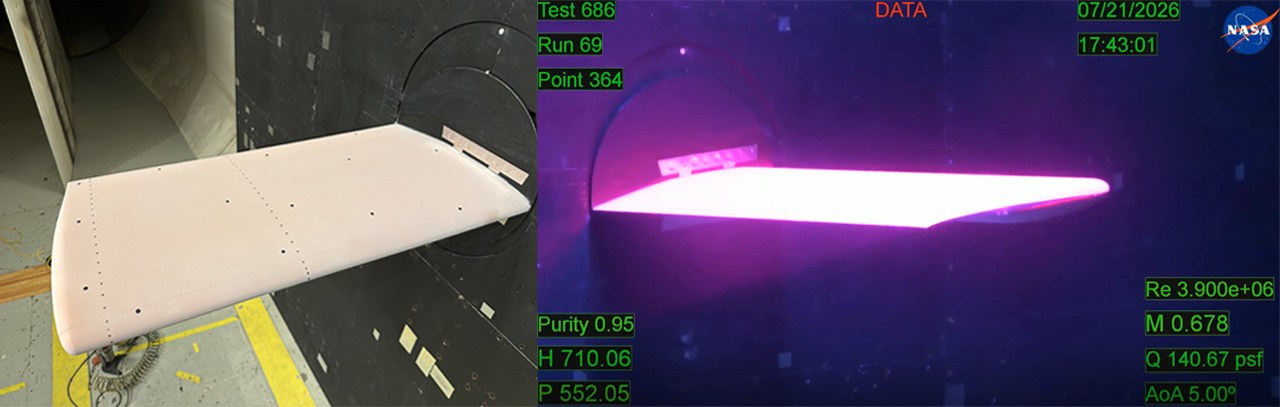
Engineers at NASA’s Langley Research Center in Hampton, Virginia, have completed a set of wind-tunnel trials that could expand how future aircraft are designed and validated. Inside Langley’s Transonic Dynamics Tunnel, researchers conducted the first tests there using unsteady Pressure Sensitive Paint to map airflow pressures over a widely used reference model called the Benchmark Supercritical Wing.
During the run, the wing appeared to glow in shades of pink and purple under ultraviolet illumination. That color change wasn’t for show: the coating is engineered to alter its brightness in response to the pressure applied by the moving air. High-speed cameras recorded the shifting light patterns across the wing surface, turning the paint’s optical response into detailed measurements that can be fed directly into aerodynamic analyses.
The experiment effectively paired two of NASA’s most valuable research assets. The Benchmark Supercritical Wing is part of a family of “benchmark” models that are not tied to any single aircraft program. Instead, they serve as standardized test articles that allow researchers to compare wind-tunnel measurements with computational results, helping to refine and validate computer simulations used across aeronautics. By applying unsteady Pressure Sensitive Paint to this benchmark configuration, the team gathered rich pressure data that can be used to improve how well computer models predict real-world aerodynamic behavior.
Pressure Sensitive Paint has been under development and evaluation for years as NASA teams worked to bring it from specialized demonstrations into routine wind-tunnel use for both aircraft and rockets. Unlike conventional sensors that provide data only at discrete locations, the paint offers a way to capture pressure variations over broad areas of a model, with time-resolved changes recorded by high-speed imaging. NASA researchers view that capability as increasingly important as designs become more complex and as simulation tools demand higher-quality experimental data for verification.
What made these trials especially notable was the scale and the test conditions. NASA said this marked the first time the technique had been applied to a large, freely moving model operating in a low-oxygen environment—an accomplishment enabled by the Transonic Dynamics Tunnel’s distinctive operating capabilities. Demonstrating that the paint, lighting, and high-speed imaging can work together under those conditions is an important step toward broader adoption.
The milestone also points toward what comes next. NASA expects the approach to support future wind-tunnel campaigns involving flexible aircraft models—design concepts intended to bend or adapt in flight to boost efficiency. With unsteady pressure measurements available across a moving, deforming surface, researchers can better understand how airflow, structural motion, and aerodynamic loads interact. Ultimately, the new capability is aimed at strengthening the link between wind-tunnel experiments and advanced simulations, providing a clearer path to designing and evaluating the next generation of flight technologies.