NASA and the Energy Department have signed a new agreement to fast-track nuclear power and propulsion for deep-space missions, covering fuel, testing, launch and safety.
NASA and the U.S. Department of Energy (DOE) are formalizing a broad new partnership aimed at speeding the arrival of next-generation nuclear power and propulsion for space missions—technology the agencies say could extend the reach and endurance of spacecraft as deep-space exploration accelerates.
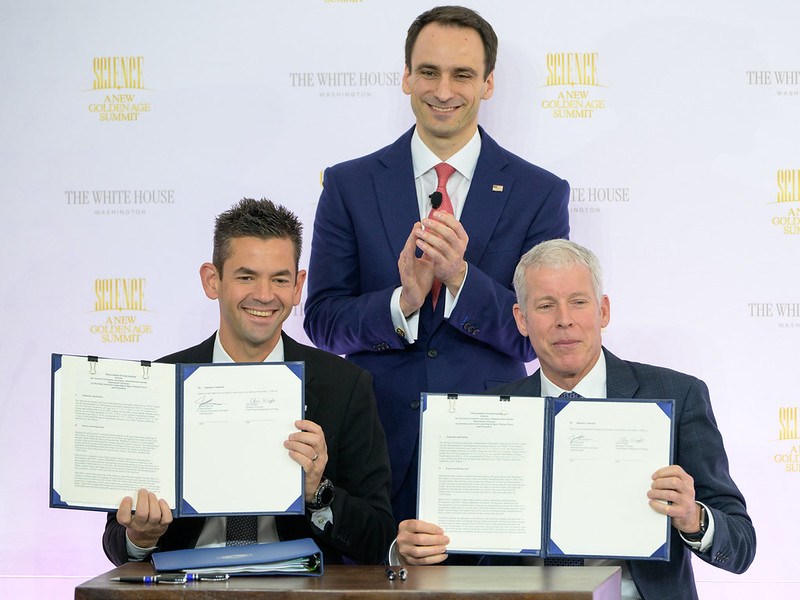
The agencies signed a new Memorandum of Understanding, titled “Accelerating American Leadership in Space Nuclear Power and Propulsion,” creating an end-to-end framework for collaboration across the entire lifecycle of space nuclear systems. That scope runs from advanced research and nuclear fuel production to ground testing, launch integration, and on-orbit operations. Safety, both agencies emphasized, sits at the center of the agreement’s structure.
NASA Administrator Jared Isaacman described the moment as the start of a “Nuclear NASA-era,” arguing that fission-based systems would allow missions to travel farther, last longer, and carry more capable instruments than today’s power sources typically allow. DOE Secretary Chris Wright tied the initiative to what he called a national “nuclear renaissance,” saying the department is positioning nuclear energy expertise to support future U.S. missions beyond Earth.
The signing occurred during the Golden Age Summit, hosted by the White House Office of Science and Technology Policy at the Donald J. Trump Institute of Peace in Washington. The agreement is set to take effect on Sunday, Nov. 1.
The MOU also aligns with federal direction issued in a December 2025 executive order on Ensuring American Space Superiority, which instructs NASA to produce a launch-ready lunar surface reactor by 2030. NASA and DOE say they are already progressing toward that target, building on existing work in both fission power systems and radioisotope power sources.
A key near-term milestone is the planned 2028 launch of Space Reactor‑1 (SR‑1) Freedom, which NASA says will move nuclear propulsion from laboratory development toward operational use in deep space. That step is intended to set the stage for Lunar Reactor‑1 (LR‑1), a fission surface power system designed to support a future Moon base through long periods of darkness and extreme shadowed conditions.
The agencies describe lunar nuclear power as a backbone capability for sustained operations: providing electricity for habitats, communications links, scientific instruments, rovers, in-situ resource use, and other infrastructure. They also argue that nuclear power will be difficult to replace for the high energy demands anticipated for eventual human missions to Mars. Together, SR‑1 and LR‑1 are framed as cornerstones of a domestic “nuclear-space” industrial base meant to support long-duration outposts, exploration of more distant destinations, and continued U.S. leadership in space technology.
Alongside fission efforts, NASA is expanding its use of radioisotope power systems—a separate class of nuclear technologies that generate heat and electricity from decaying radioactive materials. The agency’s Dragonfly mission to Saturn’s moon Titan, currently slated for 2028, will fly a car-sized rotorcraft powered by a Multi‑Mission Radioisotope Thermoelectric Generator and kept warm with 24 Light Weight Radioisotope Heater Units. Dragonfly is expected to travel between multiple Titan sites while investigating the moon’s potential habitability.
NASA and DOE also plan to support the European Space Agency’s Rosalind Franklin Mars rover by supplying 24 similar heater units to keep instruments within operating temperatures in Mars’s severe cold, aiding studies of possible past or present life on the planet.
Why it matters
Nuclear power could reshape how long spacecraft can operate and how far they can travel—especially in environments where sunlight is weak or intermittent, such as the Moon’s polar shadows or the outer solar system. The new NASA–DOE agreement aims to streamline everything from fuel production to flight operations, potentially accelerating timelines for lunar infrastructure and deep-space missions. Watch for progress toward SR‑1’s 2028 launch and whether the 2030 deadline for a lunar surface reactor remains achievable as safety reviews and testing requirements expand.