APODScienceAPODAPOD: 2026 November 22 –…Today’s APODArchiveSubmissionsIndexSearchCalendarRSSEducationAboutDiscuss APOD Astronomy Picture of the Day Discover the cosmos! Each day a different image or photograph of our fascinating universe is featured, along with a brief explanation written by a professional astronomer. Swirls and Colors on Jupiter from Juno Explanation: What creates the colors in Jupiter’s clouds? No one […]
What gives Jupiter’s clouds their striking palette of reds, browns, and creams remains an open scientific question. The giant planet’s upper atmosphere is dominated by hydrogen and helium—gases that are essentially colorless at the frigid temperatures near the cloud tops. That means the hues seen in telescopic views and spacecraft images must come from far rarer ingredients mixed into the atmosphere, and researchers are still working to identify exactly which trace compounds are responsible.
One leading suspect is ammonium hydrosulfide, a molecule thought to exist in small quantities within Jupiter’s cloud layers. Even so, the precise chemistry behind the planet’s varied coloration is not yet settled, and the search for the key coloring agents continues to be an active area of research.
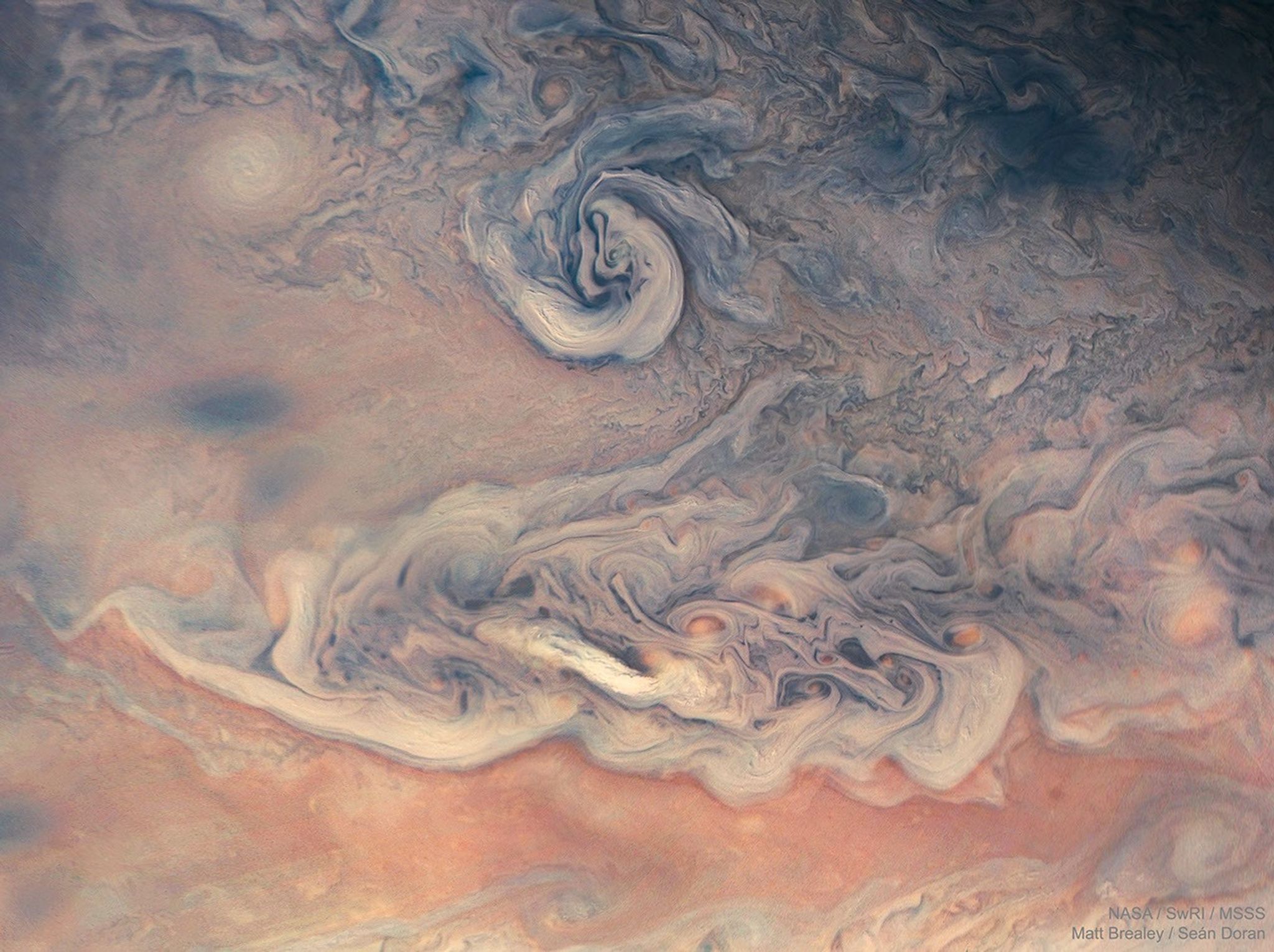
While the origins of the colors are uncertain, one pattern shows up consistently: bright cloud features tend to sit higher in the atmosphere than darker ones. A recently highlighted, color-enhanced view underscores that vertical layering. In the scene, pale clouds curl and twist around reddish-toned regions toward the lower right of the frame. Elsewhere—particularly toward the upper right—lighter material appears to spread across and partially obscure darker patches below, reinforcing the idea that the brighter clouds are elevated above deeper, dimmer layers.
The image was captured in 2018 by NASA’s Juno spacecraft during its 14th close approach to Jupiter. Juno has been studying the planet from a looping, elongated orbit that repeatedly carries it from far out into space down to a fast, close pass over the cloud tops. Roughly every 33 days, the spacecraft dives past Jupiter again, each time surveying a somewhat different slice of the planet as it continues its ongoing investigation of Jupiter’s atmosphere and weather systems.
Why it matters
Jupiter’s colors are more than eye-catching—they are clues to the planet’s atmospheric chemistry and the structure of its cloud layers. Understanding which trace molecules produce the hues could sharpen models of how giant-planet atmospheres circulate and evolve. With Juno continuing its regular close passes, scientists will be watching for additional high-resolution views that help link cloud color, altitude, and composition.