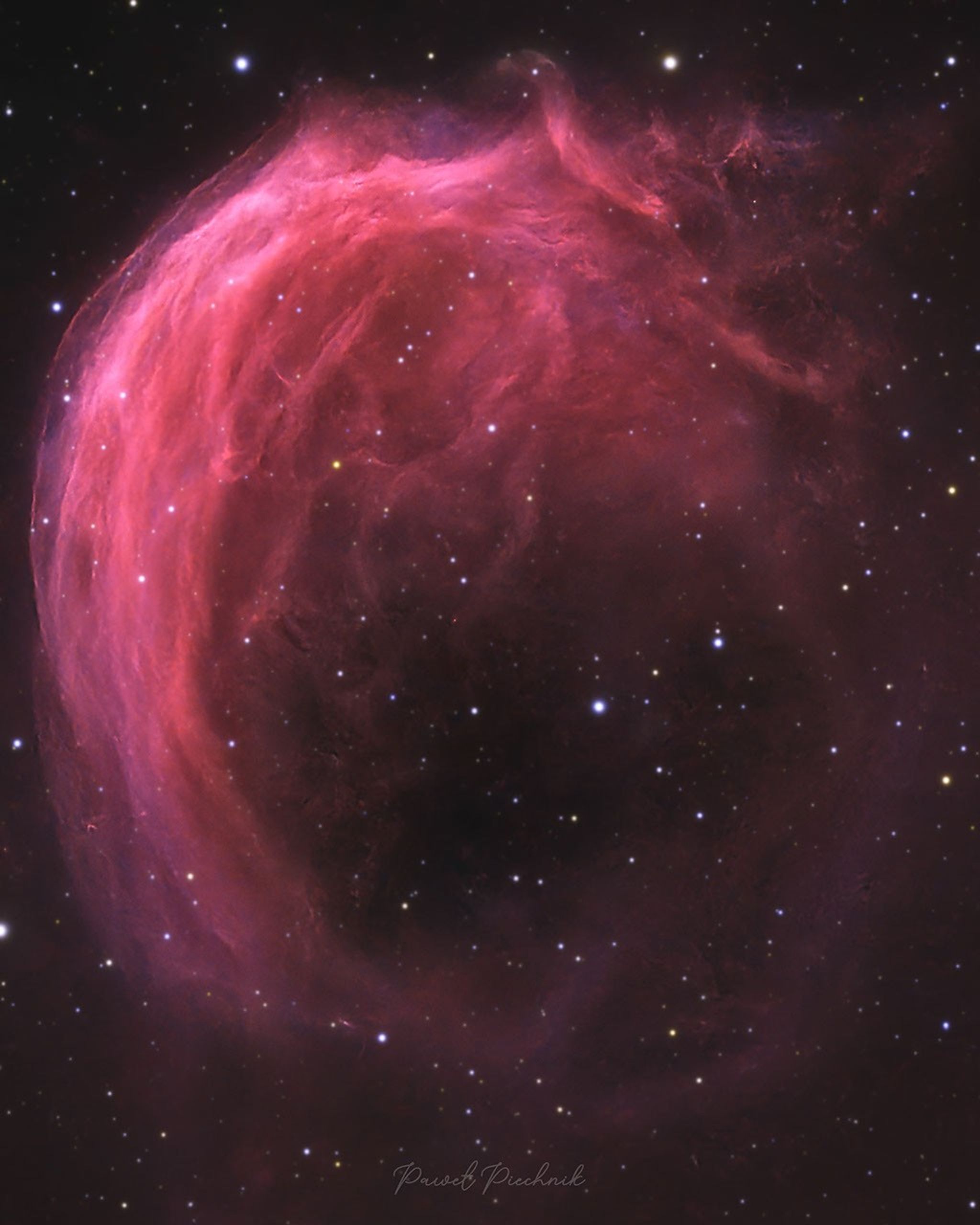
A new featured sky image spotlights Sh2-188, a vast planetary nebula nicknamed the Shrimp Nebula, and astronomers think its striking, curled appearance may be tied to motion—lots of it.
A new featured sky image spotlights Sh2-188, a vast planetary nebula nicknamed the Shrimp Nebula, and astronomers think its striking, curled appearance may be tied to motion—lots of it.
By apparent size, Sh2-188 ranks among the biggest planetary nebulae visible from Earth, stretching across roughly half the Moon’s diameter. Despite the “planetary” label, these objects have nothing to do with planets. They form late in the life of a Sun-like star, when the star expels its outer layers into space. What remains at the center is a dense, hot white dwarf—the stellar core left behind after the envelope has been shed.
In the case of Sh2-188, that central white dwarf is not sitting still. It is traveling through the interstellar medium at an unusually high speed, and the nebula is plowing through surrounding gas along with it. The result is a bow shock—an arc-shaped compression front—most prominent toward the upper left of the image. The effect is often compared to the wave that builds up ahead of a fast-moving boat: as the nebula’s material pushes into interstellar gas, the leading edge is squeezed and brightened.
That interaction helps explain more than just the bright rim. Although the Shrimp Nebula is faint overall, its glow is enhanced where the flow compresses gas at the front, giving the nebula a sharper, more defined boundary on the side facing its direction of travel. The broader swirl-like structure, meanwhile, remains the central mystery presented by the object—one that the nebula’s rapid motion makes especially plausible as a driver of its unusual shape.
The image was captured from Krakow, Poland, using a backyard telescope and narrowband filters sensitive to light emitted by hydrogen, sulfur, and oxygen—elements that trace different physical conditions in the nebula’s gas. After the data were collected, the colors were digitally balanced to closely resemble the nebula’s expected natural hues, producing a view that is both scientifically informative and visually vivid.
The daily astronomy image feature that published the Shrimp Nebula view also noted two updates for its community: the email address used for image submissions has changed, and the project’s primary NASA-hosted website has moved from apod.nasa.gov to science.nasa.gov/apod.