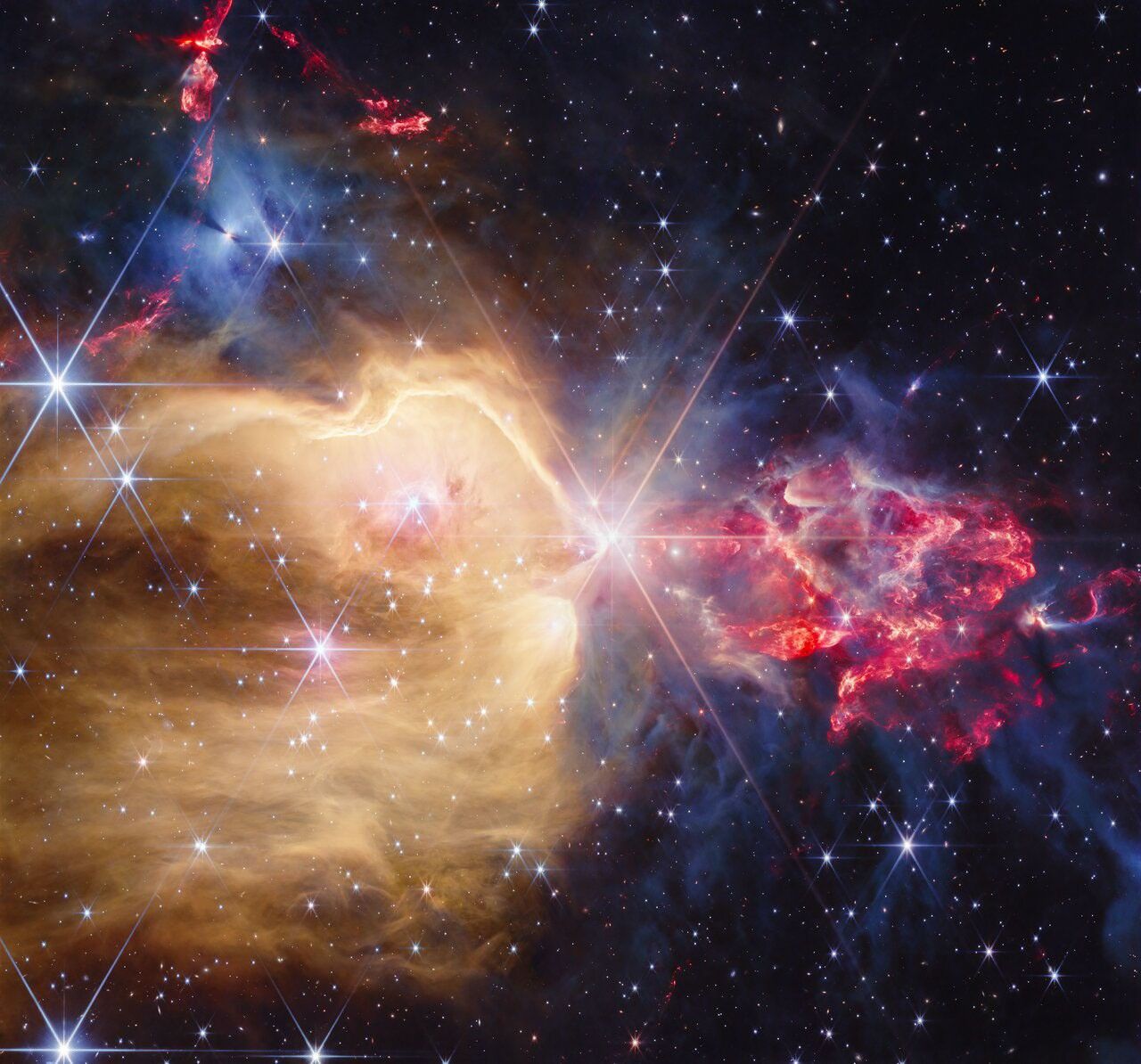
NASA is using the James Webb Space Telescope to study how stars are born, with a new infrared view of the dusty stellar nursery NGC 7129.
NASA is turning to the James Webb Space Telescope to probe one of astronomy’s most persistent questions: how stars are born. A new infrared view of the star-forming region NGC 7129 reveals a crowded, dynamic nursery where gravity, dust, and the violent outflows from young stars all shape what emerges.
At the heart of star formation is a simple process. Large reservoirs of gas begin to collapse under their own gravity, concentrating material until dense pockets can ignite into new stars. But the Webb image underscores that the “simple” picture doesn’t stay simple for long. As soon as stars begin to form, they start pushing back on their surroundings. Powerful winds and narrow jets launched by young stars can carve, compress, and stir the very clouds that produced them. In some cases—once massive stars evolve—explosions can further disrupt the region.
Webb observed NGC 7129 in infrared light, which is particularly useful in places like this because star-forming regions are rich in dust. Dust grains can arise in the cool outer layers of stars and later spread through space, where they absorb and block visible light. That makes optical images of stellar nurseries incomplete or misleading: the most active parts of the scene can be hidden behind dark veils. Infrared wavelengths, however, can penetrate much of this obscuring material, allowing astronomers to trace structures and pinpoint embedded young stars that would otherwise be difficult to see.
The new image shows numerous stars in the process of formation. It also reveals an apparent split in the region’s stellar population. On the left side, young stars sit amid a gold-toned cloud and are interpreted as being, on average, somewhat more advanced in their development. On the right, a redder zone hosts younger objects. The red gas is not smooth; instead, it appears streaked and threadlike. Those filaments are likely the signature of jets and stellar winds interacting with the surrounding material—sculpting the gas into elongated structures and indicating where energy and momentum are being injected into the cloud.
Astronomers prize scenes like NGC 7129 because they offer a snapshot of multiple phases of stellar development in one location. By comparing objects at different stages—still embedded in gas and dust, or already emerging from their birth cocoons—researchers can better determine which physical mechanisms dominate at each step. In particular, the interplay between gravitational collapse and feedback from newly formed stars remains a central problem: the same outflows that can slow or halt accretion may also trigger additional star formation by compressing nearby gas.
In short, Webb’s detailed infrared look at NGC 7129 turns a stellar nursery into a laboratory—one where the forces that build stars can be measured alongside the forces that threaten to tear their birthplace apart.
Why it matters
Understanding star formation is key to explaining how galaxies evolve and how environments capable of forming planets arise. Webb’s infrared capabilities are revealing young stars and dusty structures that visible-light telescopes often miss, refining models of how feedback from jets and winds shapes stellar nurseries. What to watch next is how follow-up studies use regions like NGC 7129 to quantify when outflows suppress star birth—and when they instead help spark the next generation.