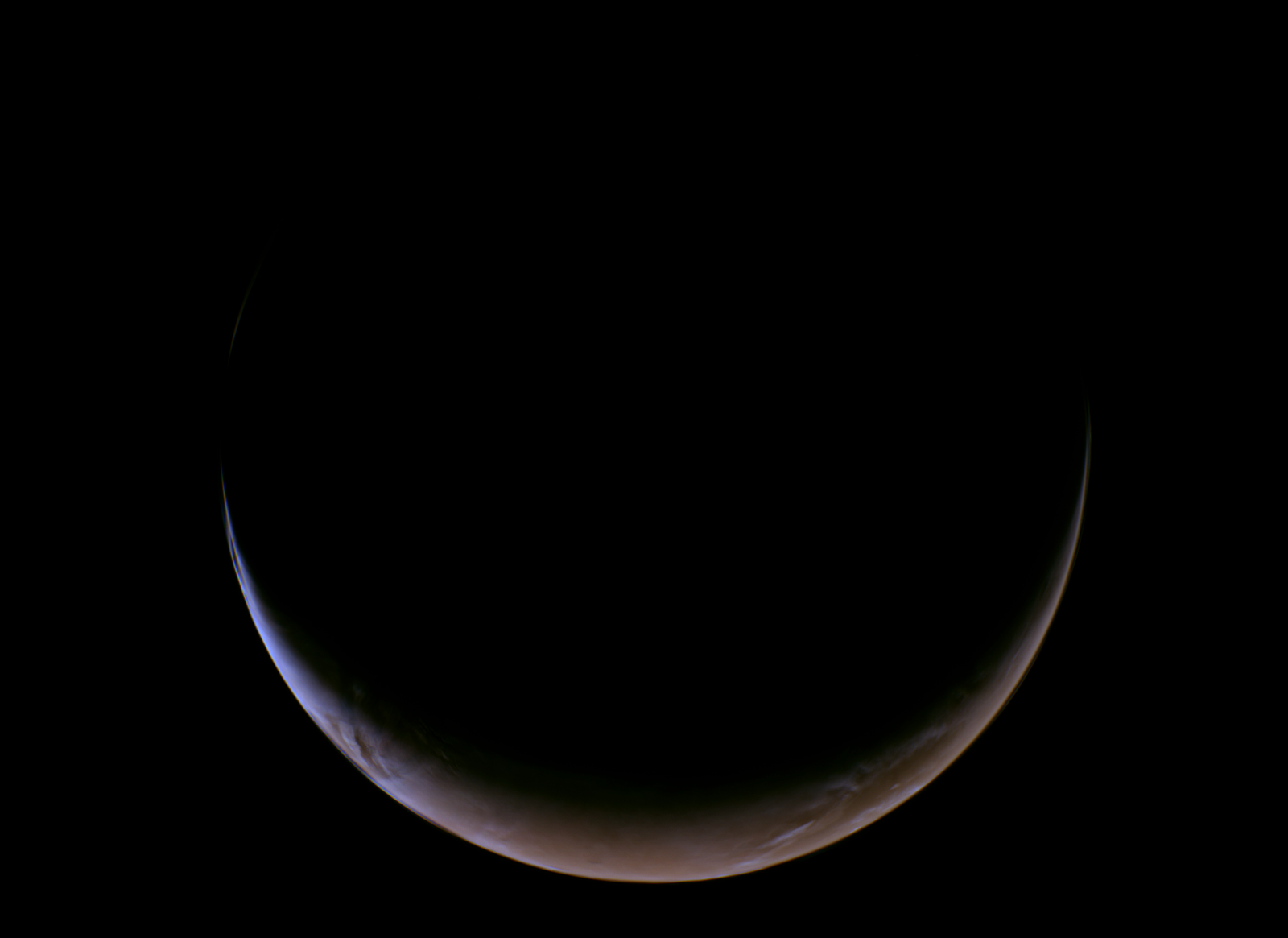
NASA’s Psyche spacecraft has returned a striking look at Mars as it closed in on the planet for a gravity-assist flyby, capturing the Red Planet as a delicate crescent in the early hours of May 15, 2026.
NASA’s Psyche spacecraft has returned a striking look at Mars as it closed in on the planet for a gravity-assist flyby, capturing the Red Planet as a delicate crescent in the early hours of May 15, 2026.
The image was taken at about 5:03 a.m. PDT as Psyche approached Mars from a geometry that left most of the planet in shadow. Coming in at a high phase angle—meaning the spacecraft, Mars, and the Sun were positioned so that Psyche saw the planet mostly backlit—Mars presented itself not as a familiar full disk, but as a narrow sliver illuminated by sunlight reflecting off the surface. In the days leading up to the closest approach, this crescent view persisted as Psyche’s vantage point kept the sunlit portion confined to the planet’s edge.
This particular frame marked a milestone in the encounter: it was the final moment Psyche’s camera could still fit the entire Martian globe within its field of view. Soon after, the planet grew so large in the instrument’s perspective that it began to spill beyond the camera’s frame as the spacecraft continued inbound.
Psyche recorded the view using its multispectral imager, a camera system designed to observe targets through multiple filters so scientists can compare brightness and color across different wavelengths. The shot was acquired specifically with Imager A, one of the instrument’s two imagers. Engineers and scientists then processed the data into a natural-color composite, combining information from red, green, and blue filters to approximate how Mars would appear to the human eye.
The flyby also delivered an unexpected atmospheric lesson. In Psyche’s multispectral observations, the crescent appeared brighter and wrapped farther around the planet’s edge than scientists had predicted. The reason lies in Mars’ pervasive dust: sunlight doesn’t simply reflect off the ground and stop. Instead, it is strongly scattered by the fine particles suspended in the Martian atmosphere, allowing light to “bleed” around the limb and brighten the crescent more than anticipated from surface reflection alone.
Gravity assists are a standard tool in interplanetary navigation, using a planet’s gravitational pull to reshape a spacecraft’s trajectory while conserving onboard propellant. For Psyche, the Mars encounter is a key step on its longer journey, and the images provide both a navigational milestone and a scientifically informative look at how dust in the Martian atmosphere redirects sunlight under extreme viewing angles.
More information about NASA’s Psyche mission is available through NASA’s mission resources.